
A recent press article notes a disturbing Tribunal decision: ‘Humiliated’: Trans worker awarded $35,000 in landmark ‘dead-name’ ruling (The Australian; 17 Sept 2026; paywalled). It is a case worthy of comment here because a casual reading might suggest that merely calling a trans person by a former name, of its own would amount to unlawful discrimination. That is not what the case holds. However, as will be seen, what the case does hold in fact seems to be wrong.
In short, an employee of the Northern NSW Local Health District (part of the NSW Health Service) applied for an internal transfer to a new role, and following the standard system of employee checks, the employee was asked to confirm any previous names. The employee, “HGY”, had to reveal that they had been born with classically female names and now bore classically male names. This distressed them, because the person making the enquiry was known to them, and would be part of the panel conducting the interview. This, HGY said, led to fear that once their former names were known, they would be “outed” as transgender and potentially suffer harassment and discrimination.
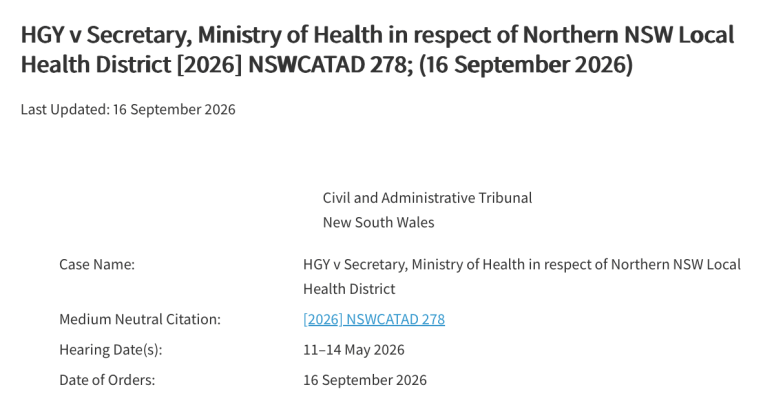
The NSW Civil and Administrative Tribunal (NCAT) ruled in HGY v Secretary, Ministry of Health in respect of Northern NSW Local Health District [2026] NSWCATAD 278 (16 September 2026) that the Department was guilty of “indirect gender identity discrimination”, and ordered that they pay HGY $35,000. Here I will aim to explain what was, and was not, decided, and why in my view the decision was incorrect.
As mentioned previously, the incident of discrimination was alleged to be the conversation with another staff member, outlined at para [14]:
“The applicant is transgender. On 1 June 2023, while at work, he received an unexpected phone call from a colleague, a Support Services Officer, to confirm his previous name as part of security checks for recruitment to the Specialist Child Support Program Coordinator role. This was his birth name and quite clearly identified him as a transgender person.”
To be clear, nothing the SSO said indicated any concern about HGY’s gender identity, nor was there any evidence of any detrimental treatment or statements made subsequent to the phone call. Indeed, the Health Service had policies which made it clear that staff should not detrimentally treat others on this basis. But HGY claimed that having to answer this question led to the following consequences:
[9]… Because of it, he says he holds significant fear that he will be discriminated against and “outed” against his will, to those with whom he will work in any further role for which he applies. Despite being an early career social worker, this fear prevents him, he says, from applying for any other employment in the NSW Health Service again.
The Health Service defended the claim by noting that they had rigorous checking policies in place due to their duty to care for children and others, and that the question was asked as a part of that process. They conceded that HGY had indeed already provided information about their former names to a central database, but noted that not all managers had access to that database, and that the process of double-checking names was an important cross-check. (To be clear, checking former names would allow records of criminal offenders to be checked before a staff member was employed. Of course there was no suggestion that HGY fell into this category; but the check was carried out for all employment decisions.)
1. The legal basis for the claim
The claim against the Health Service was made under s 38B of the Anti-Discrimination Act 1987 (NSW) (“ADA”), which prohibits “transgender discrimination.” It was a claim, not of “direct” discrimination, but of “indirect” discrimination, as set out in s 38B(2):
38B WHAT CONSTITUTES DISCRIMINATION ON TRANSGENDER GROUNDS
(1) A person (“the perpetrator”) discriminates against another person (“the aggrieved person”) on transgender grounds if the perpetrator– …
(b) requires the aggrieved person to comply with a requirement or condition with which a substantially higher proportion of persons who are not transgender persons… comply or are able to comply, being a requirement which is not reasonable having regard to the circumstances of the case and with which the aggrieved person does not or is not able to comply.
The discrimination was not “direct” – all applicants for jobs were asked the same question. But the claim was that imposing a “requirement” to disclose past names to potential colleagues, was something that would cause no problems for non-transgender persons, but would be something that the applicant would not be able to comply with, and which is not “reasonable”.
Without going into all the details, the Tribunal (P Roney KC, Senior Member and M Maher, General Member) ruled that this requirement was (1) something with which a substantially higher proportion of non-transgender persons could comply, as compared to transgender persons; (2) something that HGY was not able to comply with; and (3) was not reasonable. With respect, those findings may be doubted.
First, there is no doubt that a requirement to disclose past names may be distressing to some extent to a number of persons who are not transgender. Women who have changed their names to avoid domestic violence are one such group. Others will have other reasons for changing names, some of them of course not distressing (such as simply changing a surname after marriage), others raising sensitive issues (perhaps fleeing abusive family situations generally). There was no empirical evidence presented as to the number of people in these different circumstances.
Second, even if we concede that this type of requirement impacts more heavily on transgender folk, why is it the case that HGY could “not comply” with the requirement? The Tribunal does discuss this issue, and notes that “not able to comply” can refer to an inability created by personal circumstances rather than physical factors. But it will clearly be a judgment call as to when discomfort caused by a requirement crosses over into inability. It is not as if the requirement was an order to dress in a way reflecting one’s biological sex, for example. The “distress” was based on a fear that a senior manager, known to be committed generally to policies of non-discrimination and privacy, might draw a conclusion from the information and then share that with others to allow harassment or humiliation. There is much to be said for the view that this was not a very likely outcome.
Thirdly, was it “reasonable” of the organisation to have this double-checking policy for new appointments? With respect to the Tribunal, this is the weakest point of the decision. Surely by now we have learned that in respect of persons who are working with children, we need to take all reasonable precautions to see that they do not have a history of child abuse or other problems. Knowing the full history of the applicant’s names is a key part of the checks. What has to be put in the balance here is the possible concern created for a prospective employee about misuse of the information by a senior officer, against the massive change that would be required to checking processes if those on the ground are not allowed to ask this question.
The Tribunal from [188] makes much of some evidence given by a senior manager, Ms T, who had previously said that changing the checking process would be expensive and difficult, but under cross-examination conceded that it could be done. In effect the Tribunal took it on itself to offer opinions about the possible cost of a new checking process and concluded it would be manageable.
Again, this seems problematic. Arguably the Tribunal does not have the expertise to redefine administrative processes in this sensitive area, simply on the basis of a concession from one senior manager. It seems likely that the outcome of this case will be that time and money would have to be spent on redesigning a checking procedure which seems to have been functioning well, and in the process opening up gaps where proper checks might be not conducted. All of this, then, is based on a perception of possible future discrimination of which there was no actual evidence.
Following the finding that there had been unlawful indirect discrimination, the Tribunal then awarded substantial damages of $35,000 against the Health Service. Of this, $25,000 was compensation for non-economic loss (somewhat oddly at [239] called “non- monetary compensation”- it was certainly monetary!). Another $10,000 was awarded by way of “aggravated damages” taking into account some aspects of the way the litigation had been conducted. I make no detailed comment on these matters except to say that, stepping back from the case, it seems hard to understand how this award (for a brief and innocently motivated conversation) can exceed the damages of $20,000 awarded by the Full Federal Court in Giggle for Girls Pty Ltd v Tickle [2026] FCAFC 64 (15 May 2026) for the deliberate exclusion of Tickle from joining a female-only app. (To be clear, I think that Giggle v Tickle was wrongly decided- see here, but if it is accepted to be correct the behaviour sanctioned seems objectively far more serious than that in this case.)
2. What the decision holds
The decision as it stands (unless it is appealed) means that it can amount to indirect transgender discrimination to ask someone to provide information which may reveal that they identify as a sex opposite to that in which they were born. Whether it does amount to such will very much depend on whether the request for information was part of a reasonable system serving worthwhile purposes. The strongest part of the applicant’s case here was that the information had previously been provided to a general database and so was actually already available (though arguably not under current access rules.)
3. What the decision does not hold
Given the limits of the above findings, it is important not to mis-state the effect of the decision.
- It does not mean that using someone’s former name (their “deadname” as it is sometimes called) will automatically be either discrimination or vilification. On the facts of this case, the applicant’s former name was not in fact used or shared with anyone inappropriate. Indeed, it would seem likely that initiating this litigation would have had the result (anonymisation notwithstanding) that the applicant’s identity as transgender would probably have become known to many more colleagues in the Department than previously was the case (an example of the so-called “Streisand Effect”.)
- The decision does not mean that the applicant had to be treated as a male while still biologically a female. That is not part of the reason for the decision.
In short, the decision has a very limited scope. It should not be used to argue that a transgender person’s former names can never be used (and it says nothing about use of third person pronouns to refer to a person.) To link to the law and religion area, if a church or other religious organisation had a checking process of the sort used here, it seems likely that it would not be in breach of s 38B. That is because s 56 of the ADA provides for such bodies to be able to act in accordance with their beliefs. Section 56 provides:
56 RELIGIOUS BODIES
Nothing in this Act affects–
(a) the ordination or appointment of priests, ministers of religion or members of any religious order,
(b) the training or education of persons seeking ordination or appointment as priests, ministers of religion or members of a religious order,
(c) the appointment of any other person in any capacity by a body established to propagate religion, or
(d) any other act or practice of a body established to propagate religion that conforms to the doctrines of that religion or is necessary to avoid injury to the religious susceptibilities of the adherents of that religion.
If a church, say, were considering appointing a female youth worker, and asked questions of an applicant about their former names, they would probably be exempted from breaching s 38B under s 56. This would be either because this would involve the appointment of someone in the “capacity” of female youth worker- para 56(c), or because questions about name changes which revealed someone who now identified as a member of the opposite sex to that in which they were born, would be important to conform to the doctrines of the church that a person’s sex is appointed by God and cannot change- para 56(d).
In general, however, there must be a real doubt as to whether this decision in HGY is correct. Simply asking questions about former names as part of a careful screening process to protect children (by allowing databases of offenders to be properly searched), seems eminently reasonable. It feels wrong to allow the fear of an unlikely revelation by a senior manager, to require a wholesale overhaul of systems and undermine the checks needed for child safety.

