
Football and “transgender vilification”- the Kirralie Smith cases

I have written previously about litigation involving Kirralie Smith stemming from her comments about a biological male playing in a womens’ football team. In that post I noted the decision in the NSW Civil and Administrative Tribunal (“NCAT”) in Blanch v Smith [2024] NSWCATAD 20 (22 January 2024). Ms Smith is part of an advocacy organisation, Binary Australia Ltd, which advocates for sex-based rights, especially for women, and sometimes posts about transgender males who have been allowed to compete in women’s sport. Stephanie Blanch was mentioned on the website of Binary and elsewhere online in this context, and then claimed that this amounted to “transgender vilification” under sections 38S(1)(a) and 52 of the NSW Anti-Discrimination Act 1975 (“ADA”). As the judge in the liability proceedings noted below commented at para [3]:

the Plaintiff is a transgender woman. She was born a male and has lived solely as a woman since 2016.

Ms Smith’s case was then transferred for constitutional reasons to the Local Court, where she was subsequently found to have been guilty of vilification. Most recently, in a decision involving Blanch and also in a case mounted by Riley Dennis, Ms Smith was fined and found to be liable for costs. In my view all of these four recent decisions were wrong, and I hope will be overturned on appeal.
Continue reading

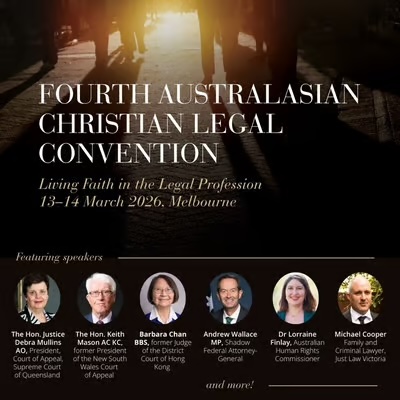
Australian Christian Legal Convention 2026

Christian lawyers and others connected to the legal profession will be gathering in Melbourne on 13-14 March 2026 for the Fourth Australian Christian Legal Convention. I hope to join them, and would love to see lots of others come along! There are special rates for Uni students; early bird registration is available till Jan 31. You can watch a video about the event here .

Unfair Gig Economy? Unexpected Generosity – Newcastle City Legal Breakfast event

You may have come across some shocking examples of worker exploitation in Australia’s “gig economy”, but you’ve probably never heard of an employer’s unexpected generosity causing resentment amongst their workers. Come along to Newcastle City Legal on Wed 3 Dec to hear Dave Moore reflect on how Jesus’ picture of the promised Kingdom of Heaven turns our expectations upside down!

If you are in or around Newcastle, join us at our next Newcastle City Legal event. This will be a breakfast seminar, run by the Newcastle Christian Lawyers Fellowship, in partnership with “City Legal”, Wednesday 3 December, 7:30 am- 8:30 am, in room X703, Nuspace Building, University of Newcastle, Cnr Hunter St and Auckland St, Newcastle. More details and registration here. Charge is $5 (and free coffee), or $10 for pastries with coffee. Everyone is welcome to come: lawyers, law students, or those just interested in the intersections between law and the Bible!

Aged Care, VAD, Religious Freedom and s 109

Should a religious aged care provider be able to operate in accordance with its religious convictions? This issue is being debated in NSW at the moment in the context of the law allowing “voluntary assisted dying”. The Voluntary Assisted Dying Act 2022 (NSW) allows persons with a terminal illness to choose death, which can be self-administered or administered by a health professional. Many health professionals have religious convictions which mean that they find the procedures for persons to choose death morally unacceptable. They do not wish to be involved in the process.

Under the legislation there is a right for individual health professionals to conscientiously object to the procedures, and to decline to be involved: see sections 9, 21 and 32. Faith-based hospitals may also decline to be involved in VAD procedures. However, at the moment faith-based aged care facilities are obliged to allow medical practitioners onto their premises to administer VAD.

A Private Member’s Bill has been introduced into the NSW Parliament which will amend the Act to allow faith-based residential aged care facilities the same choice as that available to faith-based hospitals, to decline to be involved in VAD or to decline to allow VAD to be administered on their premises. The Voluntary Assisted Dying Amendment (Residential Facilities) Bill 2025 is due to be debated soon.

In this comment, rather than deal with other policy issues as such, I want to address the claim that has been put forward that these amendments would be inoperative because they would bring about a clash with Commonwealth law. A legal opinion has been made available, prepared by Arthur Moses SC and Dr Patrick Keyzer, which asserts that the amending Act would be invalid due to the operation of s 109 of the Commonwealth Constitution (“the VAD Opinion”). In my view this is not correct. Whatever other reasons there may be for opposing the amending Bill, s 109 does not provide a good reason to do so.

Continue reading

Australian Journal of Law and Religion- vol 6

The latest volume of the Australian Journal of Law and Religion has been published (and is freely available online here.) The Table of Contents is below- always worth reading!

ContentsVolume 6, 2025

Editorial                                                                                                                                  i

Articles

Modelling the Anchor and Range of State-Religion Relationships in Australia and Italy: Towards a New Understanding of State-Religion Typologies Renae Barker & Tania Pagotto                      1

Skilful Navigators or Guerrilla Subversives? Accommodating Colleges of Islamic Higher Education in the West Salim Farrar                           27

Maximising or Determining Rights? On Using (and Discarding) Statutory Exceptions Joel Harrison                          50

A Legal Education ‘Born From the Heart of the Church’: Reflections of a Catholic Law School Dean Michael Quinlan                     66

Comments

Australia’s Culture of Death: Rejecting the ‘Sanctity of Life’ Principle Gabriël Moens                        80

The Australian Catholic University and Challenges after the 7 October Hamas Massacre Suzanne D. Rutland                87

Book Reviews

Religious Liberty in a Polarized Age by Thomas C. Berg  Jeremy Patrick                        89

The Crisis of Civil Law: What the Bible Teaches about Law and What It Means Today by Benjamin B. Saunders David VanDrunen                   92

Pronouns, employment and religious schools

Recent press reports (such as this one from the Guardian) say that an employed teacher at a Victorian Roman Catholic school has taken action against the school for “gender identity” discrimination. The school apparently has refused to allow the teacher, Myka Sanders, who identifies as “non-binary”, to use “Mx” as a title (instead of the usual “Mr”). The school has referred to the teacher as “he” rather than using “they” as a preferred pronoun.

The complication in the action is that it seems that the school, Sacred Heart Girls College in Oakleigh, Melbourne, run by Melbourne Archdiocese Catholic Schools (MACS), has raised the fact that the Commonwealth law on this issue of “gender identity discrimination”, would allow the school to operate in accordance with its religious ethos and affirm their view that there are only 2 genders (corresponding to biological sex). So the case has the potential to require the courts hearing the matter to address the question (not so far resolved) whether an organisation can rely on a religious freedom right granted by Commonwealth law, if that right is not recognised by State law. I will explain here why I think this argument made by MACS is correct and any action against the school should fail.

Continue reading

Recent cases on transgender vilification

I am presenting some material on vilification laws, and this paper deals with some recent cases on “transgender vilification”: Blanch v Smith (Local Court of NSW; 26 Aug 2025) and Dennis v Smith (Local Court of NSW, 26 Aug 2025). The paper can be downloaded below. It supplements material presented in a previous paper linked here.

Religious Liberty conference at Uni of Notre Dame, Sydney

 The University of Notre Dame Australia School of Law and Business will hold its 11th Annual Religious Liberty Lecture on Thursday 11th September 2025 – 5:30pm for 6pm, at St Benedict’s Hall, 104 Broadway, Chippendale, Sydney. A full day Annual Religious Liberty Conference will follow on Friday 12th September 2025 from 9am. 

More details and registration information can be seen in this flyer:

While the official RSVP date has passed, the organisers assure me they would still welcome registrations! I will be speaking on the vilification and hate speech issues, and there will be a number of other important papers presented on the day.

Freedom for Faith conference

Freedom for Faith is holding its annual conference on religious freedom and the law on September 27th, and is offering a student ticket discount. There is a great line-up of speakers- do come along!

The conference will be held on Saturday September 27th, 10am-3:30pm, at Village Church Annandale (Sydney) and the Student price: is $45 .

Speakers include Prof Patrick Parkinson and Ass Prof Alex Deagon – both of whom will be launching books – as well as Monica Doumit, the head of public affairs for the Catholic Archdiocese of Sydney. 

There will also be a conversation between Julian Leeser MP, the Federal Liberal Member for Berowra and Shadow Attorney General, and Dr Hugh McDermott, the NSW Labor Member for Prospect and Parliamentary Secretary (Assistant Minister) to the NSW Attorney General. 

Ticket includes lunch and unlimited coffee from the in-house coffee cart.

More information and tickets at: https://fff.org.au/f25 .

The Snail in the Bottle and the Good Samaritan

As mentioned recently, I was invited to address a group of Christian lawyers and law students on a key tort case, the famous “snail in the bottle” case of Donoghue v Stevenson [1932] AC 562, and its connections to the Biblical parable of the Good Samaritan. The paper I presented can be downloaded here:

One further comment: in the second half of the paper I address the question that Jesus was asked before telling the story of the Good Samaritan: “What must I do to inherit eternal life”? I was interested to see that the President of the United States seemed to be addressing this question recently in terms of a hope for heaven. For those interested in the answer to the question, I recommend not only my paper, but also this excellent recent comment by my friend Murray Campbell: “Will Donald Trump be welcomed into heaven?” (22 Aug 2025). Spoiler alert: President Trump may have the wrong approach! But Jesus can provide the answer.