Same sex marriage: referendum or plebiscite?

The debate on same sex marriage in Australia has changed dramatically in recent days. The current Liberal and National Party Coalition Government went into the last Federal election promising to maintain the definition of marriage as between a man and a woman. Subsequently some members of the Liberal Party indicated that they were personally in favour of recognising same sex marriage. (As previously noted here, in Australia at the moment it is clear that change in this area will have to come from the Federal Parliament in some way, as the High Court of Australia has made it clear that States and Territories cannot over-ride the Federal law on the matter, and that court is not at all likely to find an “implied constitutional right” to same sex marriage as was done recently by the US Supreme Court in the Obergefell decision.)

In response to pressure from the members of his own party, the Prime Minister, Tony Abbott, who has long signalled his desire to maintain traditional marriage, called a meeting of the party room to discuss whether or not members of the Coalition should be given a “conscience vote” on the issue. (In the Australian version of the Westminster system, party members almost always vote with their party on legislation in Parliament. Conscience votes, where members are free to express their own view without facing party censure in any way, are rare, and mostly reserved for the traditionally difficult “life or death” issues such as abortion and euthanasia. On the other side of politics, the opposition Australian Labor Party currently has a policy allowing its Parliamentary members such a vote on this issue; but at its most recent annual conference, it put in place a policy which means that support for same sex marriage will be a platform of the party from 2019, and at that point any ALP member of Parliament who disagrees will have to resign from the party.)

The result of the recent Coalition party meeting was that, by a 2/3 majority, the meeting voted to maintain support for traditional marriage as formal part of party policy. This means that, in theory, an individual Coalition MP or Senator could choose to “cross the floor” to support same sex marriage, but if they did so they would be unlikely to receive further advancement within the Government. In addition, members of the Cabinet are now bound to support traditional marriage, and if they wish to depart from that policy will have to resign their posts as Cabinet ministers.

Following the meeting, however, the Prime Minister announced that, at some stage in the future, the Coalition would undertake to hold a broad public vote to determine the extent of support for change in the Australian community. Some matters are still unclear, however. The timing of such a vote is uncertain: would it be prior to the next Federal election? Held at the same time? Following the election? In particular, there is ongoing debate over the legal form such a vote would take. The main choices seem to be between a referendum and a “plebiscite”.

There are important differences between these two options. A referendum is the means by which the Australian Constitution is amended, under s 128. (As this excellent review piece by electoral commentator Anthony Green notes, the word “referendum” is not used in the Constitution, but the word, in the Federal sphere at least, has come to be applied to the s 128 process). Procedures for setting and arguing a referendum question are reasonably clear. Such a vote could only be successful if supported by a “double majority”: an absolute majority of the voters, and also by a majority of voters in a majority of States. On the other hand, a plebiscite is a more generic term which simply refers to a vote on an issue, which presumably (unless Parliament decided otherwise) would simply require a majority of voters to approve it. Anthony Green notes that historically there have been only three plebiscites held in Australia, two during World War I about conscription, and one to vote on a new national anthem.

What are the relevant issues needing to be resolved to choose between these options, should they proceed? (It should be said that the ALP has indicated that, if they are returned at the next election, they will immediately put the matter to the Parliament. So there may not need to be such a vote in that case. On the other hand, if this happens before 2019, and given that there are some ALP members of Parliament who are known to support traditional marriage, the proposal might once again not succeed. In which case the national vote might come back onto the agenda!)

Jeremy Gans in a brilliant piece in the “Opinions on High” blog from Melbourne Law School does a great job of summarising the options. Which one is preferred by any particular commentator will be partly affected by their view on the best outcome.

Referendum

There are at least two important questions about a referendum on this topic. Is it necessary? What would be the effect of the vote?

As to the necessity of a referendum, opinions differ. What is clear is that, in its decision in Commonweath v ACT [2013] HCA 55 (12 Dec 2013) (the Same Sex Marriage case), the 6 judges of the High Court of Australia who decided that case took the view that the word “marriage” in s 51(xxi) of the Constitution was broad enough to allow the Federal Parliament to enact a law conferring that status on a same sex couple. However, with respect to the court, I disagree, and I am not the only commentator to suggest that this aspect of the Court’s decision is open to challenge (see articles by Professor Twomey, “Same-Sex Marriage and Constitutional Interpretation” (2014) 88 Aust Law Jnl 613- 616 and Professors Parkinson and Aroney, “The Territory of Marriage: Constitutional Law, Marriage Law and Family Policy in the ACT Same Sex Marriage Case” (2014) 28 Australian Journal of Family Law 160-192.)

The problem as I see it is that the 2013 case was not in essence about the power of the Federal Parliament. The issue in that case was whether the ACT legislature could pass its own legislation recognising same sex marriage, contrary to the clear words of the definition in s 5 of the Federal Marriage Act 1961 (Cth) providing that marriage is a relationship between a man and a woman. For reasons spelled out in my earlier paper (which I urge the reader to consult, if only for the opening cartoon!), I maintain that the Court’s decision on this main point, that the ACT law was invalid in light of the Federal law, was correct; but that it was not necessary for that decision for the Court to rule on the wider point as to whether such a Federal law would be within power. I appreciate that the Court itself took the view that this issue was necessary to decide; I am simply not persuaded that they were correct.

In the paper I use a somewhat far-fetched example about “bankruptcy”, mainly because it is also a specific head of Federal legislative power, and it is also a personal “status” which the law regulates, like “marriage’. I suggest that one may conclude that a State or Territory law declaring all red-headed persons to be “bankrupt” is invalid due to the “covering of the field” of bankruptcy by the Federal Parliament, without  also needing to conclude that the Federal Parliament’s power would entitle it in its turn to pass such a law. It may be that no legislature in Australia has the power to bankrupt persons on the basis of their hair colour. While such a result may seem odd for those committed to the most expansive possible definition of Parliamentary sovereignty, it seems consistent with the nature of our Federation that some matters may just not be capable of being legislated, at least as the Constitution currently stands.

Of course there is an ultimate sovereign Australian legislator who could enable such a law- it is the Australian people, acting through s 128 of the Constitution, who could provide the Federal Parliament with all the hair-colour-based bankruptcy powers they need. And so with same sex marriage: a referendum altering s 51(xxi) could allow a law to be passed to recognise a same sex relationship as a “marriage”.

In my view, if such a change were to be introduced into the Australian community, this is how it should be done. There is, after all, some lingering doubt that the comments of the High Court in the Same Sex Marriage case might be regarded as obiter dicta, which could be put to one side by a later bench squarely presented with the issue. (As I and others have pointed out, it is particularly unfortunate that these comments were made in a case where there was no “contradictor”, because the Commonwealth, for whatever reason, effectively conceded the issue without real arguments, and neither party had come prepared to argue the point in any detail.)

Jeremy Gans notes some of the consequences of a successful referendum:

One possibility is that the referendum will succeed, writing the view of six High Court judges in 2013 permanently into the Constitution. While that won’t change the law, it will have the effect of barring a future High Court from disagreeing with that particular holding. Specifically, it would remove the power to decide from four future High Court judges, for instance stopping Gageler, Nettle and Gordon JJ (none of whom participated in the 2013 decision) from getting together with French CJ’s successor sometime after 2017 to rule that the federal parliament lacks power to enact a same-sex marriage law (effectively putting the political ball in the court of state or territory parliaments.)

In other words, Gans concedes (though does not support) the possibility that at least 4 out of a future 7-member High Court bench might possibly conclude that the earlier decision was wrong. (Another possibility, of course, is that one of the members of the 2013 bench may be persuaded to change their mind.) For supporters of same sex marriage, that ought to encourage them to see the referendum as a positive step, especially if the oft-cited statistic of 64% of the Australian people supporting same sex marriage is correct.

It is important, however, to spell out the consequences of a referendum either way.

  1. A successful referendum changing the law

On the one hand, the referendum might succeed. But the result of such a vote would simply be to authorise the Federal Parliament to enact a law allowing same sex couples to marry. One may presume that a Government which had put the question to the people would, when confronted with a vote in favour, go ahead and implement the wishes of the people. (The current Prime Minister has given such an undertaking.) But there would be no mechanism requiring them to do so. Still, I think it can be assumed that even a Coalition Government faced with a successful referendum would enact a law on the topic.

However, one issue which has not been satisfactorily resolved is the question as to whether explicit protections are to be provided for religious freedom, once such a referendum had passed. A number of recent commentators, including the Human Rights Commissioner, Tim Wilson, a supporter of same sex marriage, have pointed out that such protection will be needed.

Interestingly, there is a precedent already for protection of competing rights to be provided for in a Constitutional referendum. Section 51(xxiiiA) was added to the Constitution in 1946, after World War 2, to allow the Commonwealth Government to continue to make payments of various pensions and benefits which it had been previously been making, but which had been found to be not supported by an existing Commonwealth head of power. It provides that the Commonwealth Parliament has power to legislate for:

“the provision of maternity allowances, widows’ pensions, child endowment, unemployment, pharmaceutical, sickness and hospital benefits, medical and dental services (but not so as to authorize any form of civil conscription), benefits to students and family allowances”.

The meaning of the bracketed words, “but not so as to authorise any form of civil conscription”, has been the subject of some debate in subsequent decisions of the High Court (see British Medical Association v Commonwealth [1949] HCA 44; (1949) 79 CLR 201 (7 October 1949); General Practitioners Society v Commonwealth [1980] HCA 30; (1980) 145 CLR 532 (2 September 1980); Wong v Commonwealth of Australia; Selim v Lele, Tan and Rivett constituting the Professional Services Review Committee No 309 [2009] HCA 3 (2 February 2009)). However, at the very least they provide protection to doctors and dentists from being “drafted” into government service against their will.

If a referendum is to add a specific provision allowing same sex marriage, it would seem to be wise to include some such words of protection for religious freedom and conscientious objection. Such protection is required, in the face of increasing evidence from other parts of the world where same sex marriage has been introduced, that “wedding support” businesses are being penalised where the business owners object to being “conscripted” into celebration of unions which they find, for deeply held reasons of religion or conscience, unable to support. (See previous posts here and here dealing with some of these cases.) Perhaps some such wording as the following would be suitable for an amended s 51(xxi):

“(xxi) Marriage, including marriage of persons of the same sex (but in that case not so as to authorize undue interference with the free exercise of religion or belief by those asked to celebrate or provide creative support for the relevant ceremony).”

The reference to “creative support” here is intended to cover those who are asked to devote artistic talents to a ceremony, such as wedding cake makers, florists or wedding photographers, but not to include those simply asked to provide ordinary commercial services such as the provision of food or the hiring of secular premises. (The only danger of including such a specific provision is that it might be said that this precludes recognition of other circumstances where religious freedom ought to be recognised, but it should be made clear in the enacting law that this is not the intention. Where s 116 of the Constitution would generally require protection of “free exercise” of religion in other circumstances, it should continue to do so.)

2. A referendum which fails to change the law

Suppose, on the other hand, that a referendum were unsuccessful? In that case presumably the Government of the day would feel free not to proceed with proposals to change the law. But then what would happen should that Government be replaced by another with the Parliamentary power to enact same sex marriage legislation? Would the failure of the referendum mean that legislation could not be enacted?

It seems fairly clear that this would not be the case. In other words, even if a referendum to introduce same sex marriage were to fail, there would be nothing to stop a later Parliament from enacting a law, based on a view that the comments in the 2013 High Court decision in the Same Sex Marriage case were correct.

Jeremy Gans puts it this way:

But what about the other possibility (one presumably hoped for by many of the referendum’s current proponents), that the referendum will fail (either by failing to attract a majority of Australian voters, or failing to attract a majority of voters in at least four states)? That would leave the Constitution unchanged, but could it affect a future High Court’s willingness to revisit its earlier rulings (e.g. on the basis that the referendum signals that the Australian people disagree with the 2013 ruling?) In a 1997 case on whether territory governments could acquire property without just terms, Gaudron J and Kirby J split on whether the fact that a majority of ACT residents voted against a 1988 referendum on this issue could be taken into account. In 2006, a majority of the High Court firmly rejected relying on failed referenda in the decision upholding the Howard government’s workplace relations law… {quoting that case}.

Assuming a future court agrees, this ruling implies that a failed referendum on same-sex marriage would have no legal effect at all on how that issue is eventually resolved. Of course, the referendum could well have a political effect, not only on politicians, but also, perhaps, on the willingness of Australia’s judges to issue holdings that differ from a clearly expressed public vote.

So the failure of a referendum, while one might think that it should send a signal to politicians that the Australian people as a whole disagree with the change, might not mean that the change could not be attempted; and in those circumstances, the High Court would simply have to interpret the Constitution as it stands.

A plebiscite?

Would a plebiscite give any more certainty? Fairly clearly it would not. Even after a successful plebiscite on the issue, Parliament would not be obliged to pass such a law (though the political pressure would be strong.) And similarly, should the plebiscite fail, supporters of same sex marriage would, if they could command a majority in both Houses of Parliament on the issue, pass a same sex marriage law.

That is not to say that such a vote would not be useful. It would provide some resolution to the perpetual debate over polls which seem to offer widely differing results, depending on the question which is asked. “Do you favour marriage equality?”, for example, seems to be bound to receive a positive answer. “Do you think a child should wherever possible be raised by their biological mother and father?” is likely to also receive a positive answer, even if the person being surveyed does not realise that a positive answer to question 1, may preclude, or at least impact on, a positive answer to question 2. The framing of a plebiscite question is likely to be one of the most contentious debates in the area.

Referendum or plebiscite?

Finally, to come at last to the question posed by the title to this post, which is preferable? I ought to make clear what most regular readers of this blog will know already: my own view is that same sex marriage will be bad for the community, and so I would be opposing the change in any vote, and would continue to argue against such a change whatever the outcome.

But I maintain that I still have a right to have a view on the process to be followed, if such a change is to be made. And my view on balance is that a referendum is preferable. The cynical may suggest that this is because I know that referenda in Australia rarely succeed. But even if that were not so, I believe that a foundational and fundamental societal change of this sort ought not to be made without providing a clear basis for it in the document which forms the grundnorm of the Australian legal system. As noted previously, if there is no such change the question of the validity of Federal legislation on the topic will remain in some, even if slight, doubt. In addition, a binding referendum can provide, if framed as I suggest above, religious freedom protections which are carved into the bedrock of the change, rather than being subject to the winds of Parliamentary change. That, at any rate, is my view at the moment.

Religious Freedom in a Multicultural World conference, 25 Sep 2015

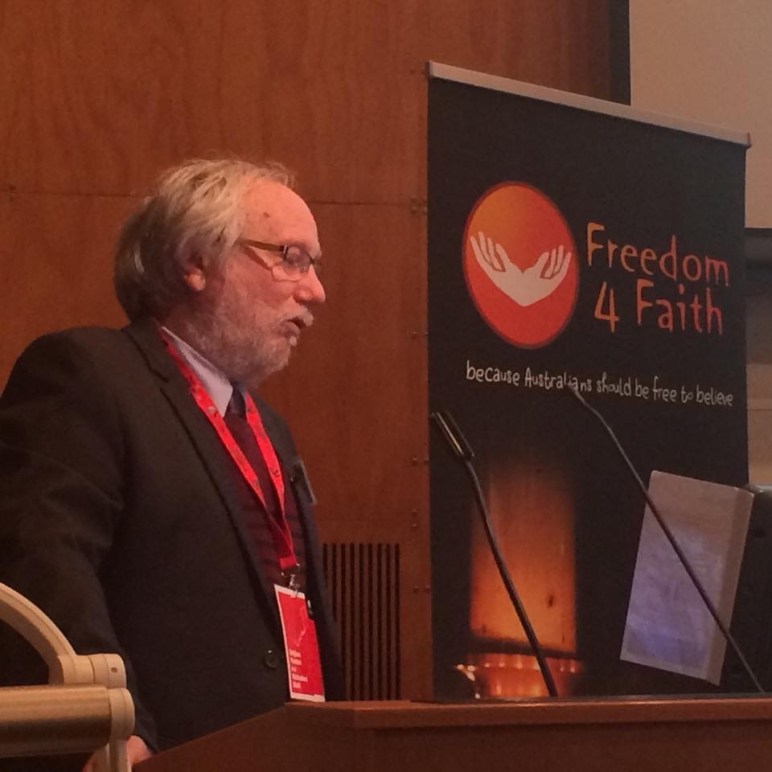
I am jointly organising a one-day conference co-sponsored by Freedom for Faith at Newcastle University on Friday 25 September 2015. All the details can now be found at the conference website:  http://www.newcastle.edu.au/freedomforfaith . The day will bring together speakers from a range of areas of public life to discuss the important issues of religious freedom, including:

  • Tim Wilson, Australian Human Rights Commissioner,
  • The Right Rev Dr Peter Jensen, General Secretary of the Fellowship of Confessing Anglicans,former Anglican Archbishop of Sydney;
  • Dr Paul Taylor, International Law Advisor and Barrister;
  • Dr Renae Barker, UWA School of Law and Honorary Research Fellow, Centre for Muslim States and Societies;
  • Dr Greg Walsh, from the University of Notre Dame Australia; and
  • myself!

There is also a flyer here which you should feel free to download and distribute as widely as possible! I hope that some of the readers of this blog may be able to join us on the day!

ReligiousFreedomConferenceInvite

“Extremism” in schools and religious freedom

The NSW Government is rightly concerned about reports from Epping High School, in Sydney, that a student at a “prayer group” meeting at the school was preaching Islamic State ideology to fellow students. It seems that an “audit” is being conducted of “prayer groups” generally to see if others are involved in spreading “extremist” ideology.

While there is no doubt some good reason to be concerned here, there are a number of potential problems flowing from this situation for religious freedom. One of the first issues to be cleared up is this: what is “extremist”? The press report linked above notes, thankfully, that some attempt is being made to give it a confined meaning:

[D]eputy police commissioner Catherine Burn… explained that police defined extremism as “willingness to use violence or support the use of violence by others to promote a political, ideological or religious goal”.

This seems like a reasonable approach. While students, like their parents, should be able to enjoy religious freedom to meet for prayer and discussion in their lunchtimes, it is clear that the limits of religious freedom are reached when this freedom is used for the purposes of generating violence. (I discussed religious freedom in Australia generally in a previous post, and there I noted that one of the earliest Australian decisions on the topic, the Jehovah’s Witness case from 1943, gave strong support to religious freedom as a value, but noted that it had to give way when questions of national security were at stake.)

However, it would be easy to slide from a justified concern about the preaching of religiously motivated violence, into a more “expansive” definition of “extremism” which really would challenge religious freedom in unjustified ways. We can see this danger emerging already in an article in the Newcastle Herald, “Preaching in playground: DET ‘ignored’ repeated warnings” (July 28, 2015). There a lobbyist previously associated with attacks on Special Religious Education in schools (see my previous posts here and here for reports of former attacks on SRE) jumps on the “extremism” bandwagon to claim that his previous “warnings” on the topic should have been heeded. But those warnings, so far as the article claims, seem mainly to have been about “religious groups trying to convert students in public schools”, not about the preaching of violence. Indeed, it seems highly unlikely that the student in Epping was speaking to non-Muslims; one would imagine his words were directed to other Muslim students.

But the difference between the two is elided in an article which seeks to tar any religious group which presents its teachings seriously, as being “extremist”. And, of course:

you can’t cherry pick which religions with extremist views you allow in, and which ones you don’t.

Well, with respect, you can distinguish between different “religious” groups, and have to, precisely on the grounds of what they teach. Some religious views are “extremist” and others are not. This means, of course, that schools are quite justified to generally monitor the content of what is being taught in school religious groups, so long as this is not done in such a heavy-handed way as to stifle all expressions of religious faith by students. And it will be perfectly rational to be more careful with religious groups where high-profile representatives of the religion concerned have been known to make clear public pronouncements about inflicting physical violence on non-believers.

Unfortunately the developing issues here in NSW reflect to a large extent developments on a far more serious scale in the United Kingdom. There, in a scandal in 2014 that engulfed a number of government-run schools which came to be known as the “Trojan Horse” incident:

An investigation ordered by the government.. found a “sustained, coordinated agenda to impose segregationist attitudes and practices of a hardline, politicised strain of Sunni Islam” on children in a number of Birmingham schools.

The investigation of this incident, of course, led to a Government determination not to allow hard-line Islamic views to dominate in government schools. Unfortunately, it seems that the lazy “all religions are the same” attitude of some bureaucrats has led to proposals to severely restrict all religious groups, not just those advocating religious violence, from presenting their views in schools. Indeed, in more recent times the UK Government has proposed a system of “Extremism Disruption Orders” which are seen as raising important challenges to freedom of speech and religious freedom. In an attempt to deal with the very real threats of religiously inspired violence, the danger of sweeping up religious views generally, especially those which do not conform to the current “sexual orthodoxy”, is a very real one. In an important article, Extremism and Censorship, the Gatestone Insitute notes that the definition of “extremism” that the UK Government seems to have adopted is:

vocal or active opposition to fundamental British values, including democracy, the rule of law, individual liberty and mutual respect and tolerance of different faiths and beliefs.

What, then, are “fundamental British values”? Again this is unclear, but one commentator has noted:

Those engaged in passionate debates — such as Christians objecting to gay marriage — could find themselves slapped down. Monarchists or communists could be swept up for peacefully expressing their political views.

Indeed, the Christian Concern group in the UK reports that recent comments of the Education Minister there seem to suggest that

the Christian teaching about marriage and sexual ethics would now be labelled as an “extremist view that needs to be monitored and punished.”

In short, we need to be discerning about the sort of views which are targeted when we start using the label “extremist”. The Gatestone Institute, in the post linked above, notes that governments will need to be discerning in deciding which religious groups receive funding and support, and which don’t. It will be necessary to “cherry-pick”- to listen to the views that are being presented by different groups, and where viewpoints are to be opposed, to only do so in the most serious cases of physical violence against others being advocated and supported. Differences of opinion on other matters, on sexuality, on abortion, on forms of government, on asylum seekers and climate change, need to be tolerated and debates allowed to continue. There will be no substitute for careful and thoughtful work with religious groups and their leaders, and on occasions the drawing of clear lines. But suppression of religious freedom can only be justified by the most serious forms of direct harm, and should never be engaged in merely to avoid “offence” or “annoyance”.

Further comments on churches withdrawing from solemnising marriages

My previous post on the question of whether Christian churches who see same sex marriage as contrary to God’s word, should withdraw from solemnising marriages under Australian law if that law changes to recognise such unions, was followed by a helpful response from Dr John McClean. In this post I want to offer my response to John’s remarks. (Readers who are interested in this area should also see the detailed response of another Presbyterian minister, Nathan Campbell, whose views are very similar to mine, in 8 Reasons Withdrawing From The Marriage Act Is A Bad Idea For The Presbyterian Church.) Following John’s lead on academic style I will refer to him by his last name. (Again, this post furthers an “in-house” debate, which may not be of interest to those not involved in Christianity, who should feel free to move on at this point!)

Areas of agreement

Perhaps it would first be helpful to clarify areas where McClean and I are in full agreement. As I see it, as fellow evangelical Christians, we agree that

  • The Bible makes it clear that homosexual behaviour is contrary to God’s purposes for humanity and wrong.
  • We are also convinced that God’s grace offers forgiveness and salvation to those who trust in Jesus Christ, his death for sins and resurrection. For both of us, I take it, those issues are the most important. But this debate is one that needs to be had because Australian society, formerly based on a consensus ethical view drawn from the Bible, is now moving further and further away.
  • The introduction of same sex marriage in Australia would have serious long-term impacts on the institution of marriage generally.

Institutional Change of Marriage

However, where McClean and I differ is in the short-term response of the Christian church to the proposed change. He argues that the institution in some sense will be “corrupted” immediately; I take it that the institution of marriage, while it will be impacted in some areas, will continue to reflect God’s purposes for humanity in most marriages that will continue to take place, and that in those areas the institution should be supported by the churches.

I previously offered as a summary two main reasons I had seen in the literature for the move that McClean suggests: an “institutional change” reason, and a “clergy religious freedom” reason. We seem to agree that the second is not a very strong one (and should any proposed legislation not include recognition of the freedom of ministers of religion not to undertake same sex marriages, I would probably need to rethink my opposition to churches withdrawing from the system.) So the rest of my comments will mostly be directed to the institutional change arguments.

Detriments of withdrawal

Partly the difference between us is due to the weight we give the detriments flowing from withdrawal. I suggest that withdrawal will lead to a reduction in opportunities for positive contact between churches and members of the non-church community who still (though I concede, as McClean points out, in decreasing numbers) come to churches for weddings. I see this as an important and serious detriment. I don’t see it as bad, though, simply because of this loss of contact with particular couples. I see it as a negative because it involves yet another area where Christians are being asked to accept being forced out of a role in the public life of the community.

Christian groups have been the founders of, and continue to be the providers of, many important social services in our community. The Salvation Army and St Vincent de Paul continue to play important roles in caring for the most needy in our country. There are still many hospitals and schools run by Christians, with a specifically Christian ethos. The community benefits from these services, not simply because if they were not there then increased taxpayer funds would be needed to replace them, but because these organisations often attract people who see service of this sort as not simply a job, but as a vocation and a calling from God.

Yet there has been increased pressure in recent years from an “absolutist” form of secularism, which seems to be determined to drive Christians out of these forms of service. Overseas, a number of Catholic adoption agencies have been forced to shut their doors because they will not compromise their views on appropriate family structures in organising adoptive families. Pressure is mounting in some areas to revise the provisions of anti-discrimination laws, which allow Christian organisations to conduct their operations in accordance with their deeply held beliefs.

In this context, for a Christian denomination to withdraw from playing an important role in the public celebration of marriage in the community feels very much like a further “defeat,” and to send a message that Christianity is increasingly irrelevant to the lives of ordinary Australians. The public role of the church for many years has been to shepherd those who seek its services in the major life landmarks of “hatches, matches and dispatches”- baptising new born children, celebrating weddings, conducting funerals. Even if, as McClean suggests, churches would still offer ceremonies even to non-believers, following a civil service, the fact that what is offered could not, consistently with the Marriage Act 1961, be called a “marriage”, would I think deter many from bothering.

In my judgment, then, while I appreciate others may take a different view, the detriments of this move would in fact outweigh the detriments of continuing to be part of a changed institution, at least in the near future.

Models for withdrawal

I also noted my concerns about possible models for implementing the proposed withdrawal. McClean offers his view (as he says, no formal model has been adopted as part of the proposals at the moment). He describes one option as follows:

Given a covenantal view, the church should teach that couples are required to have a ‘wedding’ (a public exchange of vows) before they consider themselves married and live together and commence a sexual relationship. The wedding could take two forms: it could be conducted by a celebrant recognised under the Marriage Act (including a minister from a denomination which remains registered under the Act); or it could be one conducted by a Presbyterian minister following the rites of the Presbyterian Church of Australia, but which is not recognised under the Marriage Act. For matters of pastoral care or church discipline, the church would recognise either form of marriage.

He suggests that the church would “probably” favour the model where a civil ceremony was carried out first; but he leaves open the option that a couple may choose not to do this.

Here I have to say I see a major hurdle. In order to explain it clearly, however, I need to try my reader’s patience somewhat by an excursus.

Excursus: What does the Bible say about wedding ceremonies?

One would think that the issue of the Bible’s teaching about wedding ceremonies was something both McClean and I ought to have started with. We both agree on the nature of marriage as the Bible teaches it should be according to God’s purposes: heterosexual, monogamous, with each party entering the relationship undertaking to be sexually faithful and that the relationship will be for life, entered into by parties who are able to freely consent, and in the sight of the community. But what does God say about the wedding ceremony that initiates such a relationship?

The answer, perhaps surprisingly, is: not very much at all. I wrote about this a few years ago when responding to suggestions made by some Christians that we should regard a de facto couple, who had become believers and resolved now to stay together for life, as “married in God’s sight”. I disagree with that view. Let me repeat some of that earlier discussion (slightly edited).

As I see it, and I think this is the Bible’s view, a couple are married when they have made a public commitment to be husband and wife exclusively for life, and they have done so in accordance with the law of the community they live in. In Australia today (and for the last couple of centuries) that means a ceremony that complies with Australian law. To write this off as a “piece of paper”, as even some Christians occasionally do, is wrong. It is not simply a piece of paper; the ceremony is the way of expressing that life commitment which makes a marriage. If that has not happened, then the couple concerned, even if they are living and sleeping together, are not married. Whatever their private intentions, whatever their promises to each other within the privacy of the relationship, a marriage has not taken place until they have entered into that commitment in the sight of the community, in a way which engages all the rules that community has set up which apply to married people.

This view I think flows from the overall pattern of marriage in the Bible. In Gen 1:24 we see that a man leaves his previous membership of the family unit shared with his father and mother, and “holds fast” to his wife and they become “one flesh”. The change is from one family to another and this needs to be recognised in the community because a number of things flow from the status of marriage. (“One flesh” is about being “closest kin” now to the wife.)

Through the Bible there is never a suggestion that a couple are married by some private decision they make on their own. Marriage is seen to be celebrated in the face of the community (eg Gen 24:67, 29:23); indeed, Abraham nearly gets into trouble because Pharaoh in Gen 12:18 does not know Sarai is his wife.

This is just what the word “marriage” means. One obvious reason is that it would undermine the prohibition on adultery if we were never sure who was whose spouse. The forbidden degrees of marriage become impossible to sort out if we as a community don’t know who is married to whom. In light of this normally accepted meaning of the word, I think (if I can resort to a lawyer’s strategy!) that the onus lies on those who say that marriage between a man and a woman can take place other than in the face of the community and in public, to provide Biblical evidence for it. (1 Cor 6:15-16 does not mean that one act of intercourse makes a couple married, as I have occasionally heard said.)

To sum up- it seems to me that marriage is the status recognised in a particular society which leads to the creation of a new family and to an in-theory life long relationship between a man and a woman. (The “in-theory” bit is because most societies, and the Bible itself, recognise some possibility of divorce.) A man and a woman are not married under the law of Australia unless they have been through a legally recognised marriage ceremony.

Further, it seems likely that a man and a woman living under the Australian legal system are not married within the meaning of that term in the Bible until they are married for the purposes of Australian law. Otherwise, as noted previously, the Biblical commands about not committing adultery, etc, become impossible to sort out because we cannot know who is married to whom, until we assess intangibles like the depth of their commitment to God and to each other. To me this is impossibly subjective and not consistent with the fairly straightforward approach of the Biblical material, which all along assumes that it is quite obvious whether someone is married or not.

Support for this view can also be found in an excellent book on this area by Christopher Ash, Marriage: Sex in the Service of God (IVP, 2003). He carries out a very careful review of the Biblical evidence and comes to the conclusion that marriage according to the Bible is “the voluntary sexual and public social union of one man and one woman from different families”. Chapter 11 of the book is where he reviews the evidence that supports the “public” aspect of the definition. I can’t do justice to his careful analysis here, but he notes for example that “consent” is a key aspect of marriage, and that

“in the matter of consent… the nature of marriage as a public commitment (a “sexual and public social union”) comes to the fore… Consent is not a private matter of the thought-life but a public affair of the spoken word and deed.” (p 220)

He points out that the Hebrew and Greek words that are used for “marriage” only rarely refer to the “status”, and most often refer to the “wedding feast”, which of course is a public community affair (p 234). He notes that a requirement that there be public recognition of marriage benefits (i) outsiders who need to know who is married to whom; (ii) the weaker party who may be pressured into giving a consent they do not mean; (iii) the parties, because “public commitment buttresses a private pledge” (p 238) and hence it is harder to back out of. He concludes the chapter by stating:

“The public dimension of marriage is not an ethical extra to make marriage better, but is of the essence of marriage as instituted by God.” (p 245)

I can see that there are possible, unusual, circumstances where a couple could be regarded as married who have not gone through a legal marriage ceremony- for example, on a desert island after a plane crash. But there seems no good reason why a man and woman living in Australia today wouldn’t enter marriage in the way our society has chosen to recognise marriage- i.e., by going through a legal marriage ceremony. Why would a couple who want to consent to a lifelong exclusive sexual commitment to each other in the service of God together, not want to use the mechanism our society provides for formalising this? Indeed, it seems that in Australia today if they choose not to do so, then they are saying by their actions that they are not willing to take on the relationship of marriage.

For the church to decide that it will set up its own rules as to when a couple can be regarded as “married in God’s eyes” is both unhelpful and unnecessary. Indeed, it is arguable that the view that there is a concept of being “married in God’s sight”, as distinct from married according to the prevailing social rules, is probably not there in the Bible. People are either married or they are not; the way you determine this is to see if they have complied with the relevant social rules, which will include some public commitment formally expressed in some way.

This does raise the possibility that a couple could enter a marriage in accordance with Australia law that might be prohibited by the Bible. Actually, given the development of Australian marriage law from Christian origins, it has up to now been a bit difficult to find a good example of this. Australia law on prohibited relationships, for example, tends to be pretty close to that in the Old Testament law (assuming for the purposes of discussion that the OT law on this point is still binding on Christians.) There is one difference, however- under Australian law at the moment it is not unlawful to marry one’s uncle or aunt; s 23B(2) of the Marriage Act 1961 (Cth) forbids marriage with “ancestors” and “descendants” and “siblings” but does not catch, say, one’s father’s sister. Leviticus 18:12 is a direct prohibition of sexual relationship with such a person.

However, my inclination at the moment is to say that such a marriage, while it may be disobedient for the people concerned to enter, is indeed a “marriage” if lawful under Australian law. One might want to say to the couple- as a matter of obedience to God you ought not to sleep together. But in my view the couple would still be married. Again, I say this because in my view the Bible’s approach to marriage is to pick up the laws of the local society to determine the status.

Take another example. Suppose that someone comes to Australia from a country overseas that allows polygamy, along with his two wives. All parties would, it seems, be recognised as “married” for the purposes of Australian law so long as the parties concerned were married lawfully in an overseas country with which they were all appropriately connected. (This is different to someone who was Australian seeking to “evade” the law of Australia by marrying overseas. The difference lies in the rules of “private international law” which we can’t go into here.)

Should the church treat the parties as married? I think so. We would want to say, polygamy is not God’s ideal purpose for marriage. But it has happened, and so the status exists. In this case I think I have the support of the Bible, which in the OT of course records cases of polygamy with no indication that any of the wives were not “really” married, and even the NT, where in 1Tim 3:2 Paul requires that an elder be the “husband of one wife” (clearly implying that there were some in the church who did not satisfy this criterion).

(This does not, by the way, mean that polygamy is good. There are sound reasons why the Bible teaches monogamy as the right model, both from a theological perspective and for social reasons. But it means that a polygamous marriage may, in some circumstances, be a “marriage”.)

Back to the main question

So- if I am right to say that marriage according to the Bible is created under the laws of the community we live in- then the flaw in McClean’s proposal from my perspective become even clearer. If the Presbyterian church allowed couples to make promises in a “marriage” ceremony of some sort, in the absence of a prior civil ceremony recognised by the law of the land– the fact is, that couple would not be married. Their sleeping together would be an act of fornication, to use the old word.

I concede that I have not found my view on this matter shared in other sources. I welcome critique from a Biblical perspective. But the evidence suggests to me that a couple are only “married” when they are so regarded by their local community.

(In private discussions John has graciously drawn to my attention the fact that Calvin seems to have had a similar view, that the “magistrate”, the State authority, was an indispensable part of God’s means to constitute a valid marriage. See Witte, John and Nichols, Joel A., “More than a Mere Contract: Marriage as Contract and Covenant in Law and Theology” (2008), University of St. Thomas Law Journal, Vol. 5, p. 595, summarising Calvin’s views: “This involvement of parents, peers, ministers, and magistrates in the formation of marriage was not an idle or dispensable ceremony. These four parties represented different dimensions of God’s involvement in the marriage covenant, and they were thus essential to the legitimacy of the marriage itself.”)

One reason why this is the best model is the need to avoid confusion noted previously. If the private “covenantal” model is adopted, and if it involves an option for couples to be “married” in church but not in a prior civil ceremony, the potential for confusion and difficulty is quite high. (McClean correctly notes that my previous comments on “confusion” were intended to be directed to this situation.)

The confusion, I suggest, would arise even if every Presbyterian minister did the right thing by, say, handing the parties a letter beforehand saying that “this ceremony does not amount to a marriage under the law of Australia”, and a certificate afterwards with these words included. For how many starry-eyed brides and grooms read all the fine print of the documents they sign? There will always be a danger that, if the ceremony adopted by the church for “covenantal marriage” strongly resembles the traditional “white wedding” ceremony that has been conducted for years, the parties, and their families, will assume that they are actually “married”.

The scenarios that might follow are as varied as human relationships and human sinfulness. A “covenantal husband” leaves his “covenantal wife” 18 months later and then enters into a civil marriage ceremony with someone else. In the church’s eyes he will presumably be subject to ecclesiastical discipline. But how are the property relationships between the parties to be sorted out? As McClean points out, the jurisdiction of the Family Court to deal with property issues on break-up of what the law will regard as a de facto relationship does not usually arise until the parties have lived together for 2 years.

Suppose that the “husband” and his new “legal wife” now decide to go to another church. Does that church regard them as married, or not? Should it counsel them not to sleep together, as the husband is “really” still married to his “covenantal wife”?

With respect to McClean, it seems to me that these and a number of other nightmare scenarios are perfectly possible. Bifurcation of relationships into marriages “in God’s sight” and those which are “legal” is generally a bad idea. Of course it is possible to have such an arrangement. McClean is correct to point out that prior to 1753 or thereabouts in England, and after that date for some time in Scotland, “common law marriage” was not uncommon. But the sort of confusion and potential for abuse already noted were rife in this context, which is why we moved away from that system to the one we have operated under for hundreds of years, where we formally register and note marriages so that we are clear who is married to whom, and who is not.

Similarly, it is sometimes noted by proponents of withdrawal that France and some other European countries require a civil ceremony as well as a church ceremony. But one of the reasons that France does this is that it has a very strong streak of antipathy to Christianity, and religion in general, stretching all the way back to the French Revolution. Religion is almost completely excluded from the public sphere in France. Is this in fact a model we want to encourage? Or rather, while churches are able to play a role in the legal solemnisation of the good institution of marriage, should they not continue to do so as long as the society still allows?

Political Theology

Near the conclusion of his piece McClean sums up some views on “political theology” which he says support his approach. With respect, I think my views are perfectly consistent with the Bible’s views about the State from Romans 13, where in general Christians respect the State where it organises the community (although the overall context of the Bible, of course, means that there are some lines which we cannot cross in obedience to God’s word.) Since the Bible does not deal with the situation of State recognition of church wedding ceremonies, whether or not the point of disobedience has been reached is a matter of judgment where, as we see, believers may differ. In my judgment at the moment remaining within the system is the wisest course of action.

Readers who are more interested in discussion of the Westminster Confession on political theology may find Nathan Campbell’s post (noted previously) of some assistance.

Implied affirmation

I note from re-reading Nathan’s post that proposals similar to those put forward by the PC(NSW) people were canvassed by Tasmanian Campbell Markham not long ago (see the article here.) Perhaps the main additional point made by Markham, not stressed by McClean, is the fear that those who see a Christian minister continuing to solemnise marriages if same sex marriage were introduced would be led to believe that the minister supported same sex marriage. Again, this is a question of judgment, but in my view this is not so. The community recognises that marriages are solemnised by clergy with a very wide range of views. That a Presbyterian minister solemnises a marriage at his church, while a Muslim Imam solemnises a marriage at a mosque down the road, does not lead members of the public to think that Presbyterians and Muslims have identical beliefs, even on the topic of the principles governing marriage.

Interestingly similar suggestions to those made by the Presbyterians have been made in relation to the Roman Catholic church in the United States. For a Catholic canon lawyer’s comments on proposals by some Catholic clergy to “withdraw” from the marriage system, see this post, and for a full list of posts on the topic see here.

Conclusion

In conclusion, I am grateful for John’s response to my comments and the thoughtful and helpful manner in which they were presented. This debate may well be one that continues for some time, and I trust that Christians will continue together to commend God’s good purposes for humanity in creation and in the gospel of Jesus Christ, to seek the good of society, and to encourage God’s people to live lives that are worthy of that gospel.

More on withdrawal of churches from solemnising marriage

My friend Dr John McClean has posted a thoughtful response to my previous post on this topic; John’s response can be read here. I will have my own response once I have had a chance to think it over, but in the meantime I recommend it to those who are interested in this “internal” debate among those concerned about the consequences of same sex marriage from a shared commitment to the truth of the Bible.

Should Christian churches withdraw from marrying if same sex marriage is introduced?

The above question has been raised in Australia by news that the Assembly of the Presbyterian Church in NSW has recommended to its national body that ministers of the Church should withdraw from performing legally recognised marriages should proposals for recognising same sex marriage proceed. (I have discussed previously the situation with same sex marriage in Australia, noting that at the moment it is generally regarded as a matter for the Federal Parliament to decide.)

Many Christians who take the Bible seriously take the view that homosexual practice is contrary to God’s will for humanity as expressed in the Bible. (See, for a recent clear and careful analysis of the Biblical position, this post from the Principal of Moore Theological College in Sydney.) But, despite an increasing trend to civil ceremonies, many marriages are still conducted by ministers of religion. Other churches and groups around the Western world have suggested, in light of the adoption or possible adoption of same sex marriage by their governments, that Christians who believe this is so ought to withdraw from the solemnisation of marriages altogether. The logic of many of these arguments was expressed by a spokesman for the NSW Presbyterian Church, Rev John McLean, as follows:

It would still be possible to form a life-long monogamous heterosexual union under a changed act. But the act, and the way Australian society will use it, will be so different from the classic Christian view that the rationale for the church sharing in the system will have gone. From the church’s point of view, a wonderful blessing from God would be largely emptied of its meaning and purpose. It might be better for us not to be part of a system which endorses that.

But does it follow that Christians who object to same sex marriage on Biblical grounds should withdraw from solemnising legally binding marriages? I would like to suggest that it does not, and that the arguments presented in favour of this view are flawed.

(Perhaps I should note that, while most of the material I post on this blog is relevant to the community generally, to some extent this debate is a “family discussion” within the Christian church, of which I am of course a part. Observers who are not involved may wish to move on at this point! But I would like to address these issues to fellow believers, as I think there are some dangers in the course of action being proposed.)

The arguments in favour of withdrawal

Many of those who argue for withdrawal from a system that recognises same sex marriages do so from a position somewhat similar to that noted above- that the “institution” of marriage would be so changed by this development that it would be no longer right for Christians to support it. We may call this the “institutional change” argument.

Others have put forward the argument in terms which suggest that they think it will contribute to religious freedom. Concerned at the prospect of clergy being forced to conduct same sex weddings, they argue that if the church stops conducting weddings at all, then there will be no legal grounds for such an action. This is the “clergy religious freedom” argument.

These seem to be the main two arguments that are presented in favour of withdrawal.

The current situation with religious celebrants

It seems best, before addressing these, to outline the current position of religious celebrants in Australia. Under s 51(xxi) of the Commonwealth Constitution, the Federal Parliament has a concurrent legislative power over the topic of “marriage”. Prior to 1963 the Federal Parliament had not exercised that power in any substantial way, but with the commencement of the Marriage Act 1961 (Cth) (the Act) it took over the whole area from the States. The Act regulates the whole topic of the celebration and validity of marriages in Australia.

There are currently four categories of persons authorised under the Act to solemnise legal marriages in Australia (“authorised celebrants”). They are (1) ministers of religion of “recognised denominations”- Part IV, Div 1, Sub-div A of the Act; (2) public servants who work at Registry offices- Part IV, Div 1, Sub-Div B; (3) persons appointed as “marriage celebrants” under Part IV, Div 1, Sub-Div C, who may be either “civil” celebrants, or (4) such persons who are ministers of religion but not associated with the major “recognised denominations”. The final category will then include ministers of small, independent churches, for example.

In the interesting decision of the present Chief Justice of the High Court, French J (as his Honour then was as a member of the Federal Court) in Re Michael William Nelson v M Fish and R Morgan [1990] FCA 28 (9 February 1990) was asked to decide whether a “minister” of a group called “Gods Kingdom Managed by his Priest and Lord” should be recognised as a marriage celebrant. The case sets out the administrative guidelines used by the Attorney-General’s Department to determine whether or not a group is a “recognised denomination” under s 26 of the Act (see para [4] point 5), and whether or not someone should have been appointed as an independent “religious” celebrant under the provisions of s 39(2) of the Act as it then stood.

(Those who are interested in the history of the law relating to the need for the presence of a celebrant at the celebration of a valid marriage, and what that presence involves, may like to consult the fascinating case of W and T [1998] FamCA 49 (7 May 1998), holding that an authorised celebrant who was at the back of the church while promises were taken by someone else, was to be regarded for the purposes of the Act as “solemnising” the marriage.)

The list of “recognised denominations” for the purposes of s 26 of the Act may be found here. It includes, of course, the Presbyterian Church of Australia.

Withdrawal for celebrant religious freedom reasons

Would it be a good idea for a church to withdraw from a system that recognised same sex marriage to avoid ministers of that church being obliged to solemnise same sex marriages? In my view this would not be necessary under any plausible proposals for same sex marriage in Australia in the near future.

All proponents of the change have said that they would not require ministers of religion to perform same sex weddings. The most recent draft Bill introduced by the Leader of the Opposition on 1 June 2015, for example, provides, in Schedule 1 clauses 5 & 6, an amendment to s 47 of the Marriage Act1961 which says that that a minister of religion may not be obliged (by the Marriage Act or any other Act, such as a law prohibiting sexual orientation discrimination) to solemnise a same sex marriage. Protections of this sort were introduced in the UK when that country’s Marriage (Same Sex Couples) Act 2013 was introduced- see the complicated section 2 of the Act, accompanied by an amendment to the Equality Act 2010, s 25A, which explicitly provides that there is no breach of sexual orientation discrimination laws by a member of the clergy declining to be involved in a same sex wedding. (The complex nature of these provisions, however, seems to point to the need for much more careful drafting than the somewhat minimal s 47 amendments proposed in Australia at the moment.)

There is no denying, of course, that if same sex marriage is introduced there may be political pressure put on ministers of religion to solemnise same sex marriages. (See this report from the UK indicating that, even with the so-called “quadruple lock” protection for the Church of England under their legislation, two same sex activists were threatening to take the church before the European Court of Human Rights to enforce a right to be married in their local Church of England building.) However, it seems to me that that is a battle to be fought in the future. If the law were to change to require all marriage celebrants to solemnise same sex weddings, then consideration could be given at that stage to withdrawal from the system. (Although it would seem to be arguable that such a law would be so extreme that it might even breach the fairly minimal religious freedom protections provided by s 116 of the Constitution, and could be challenged on that basis. See my previous post for discussion of religious freedom protections in general in Australia at the moment.)

Withdrawal on “institutional change” grounds

A stronger argument can be made that the institution of marriage would be so fundamentally altered by introduction of same sex marriage that churches should no longer support it. But in my view, again, this argument is not convincing.

The fact is that marriage as practised in Australia today already falls short of Biblical ideals of life long faithfulness and commitment. But, justifiably, churches continue to solemnise marriages under the current law. Marriage is not a special custom for believers; it is generally recognised that it is what the older theologians called a “creation ordinance”, designed for the general good of mankind. While some examples of marriages take place where the Bible may suggest they ought not to, the good achieved by Christian churches in celebrating marriages generally seems to outweigh the examples of cases where people are being married wrongly. (To give an example, many Christians take seriously Jesus’ words that there are very limited grounds that justify divorce. Yet a person who may have obtained a divorce from a previous marriage in circumstances which would not fall within the category recognised by Jesus, may under our law be free to remarry. The fact that such marriages currently take place, despite them being contrary to God’s word, does not of itself mean that the institution of marriage as a whole should be abandoned.)

There are a number of important benefits, from a Christian perspective, in Christian ministers being willing to solemnise marriages as part of the general legal system. They will have the opportunity to serve members of the community who may have no other contact with a church, by not only celebrating a joyful occasion with them, but also by explaining a Biblical view of marriage. They will have a chance, too, if the couple are interested, to explain other aspects of the Christian gospel. They will make a connection that may see the couple come back, either for themselves or with children who may come along later. Many of these opportunities may be lost if churches decline to continue to solemnise marriages for members of the community at large.

What model of withdrawal is suggested?

The details of any proposed withdrawal from the general marriage system are not yet clear. Most proposals suggest that ministers of religion would no longer be “authorised celebrants” under the Act, with power to solemnise a legally effective marriage. Some suggest that churches might then say that they will conduct some sort of religious “blessing” ceremony after a couple has been to a registry office to celebrate their marriage there. Presumably this could be offered to both church members and to those outside the church if they were interested. It should be noted, however, that a decision to specifically decline to conduct “same sex blessing ceremonies” would still arguably be viewed as a decision which was discriminatory on the grounds of sexual orientation, if those ceremonies were freely available to heterosexual couples. Ironically, the church may then find itself, if not conducting “marriages”, liable for discrimination actions, unless they were able to rely on a “balancing clause” in relevant legislation. (See my previous discussion of balancing clauses in discrimination legislation, noting that courts in the past have given a very narrow reading of such clauses, even in the case of religious organisations.)

It might also be noted that at the moment s 113 of the Act already makes provision for a “religious” ceremony which is separate from a civil ceremony. Under s 113(5), where a couple have been through a legally recognised marriage ceremony, and they produce appropriate documentary proof of the fact, then they are allowed to go through a religious ceremony in front of a minister of religion, who does not need to be authorised to conduct marriages under Australian law. Any document issued by the minister, however, has to specify that the parties were already legally married. The provision seems to have been introduced to allow parties with strong religious convictions, but whose minister was not authorised under the Act, to have a specifically religious marriage ceremony. If an individual minister of religion chose to withdraw from the civil marriage system, they could presumably use the provisions of s 113 to conduct a religious ceremony after parties had been through a civil ceremony.

The detriments of withdrawal

Having briefly considered arguments in favour of withdrawal from the marriage system, let me outline a number of detriments which I see as flowing from such a decision. I have already noted the risk of losing contact with those outside the church who would no longer come where the churches were not providing the service of “marriage”.

Another set of problems arises from the simple fact that the legal system over many, many years has developed an interconnected set of doctrines and principles dealing with the status of marriage, its legal consequences, how it may be terminated in divorce or nullity, and the consequences of such termination for the rights of the parties, including property allocation and child custody issues. Yet if a church proposed to offer its members a form of “religious marriage” distinct from “civil marriage”, it would have to soon start to find ways of dealing with this multitude of issues. What if the parties who entered a “religious marriage” broke up? Would the church develop a “religious divorce” procedure? Presumably if it had separated itself from the “civil marriage” system, then it could not simply rely on “civil divorce”. What would happen if the religious rules would justify a divorce, but the civil rules would not (or vice versa?) Will all churches recognise “religious marriages” celebrated by other churches or religions? What criteria would be adopted for recognition? Who would make the decision?

In short, all the many and varied issues that our legal system has wrestled with for centuries in dealing with the status of marriage, would be up for grabs if churches pulled out of the civil system and started trying to regulate their own “religious marriages”.

Another pragmatic reason for resisting the change would be the possibility for confusion among persons who had been through ceremonies at a church, as to whether they were married or not. If all the paraphernalia of approved forms and registers are no longer used, one’s experience of life suggests that proper records may not be kept, that not all parties will have gone off and got the “civil” marriage before the religious one, and that there may be some serious consequences down the track.

Conclusions

In my view, the Bible takes a very pragmatic view of marriage. While there are clear principles set out for what marriage should be (a man and a woman, able to consent, committed to each other in the sight of the community, for life to the exclusion of all others), through the history recorded in the Bible these rules were not always followed. To summarise what needs to be a long argument (which I explore in slightly more detail here in a piece from a few years ago), it seems to me that in terms of what is needed to constitute a valid marriage, the Biblical view is that a marriage recognised as valid by the community in which one lives, is a valid marriage. For when we have rules forbidding adultery, we need to know who is married to whom with a high degree of certainty. The Bible, it seems to me, knows nothing of people being “married in God’s sight” but not in the view of the community.

Hence it seems to me a bad idea for churches to withdraw from celebrating marriages before the moment (if ever) when they literally have to do so because they are being told to disobey God’s word. Marriage is a good thing; as the letter to the Hebrews puts it: “Marriage should be honored by all” (Heb 13:4). Christians should keep on offering this good thing to the community for as long as they are able.

Same Sex Marriage, Religious Freedom and the Vibe in Obergefell

Much has been written in the last few days about the decision of the United States Supreme Court in Obergefell v Hodges 576 US ___ (2015) (26 June 2015) that there is a previously unknown “right” of same sex marriage in the United States Constitution. In this brief comment I do not propose to analyse in great detail the Constitutional basis for the decision of the majority of 5 Justices, written by Kennedy J, nor the trenchant critique of those reasons offered by the 4 dissenting Justices. Others who are much more versed in US Constitutional law have started to do that already- see, e.g., the helpful collation of reactions from scholars and commentators at the excellent First Things website. But I will try to summarise the decision, before turning to one of the main unresolved issues flowing from it: what are its implications for religious freedom in the US? I will then briefly offer some thoughts on how these issues might play out in Australia.

The Majority Decision

Kennedy J offers a keen insight into the logic of the movement for same sex marriage around the Western world in his opening paragraph:

The Constitution promises liberty to all within its reach, a liberty that includes certain specific rights that allow persons, within a lawful realm, to define and express their identity. (slip op, at 1-2)

The core of the movement is the idea of “freedom”, and not just freedom classically defined as freedom from external restraint (the dissent of Thomas J outlines in some detail this traditional understanding of liberty), but the freedom to “define and express” one’s “identity”. With those opening words there was never any doubt where this judgment was going: to the post-modern world, nothing is “fixed” or “static”, all must be “fluid” and “dynamic”, including of course sexual preference and even gender.

And yet… even here we see a problem. For of course to make the point that we must radically redefine an institution that has formed the basis for society in all human cultures for millennia, Kennedy J wants to appeal to the fact that homosexual persons in fact are “trapped” into an identity not of their own making at all. So we read later of the fact that the “immutable nature” of the homosexual petitioners (slip op, at 4) “dictates” that they must find fulfilment in marriage to a person of the same sex. On the evidence of psychiatry, we later read that “sexual orientation is both a normal expression of human sexuality and immutable.” (slip op, at 8, emphasis added) So, trapped as they are in this unchangeable homosexual nature, Kennedy J for the majority holds that the law must allow them to marry others like themselves, or else be condemned to a “life of loneliness” (slip op, at 14: “Marriage responds to the universal fear that a lonely person might call out only to find no one there”; see also the moving conclusion at slip op, 28: “Their hope is not to be condemned to live in loneliness.”)

There is much of this emotive language, and stress on the personal pain felt by the petitioners in their relationships not being recognised as marriage. And of course if indeed the predominant purpose of marriage is to allow human beings to find solace and fulfilment in the love of another (but of course, why only one other?), then it seems grossly unjust to deny this institution to same sex couples. We see that early on in his judgment Kennedy J stresses this:

Marriage is sacred to those who live by their religions and offers unique fulfillment to those who find meaning in the secular realm. Its dynamic allows two people to find a life that could not be found alone, for a marriage becomes greater than just the two persons. Rising from the most basic human needs, marriage is essential to our most profound hopes and aspirations. (slip op, at 3).

Others have asked, of course, that if emotional fulfilment is what is required, why does the State become involved at all? As the dissenters note, the fact is that marriage has never been seen simply as a vehicle for the benefit of the two parties. It is an institution which is directed toward the regulation of sexual relationships between men and women, because such relationships regularly result in the birth of children, who long experience teaches us are usually best off when raised from birth by their biological parents in an enduring family. Yet it is well into the judgment before Kennedy J notes that marriages relate to children, and where he does so it is to say that same sex marriage protects the rights of children of same sex couples (see slip op, at 14-15). Indeed, traditional marriage laws, we are told in an astonishing remark, “harm and humiliate the children of same-sex couples”! Never mind that in any same sex family where children are present, all of the children will have been deprived, in some cases deliberately and carefully, of the companionship and love of one of their biological parents.

Without going into all the details, the majority judgment finds in the words of the Fourteenth Amendment to the US Constitution, that “no State shall ‘deprive any person of life, liberty, or property, without due process of law'”, a new “liberty” for same sex couples to marry, in an example of what is called “substantive due process”. Roberts CJ in dissent notes that it was precisely this sort of Constitutional “magic trick” that was used by the Supreme Court in the infamous Dred Scott v Sandford 19 How 393 (1857)  decision to find an implied property right that could not be interfered with to set slaves free; and precisely the same logic that was used in the almost equally discredited Lochner v New York 198 US 45 (1905) decision to undermine labour laws aimed at achieving fair conditions for workers, again finding a “right” in employers to not be deprived of income by interference with their “freedom of contract”. Since those cases later decisions had tried to carefully hedge around the ability of the Court to “discover” new rights based on their intuitions of fairness, in cases such as Washington v. Glucksberg, 521 U. S. 702, 721 (1997). But at slip op 18 the majority turn their back on the checks and balances in that decision and strike out to find their ideal of a new right.

The right, they say, is also supported by the “Equal Protection” clause of the Fourteenth Amendment (see slip op at 19) in some mysterious and not quite defined way. Indeed, to an Australian lawyer a number of the passages in the majority decision are more than slightly reminiscent of Dennis Denutio in the classic legal comedy movie The Castle saying when challenged as to what part of the Constitution he was relying on: “It’s the vibe!

In the end, however they get there, the result is clear:

These considerations lead to the conclusion that the right to marry is a fundamental right inherent in the liberty of the person, and under the Due Process and Equal Protection Clauses of the Fourteenth Amendment couples of the same-sex may not be deprived of that right and that liberty. The Court now holds that same-sex couples may exercise the fundamental right to marry. (slip op, at 22)

And “marry”, of course, means marry someone of the same sex.

The Dissenters

There is no space or time here to do justice to the 4 dissenting opinions, each of which in their own way offers clear and, to my mind, compelling reasons why the majority are wrong. Roberts CJ, as noted, compares the constitutional “logic” of the majority with that of previous decisions later regarded as clearly wrong. He stresses that the Court is not a legislature, and should not be taking to itself the role of making a fundamental change in an ages-old social institution.

The Chief Justice is also very clear: such logic as is present cannot be confined to the decision to allow same sex couples to marry each other. The argument from “loneliness” and emotional support inevitably leads to the next stage, which is the recognition of polygamous relationships as valid marriages. Nothing in the majority judgment, apart from, as his Honour notes, a sprinkling of the number “two” at points where it plays no part in the reasoning, prevents this next step.

Although the majority randomly inserts the adjective “two” in various places, it offers no reason at all why the two-person element of the core definition of marriage may be preserved while the man-woman element may not. Indeed, from the standpoint of history and tradition, a leap from opposite-sex marriage to same-sex marriage is much greater than one from a two-person union to plural unions, which have deep roots in some cultures around the world. If the majority is willing to take the big leap, it is hard to see how it can say no to the shorter one. (slip op, at 20)

And, as the Chief Justice notes, there is a decision from Utah at the moment which may present this issue very shortly: see Brown v Buhman, 947 F Supp 2d 1170 (Utah 2013), appeal pending.

Scalia J is his usual scathing self, well worth reading about the threat to democracy by the way the majority reasons. Thomas J analyses the historical roots of the idea of “liberty” and points out how far the majority decision has moved from this concept as referring to freedom from government action. His Honour’s reference to Magna Carta (slip op, 4) rang many bells with me after the recent Oxford conference on this topic. He notes, strikingly, that in the 35 States of the US where the question of recognition of same sex marriage has been put to the people of the State in a referendum, 32 of those States have voted to retain the traditional model of male/female marriage- slip op, 14. Yet these democratic decisions are obliterated by the ruling of 5 Justices.

Alito J at slip op 3 helpfully identifies the focus of the majority decision on the fundamental purpose of marriage as “to promote the well-being of those who choose to marry”. But, his Honour notes at 4:

This understanding of marriage, which focuses almost entirely on the happiness of persons who choose to marry, is shared by many people today, but it is not the traditional one. For millennia, marriage was inextricably linked to the one thing that only an opposite-sex couple can do: procreate.

Adherents to different schools of philosophy use different terms to explain why society should formalize marriage and attach special benefits and obligations to persons who marry. Here, the States defending their adherence to the traditional understanding of marriage have explained their position using the pragmatic vocabulary that characterizes most American political discourse. Their basic argument is that States formalize and promote marriage, unlike other fulfilling human relationships, in order to encourage potentially procreative conduct to take place within a lasting unit that has long been thought to provide the best atmosphere for raising children. They thus argue that there are reasonable secular grounds for restricting marriage to opposite-sex couples.

As his Honour goes on to say, slip op 5, even if this model of marriage is not universally accepted in Western societies, surely a State may decide that they do not wish to “contribute to marriage’s further decay” by further departing from the ideal.

Religious Freedom implications

What, then, are the implications for religious freedom flowing from this decision? Here again there is a strong division between Kennedy J for the majority, and the dissenters.

Kennedy J devotes one short paragraph to the issue, at slip op 27, almost literally an afterthought:

Finally, it must be emphasized that religions, and those who adhere to religious doctrines, may continue to advo- cate with utmost, sincere conviction that, by divine precepts, same-sex marriage should not be condoned. The First Amendment ensures that religious organizations and persons are given proper protection as they seek to teach the principles that are so fulfilling and so central to their lives and faiths, and to their own deep aspirations to continue the family structure they have long revered.

The choice of language seems deliberate. Rather than a robust assertion of a right to the “free exercise” of religion, the literal words of the First Amendment, we see an attenuated concession that believers may “advocate” and “teach” against recognition of same sex marriage. The dissenters pick this up.

Roberts CJ puts it so clearly that I can do little better than provide an extended quote:

Today’s decision… creates serious questions about religious liberty. Many good and decent people oppose same-sex marriage as a tenet of faith, and their freedom to exercise religion is—unlike the right imagined by the majority— actually spelled out in the Constitution. Amdt. 1.

Respect for sincere religious conviction has led voters and legislators in every State that has adopted same-sex marriage democratically to include accommodations for religious practice. The majority’s decision imposing same- sex marriage cannot, of course, create any such accommodations. The majority graciously suggests that religious believers may continue to “advocate” and “teach” their views of marriage. Ante, at 27. The First Amendment guarantees, however, the freedom to “exercise” religion. Ominously, that is not a word the majority uses.

Hard questions arise when people of faith exercise religion in ways that may be seen to conflict with the new right to same-sex marriage—when, for example, a religious college provides married student housing only to opposite-sex married couples, or a religious adoption agency declines to place children with same-sex married couples. Indeed, the Solicitor General candidly acknowledged that the tax exemptions of some religious institutions would be in question if they opposed same-sex marriage. See Tr. of Oral Arg. on Question 1, at 36–38. There is little doubt that these and similar questions will soon be before this Court. Unfortunately, people of faith can take no comfort in the treatment they receive from the majority today.

The other members of the Court comment in similar fashion- see Thomas J at slip op 14-15:

Aside from undermining the political processes that protect our liberty, the majority’s decision threatens the religious liberty our Nation has long sought to protect…

In our society, marriage is not simply a governmental institution; it is a religious institution as well… Today’s decision might change the former, but it cannot change the latter. It appears all but inevitable that the two will come into conflict, particularly as individuals and churches are confronted with demands to participate in and endorse civil marriages between same-sex couples.

The majority appears unmoved by that inevitability. It makes only a weak gesture toward religious liberty in a single paragraph, ante, at 27. And even that gesture indicates a misunderstanding of religious liberty in our Nation’s tradition. Religious liberty is about more than just the protection for “religious organizations and persons . . . as they seek to teach the principles that are so fulfilling and so central to their lives and faiths.” Ibid. Religious liberty is about freedom of action in matters of religion generally, and the scope of that liberty is directly correlated to the civil restraints placed upon religious practice.

And in a telling footnote to the above quote, his Honour notes that under the terrible regime where racially mixed marriages were forbidden, one State at least made it a criminal offence for a clergyman to celebrate such a marriage, even where his religion allowed him to. The suggestion is that, conversely, under a same sex marriage regime some States at least may try to force clergy to be engaged in celebration of such marriages, contrary to their faith.

Alito J is also unusually blunt:

Perhaps recognizing how its reasoning may be used, the majority attempts, toward the end of its opinion, to reas- sure those who oppose same-sex marriage that their rights of conscience will be protected. Ante, at 26–27. We will soon see whether this proves to be true. I assume that those who cling to old beliefs will be able to whisper their thoughts in the recesses of their homes, but if they repeat those views in public, they will risk being labeled as bigots and treated as such by governments, employers, and schools.

Implications for Australia

I have written in a previous post about the current state of play as far as recognition of same sex marriage in Australia is concerned. In short, unlike the US, “marriage” is a head of legislative power given to the Federal Parliament, not left to the States, and even though it is a “concurrent” power (which can be exercised by either State or Federal Parliaments), any valid exercise by the Federal Parliament will override any conflicting State (or Territory) law. At the moment the clear definition of “marriage” in s 5 of the Marriage Act 1961 (Cth) precludes recognition of same sex marriage at any level in Australia, a result confirmed by the decision of the High Court of Australia in The Commonwealth v Australian Capital Territory [2013] HCA 55, (2013) 250 CLR 441. (For a detailed comment on that decision see my paper here.)

This situation could change, then, if legislation amending the Marriage Act were to pass Federal Parliament. As at the date of writing the Government parties have a firm policy opposing such a change, which they went into the last election promising to adhere to. The main Opposition Party, the ALP, has a policy allowing its members a free vote on the issue, although recently one of the senior leaders of the party suggested that it should make support for same sex marriage a binding plank of party policy in the near future. Minor parties differ in their views among themselves. Press reports suggest that if  the governing Liberal/National Coalition were to allow a free vote of its members, some at least would support a change. But at the moment it is unclear whether there would be a majority for the change even if all members of Parliament were able to vote freely.

There have been various pieces of legislation introduced on the topic as Private Member’s Bills, none of which have succeeded, most of which have not even come to a vote. The most recent was introduced by Bill Shorten, Leader of the Opposition, in the form of the Marriage Amendment (Marriage Equality) Bill 2015 (introduced on 1 June 2015).

From the point of view of religious freedom, the latest Bill does at least make a gesture in that direction by providing, in Schedule 1 clauses 5 & 6, an amendment to s 47 of the Marriage Act 1961 which aims to make it clear that a minister of religion may not be obliged (by the Marriage Act or any other Act such as a law prohibiting sexual orientation discrimination) to solemnise a same sex marriage. But this minimal protection does not go very far in dealing with the sort of issues that are noted by the dissenters in Obergefell  and have become more apparent in recent years: the questions as to whether ordinary believers may be required to compromise their principles by providing support for, and celebration of, same sex weddings. (See my previous posts on some of the “wedding industry” cases, here and here.) Other questions include whether religious institutions generally will be allowed to continue to operate in the public sphere if their view of the morality of homosexual conduct is so contradictory to the new “sexual orthodoxy” which would be represented by Parliament granting the status of “marriage” to same sex couples.

Will the decision of the US Supreme Court have an impact on the law of Australia? Not directly, but the decision (like the recent referendum in Ireland) may have the pragmatic effect of further persuading some members of Parliament that the “tide of history” is sweeping toward same sex marriage, and they should jump on their boards. There is also an interesting comparison between the logic of the majority in Obergefell  and the reasoning of the High Court of Australia in Cth v ACT noted above. In the High Court the court (in a move I have critiqued in my previously noted paper) held that the Constitutional head of power to legislate on “marriage” includes the power to recognise same sex marriage, and part of their logic was that “incidental” features of marriage had changed over the years. Similarly, in Obergefell, Kennedy J for the majority argues that marriage has “evolved over time” (slip op, at 6) because previous features such as the law of coverture have dropped away.

In my paper on the Cth v ACT decision I note at p 8 that the High Court settles on a “core” meaning of the term which manages to include both polygamy and same sex relationships as part of a shifting meaning. But the question remains, both in Australia and the US, as to how one decides what is part of the “core” meaning of the term, and what is an inessential accident? And, one might add, not only “how” does one decide, but “who” decides? In the US the minority’s critique of the legislative-like move made by the majority in Obergefell is very convincing. In Australia we may at least have the matter decided by a Parliamentary body. But in my own view (and I think there is also a plausible legal argument to this effect as well as good policy reasons), such a fundamental change to a foundational social institution should really be settled by agreement of the people as a whole, rather  than by the shifting forces of politics in Parliament.

Even if a referendum were held, of course, I would personally oppose such a change. But at least a referendum would have the benefit of allowing the extent of community support for the change to be properly assessed, and for its supporters to seek to persuade its opponents of the rightness of their cause. Such an opportunity, as Roberts CJ tellingly points out in his decision, has now been lost after the majority ruling in Obergefell:

Indeed, however heartened the proponents of same-sex marriage might be on this day, it is worth acknowledging what they have lost, and lost forever: the opportunity to win the true acceptance that comes from persuading their fellow citizens of the justice of their cause.

Religious Freedom and Balancing Clauses in Discrimination Law

I have just returned from an excellent conference in Oxford on Magna Carta and Freedom of Religion or Belief, sponsored by the International Centre for Law and Religion Studies. While there I had the privilege of presenting a paper on the subject, “Freedom of Religion and Balancing Clauses in Discrimination Legislation”, which can be downloaded here for those who are interested. The paper provides an overview of some of the interactions between laws prohibiting unjustified discrimination, and the protection of religious freedom, where there may sometimes be a clash between these different important rights. When I have had a chance to digest it properly I will probably explore in more detail some of the implications for religious freedom of the recent US Supreme Court decision on same sex marriage, which intersects with some of the material in the paper.

Freedom of religion in the nursery- homosexuality and the jilbab

Two recent UK decisions (oddly, both involving employment in nurseries) provide interesting examples of the operation of religious freedom principles in the workplace. In one, an evangelical Christian employee was found to have been discriminated against on the ground of her religion, by being dismissed after a conversation on homosexuality. In another, a Muslim applicant for a position claimed that she had been denied a job at a nursery because of her long robe, a “jilbab”, worn in accordance with her religious beliefs; but her claim of religious discrimination failed.

Discussion about homosexuality

In Mbuyi v Newpark Childcare (Shepherds Bush) Ltd (Case No 3300656/2014; ET, 21 May 2015) the claimant, Sarah Mbuyi, got into a conversation with a fellow worker, “LP”, about the Christian view of homosexuality. The details of the conversation were in dispute, but Employment Judge Broughton said, at para [46], that on the evidence that had been accepted by the employer (who claimed that their decision had been made solely on Ms Mbuyi’s evidence) the conversation involved LP asking questions about Ms Mbuyi’s church, mentioning that she (LP) was a lesbian and asking whether she would be welcomed at the church, and enquiring as to whether God would approve of her relationship. Ms Mbuyi conveyed that, while God accepts sinners, God was “not OK” with homosexual behaviour. LP was upset and complained to a supervisor.

On the basis of that conversation Ms Mbuyi was called to a disciplinary hearing without being told beforehand of the allegations, nor being warned that serious consequences might follow. She was asked whether, if she had been asked to read a book to the children in her care about a same sex family, she would do so; she responded that she would probably get a colleague to read it. She was then asked, without having used the word herself at all, “Do you think LP is wicked?” – see para [60]. Her response was “we are all wicked”; but this comment was later used as part of the evidence to suggest that she had been “harassing” her colleague. A few days later she was dismissed for “gross misconduct” on the basis of harassment, specifically (see [68]):

On Monday 6 January 2014 you entered into a conversation in the workplace with your colleague, LP, and the topic moved on to the issue of homosexuality… During that conversation you stated that homosexuality was a sin.

Ms Mbuyi then found other work, but took action against her former employer for discrimination based on harassment, direct discrimination on the grounds of religion or belief, and indirect discrimination on the same grounds. To summarise, her claim of harassment failed for the interesting reason that, when asked how she felt about the whole episode, she responded (see [132]) that “It was great. I could tell the gospel”! In other words, she said she did not feel bad about the incident.

However, her claim for discrimination was successful, not being dependent on how she felt about the episode. (And, of course, as a matter of precedent for the future, not all Christians dismissed in these circumstances would necessarily feel the same way!) The most obvious basis for her claim was that of “indirect discrimination”- that a requirement had been placed on her that, while not directly discriminatory, had a more serious impact on those with her religious belief than it would on others. This was indeed one of the grounds accepted by the Tribunal for her case succeeding. In terms of s 19 of the Equality Act 2010 (UK), a “provision, criterion and/or practice” (PCP) had been applied to her, that employees should not express any adverse views on homosexuality or describe it as a “sin”. (See para [101.1]) This PCP put “evangelical Christians” at a disadvantage in comparison to people in the community generally. Judge Broughton noted that art 9 of the European Convention on Human Rights protected religious freedom, and in particular that:

[106] The manifestation of religious belief may take the form of worship, teaching, practice and observance. Bearing witness in words and deeds is bound up with the existence of religious convictions (Kokkinakis v Greece, 25 May 1993, ECHR).

The Judge also noted that while an earlier approach in the UK suggested that an employee who found their religion clashing with their job, should just get another job (see [111]), this was no longer the approach favoured in the European Court of Human Rights since the decision in Eweida & Ors v UK [2013] (see the quote at [112]). Here the employer needed to consider whether it was “proportional” to a “legitimate aim” to have treated the claimant in this way. While the Judge accepted that a desire to have a “non-discriminatory” workplace was a legitimate aim, the way that the claimant had been treated in these circumstances was not a “proportionate” response- see the discussion at paras [187]-[193]. Features that led to this conclusion were that, if the issue of “discussions about homosexuality” was the real concern, then the colleague LP (who, on the accepted findings, had initiated the conversation) had not been disciplined; that no prior warning was given; that no opportunity was given for an undertaking to be offered that similar conversations would not be initiated by the claimant in the future.

While the above “indirect discrimination” analysis seems to be the most obvious way of analysing the circumstances, it is interesting to note that the Tribunal also found that there had been “direct” discrimination. Without going into all the findings, Judge Broughton found that the way the disciplinary hearing had been conducted involved a clear signal that there had been a pre-judgment made on the basis of a “stereotype”. Sufficient evidence was offered of “bad faith” (including matters such as putting the word “wicked” into the claimant’s mouth when she had not used it prior to the interview) to raise a presumption that she had been dismissed on account of her faith, and the employer had not produced sufficient evidence to rebut this finding (see the analysis of the “burden of proof” in direct discrimination cases in paras [115.3]-[115.4]).

To be frank, I have mentioned this second finding briefly because I suspect it is one that may be overturned on appeal, if there is one. The case does not really seem to rise, on my reading, to one of “direct” discrimination. But I think the decision on “indirect” discrimination seems justifiable. To dismiss an employee on the basis of a one-off conversation on a topic initiated by a fellow worker clearly seems disproportionate to legitimate aims of avoiding discrimination and harassment. While dismissal might be justified if there is a pattern of unwanted conversations foisted on others, as Judge Broughton said, here:

“there had been no warning and the dismissal was based primarily on an honest reply to a query”.

The length of the Jilbab

In the second case, Begum v Pedagogy Auras UK Ltd t/a Barney Lane Montessori [2015] UKEAT 0309_13_2205 (22 May 2015), the claimant, a Muslim woman, applied for a position at a nursery where other Muslim women were already employed. In the course of the interview, however, the employer noticed that the long traditional cloak, the “jilbab”, which she wore, extended to cover her feet completely. She said to the claimant that this might be a health and safety risk, as a tripping hazard, when moving around the nursery and picking up children, and asked her to consider wearing a shorter jilbab if she were to get the job. Evidence was that this was not a pretext of any sort, that health and safety issues of all sorts were regularly considered by the employer- see [12]. But while the interview concluded on a positive note, with the claimant to contact the employer about a starting date, she did not do so. The next they heard from her was a complaint of religious discrimination.

In this case the Employment Appeal Tribunal upheld the finding of the Employment Tribunal at first instance that there had been no discrimination on the basis of religion. The case involved, as did the Mbuyi case, the application of s 19 of the Equality Act 2010 (UK). The relevant PCP was that a long cloak covering the feet not be worn. It was accepted that the wearing of the jilbab was a manifestation of the claimaint’s religious beliefs, and the issue was whether the requirement that had been imposed was a proportionate means of achieving a legitimate aim- see para [67].

There was in fact some factual dispute about what had been said. The EAT accepted that at least a requirement had been imposed that any garment to be worn in the workplace not be a tripping hazard- see [73]. On that basis, this PCP “could not be said to be either wrong or unreasonable, and in our opinion is patently not so” – [74].

For further analysis of the decision, see comment at the Law and Religion UK blog by Frank Cramer.

Australian law

Would the result of these decisions have been the same in Australia? In my blog on the recent head-scarf case in the US I noted that there is no general law prohibiting religious discrimination which applies across Australia. However, in a jurisdiction like Victoria, where there is such a law, it seems to me that these decisions should have been decided the same way. As noted there, the issue under s 9 of the Equal Opportunity Act 2010 (Vic) s 9 would be whether a “requirement, condition or practice” (like the PCP spoken of in the UK cases) put the plaintiff at a disadvantage on the basis of religion or belief, and whether it was “reasonable”.

It seems to me that the Begum case would be reasonably straightforward, as it was in the end in the UK. To impose a requirement in the interests of safety, especially where the requirement was not “no religious dress” but simply “a slightly shorter robe”, would probably be held to be reasonable. (In Victoria, s 75 of the Act means that behaviour is not discriminatory if it is “necessary” to do something to comply with other legislation; and it might be argued that a safety requirement was mandated by the Victorian Occupational Health and Safety Act 2004.)

Arguably the outcome of a case like the Mbuyi one would be more uncertain. It seems to me, though, that a good argument could be made that in circumstances identical to this decision it would not be “reasonable” to impose a requirement that “no conversations expressing a Biblical view of homosexuality be had on pain of instant dismissal”. Determination of what is “reasonable” would be made having regard to s 9(3) of the EO Act:

(3)     Whether a requirement, condition or practice is reasonable depends on all the relevant circumstances of the case, including the following—

(a)     the nature and extent of the disadvantage resulting from the imposition, or proposed imposition, of the requirement, condition or practice;

(b)     whether the disadvantage is proportionate to the result sought by the person who imposes, or proposes to impose, the requirement, condition or practice;

(c)             the cost of any alternative requirement, condition or practice;

(d)     the financial circumstances of the person imposing, or proposing to impose, the requirement, condition or practice;

(e)     whether reasonable adjustments or reasonable accommodation could be made to the requirement, condition or practice to reduce the disadvantage caused, including the availability of     an alternative requirement, condition or practice that would achieve the result sought by the person imposing, or proposing to impose, the requirement, condition or practice but would result in less disadvantage.

Here the “censorship” of conversations on topics on which employees may wish to converse would be a serious disadvantage, arguably disproportionate to the result of seeing that employees were not harassed. Introduction of principles encouraging respect for other points of view, and even clear guidelines about not pursuing topics of conversation where one party indicates that they do not wish to discuss them, are clearly a better response. The costs of having a conversation about these issues for the future would be minimal, and impose much “less disadvantage” than a blanket prohibition on conversations. There are also other important issues at stake in terms of the value of free speech and open discussion on important issues among employees without a fear that retribution will follow a request to talk about a topic initiated by a colleague. It is to be hoped that a spirit of open discussion about important issues will allow continued freedom of religion and belief in the workplace.

Headscarves and Religious Freedom in the Fashion Industry

The United States Supreme Court has just handed down a very interesting religious freedom decision in Equal Employment Opportunity Commission v Abercrombie & Fitch Stores, Inc (No 14-86, June 1 2015, 575 US ____ (2015)). The case involved a Muslim lady, Ms Samantha Elauf, who had applied for a job in a store run by high end fashion label Abercrombie & Fitch (A&F). In the interview she wore her head scarf, which she usually wore in line with her religious beliefs, but was not specifically asked about this. A&F maintained a “Look” policy applying to staff working in their stores which included a “no headgear” requirement. The person who conducted the interview told her supervisor that she thought Ms Elauf would be suitable, but noted that she seemed to wear a scarf for religious reasons. The supervisor directed that she not be hired. The Equal Employment Opportunity Commission (EEOC) sued A&F on behalf of Ms Elauf, alleging unlawful religious discrimination.

The Law

The case, then, was not one which directly involved the First Amendment to the US Constitution, or the Religious Freedom Restoration Acts which have recently generated such controversy. The legislation involved was Title VII of the Civil Rights Act of 1964, 78 Stat 253, which relevantly makes it unlawful for an employer:

(1) to fail or refuse to hire or to discharge any individual, or otherwise to discriminate against any individual with respect to his compensation, terms, conditions, or privileges of employment, because of such individual’s race, color, religion, sex, or national origin; or

(2) to limit, segregate, or classify his employees or applicants for employment in any way which would deprive or tend to deprive any individual of employment opportunities or otherwise adversely affect his status as an employee, because of such individual’s race,color, religion, sex, or national origin. (42 U. S. C. §2000e–2(a).; emphasis added)

Another crucial part of the legislation for the Supreme Court’s decision is the definition of “religion”. The majority decision noted (at 3):

The word “religion” is defined to “includ[e] all aspects of religious observance and practice, as well as belief, unless an employer demonstrates that he is unable to reasonably accommodate to” a “religious observance or practice without undue hardship on the conduct of the employer’s business.” §2000e(j).

It is somewhat unusual to incorporate a substantive provision about “reasonable accommodation” and “undue hardship” into the definition of “religion” (Justice Thomas in his dissent here, at 9, notes a previous case that said this inclusion was “somewhat awkward”, which I think is putting it mildly). This awkward structure led to some of the disagreements within the Supreme Court.

The Decision of the Court

The outcome of the decision is that Supreme Court, by an 8-1 majority, over-ruled the decision of the lower, Tenth Circuit, appeal court that A&F could not be held liable because Ms Elauf had not explicitly requested a religious accommodation. However, even within the 8 Justices who said that the Tenth Circuit had got it wrong, and needed to reconsider, there is an important difference of opinion. A sizeable majority of 7 Justices joined in an opinion written by Scalia J in which his Honour held that A&F’s knowledge that Ms Elauf wanted to wear the scarf for religious reasons was irrelevant- that for an action of an employer to be directly discriminatory on the ground of religion (under a “disparate treatment” or “intentional discrimination” ground, contained in Title VII, §2000(e)-2(a)(1)) all that has to be shown is that a “suspected” requirement for “accommodation” (that is, some adjustment of existing rules, such as the “no headgear” policy here) on religious grounds was a “motivating factor” in the decision to subject the employee to a disadvantage. See the following comments from pp 3 and 5 of the majority opinion:

[A]n applicant need only show that his need for an accommodation was a motivating factor in the employer’s decision…

an employer who acts with the motive of avoiding accommodation may violate Title VII even if he has no more than an unsubstantiated suspicion that accommodation would be needed.  Thus, the rule for disparate-treatment claims based on a failure to accommodate a religious practice is straightforward: An employer may not make an applicant’s religious practice, confirmed or otherwise, a factor in employment decisions.

On the other hand, Alito J, concurring in the result, disagreed with the majority on the question of “knowledge”. His Honour held that a requirement that the employer know that religious reasons required an “accommodation” should be implied in the terms of the legislation. However, since there was sufficient evidence in the agreed facts to lead to a finding of such knowledge, he thought that the appeal ought to succeed. Like the majority, though, he agreed that there was no need to prove that an actual request for such accommodation was made by the employee.

With respect, the concurring decision is fairly persuasive. As Alito J notes, it seems a very odd reading of the statute to say that an employer who had no idea at all that a religious reason was involved, could be held to have breached the statute, the aim of which seems to be to prohibit “intentional” discrimination (though that word is not used). The majority avoids this outcome by its comment suggesting that a “suspicion” of a religious reason would be enough; but to be frank this word really pops up from nowhere, it is not in the legislation, any more than a “knowledge” requirement is. But something of the sort seems needed. In a footnote, p 6 fn 3, the majority say they don’t need to choose between a “suspicion” and a “knowledge” criterion. But I think Alito J seems to be correct to say it needs spelling out to make the legislation operate sensibly- see p 4 of his decision. (As Thomas J says at 4-5 of his judgement, the majority decision “leaves the door open” to argue a “strict liability” which would not even depend on suspicion, by refusing to resolve the issue.)

In dissent, Thomas J holds that the majority are wrong to characterise this case as one of “direct” discrimination, “disparate treatment”. Instead, it should be regarded as a classic example of “indirect”, or “disparate impact”, discrimination, and resolved under the principles developed in those cases. However, his Honour does not then go on to apply the “indirect” provision to this case, being content to say that he would affirm the judgment of the Tenth Circuit decision.

Comment

I agree with the outcome of this case. I will demonstrate why shortly, by referring to Australian law. But it has to be said that it certainly leaves some uncertainty in the area of protection from religious discrimination. The majority judgment does seem to open up the possibility of some odd decisions, where an employer may refuse to accommodate a religious belief on the basis of a “suspicion” and be found guilty of direct discrimination under Title VII. This seems a very high bar. I think, while I am not an expert in US law, that the explanation can partly be found in the different approaches of Scalia J (author of the majority judgment) and Alito J to the question of statutory interpretation. Partly as a result of the many decisions that the US Supreme Court has to make on the meaning of that country’s Constitution, and also for other reasons, Scalia J is a fierce proponent of the view that a statute has to be interpreted by strict reference to the words chosen by the law-makers, with possible reference to dictionaries of the English language available at the time the legislation was enacted, but excluding any consideration of what was said in Congress or what a judge believes the “policy” of the statute is. Hence his Honour’s sharp comments on p 5 that the court should not “add words to the law to produce what is thought to be a desirable result”.

On the other hand, Alito J adopts the interpretation he does, requiring “knowledge” of a religious belief needing accommodation, because, as he says at p 4 of his judgment, “This interpretation makes sense of the statutory provisions”. With respect, I think his Honour is correct; and interestingly, despite Scalia J’s refusal at one point to “add words”, the word “suspicion” pops up in the majority judgment at various points with no direct statutory warrant. (Partly it is used because the legislation does refer to “motive”, see majority p 6 fn 3; but since this word needs explanation the court has to adopt some other criteria.)

In the end it has to be said that this case, which should be reasonably straightforward, is complex because of the “awkward” way that the definition of “religion”, noted above, is drafted. The question of whether a “reasonable accommodation” is possible is logically nothing at all to do with whether the employee has a religious belief or practice; that is an issue which needs to be dealt with, but not as part of the definition of “religion”. In addition,  by incorporating “all aspects of religious observance and practice” into the definition of “religion”, the way is open for the confusion evident here. Scalia J seems correct if the statute is to be read literally: if “religion” includes any practice that might be connected with religion, then making an employment decision on the basis of, say, an employee’s desire not to work on the Sabbath is itself to discriminate directly on the basis of “religion”, even if the employer could not and does not know that the employee is Jewish. But as Alito J says, it makes no sense for the statute to operate that way.

Under Australian law?

How would this case have been decided under Australian law? Briefly, it would not have even arisen under the law of the Commonwealth or NSW, as those jurisdictions have no law prohibiting discrimination on the basis of religion. (Even the provisions of s 351 of the Fair Work Act 2009 (Cth) which forbid discrimination against a “prospective employee” on the basis of religion, would not seem to operate if the events occurred in NSW, as under s 351(2), the prohibition “does not apply to action that is: (a)  not unlawful under any anti-discrimination law in force in the place where the action is taken.”)

However, in a State that does contain such laws, then under the usual Australian approach this would be an example of “indirect”, not “direct”, discrimination (as Thomas J in dissent argued should have been the case under Title VII.) So in Victoria, for example, under the Equal Opportunity Act 2010, the “attribute” of “religious belief or activity” is one of the protected attributes- see s 6(n). Under s 9(1) it is “indirect discrimination” where:

    (1)    …a person imposes, or proposes to impose, a requirement, condition or practice—

(a)     that has, or is likely to have, the effect of disadvantaging persons with an attribute; and

(b)     that is not reasonable.

Under s 16 an employer must not “discriminate” on the basis of protected attributes when determining to offer jobs. Under s 7 this word includes “indirect” discrimination. Here it seems clear that a requirement that a worker not have headgear would be a condition that will have the effect of disadvantaging those who have the attribute of a traditional Muslim belief that women ought to have their head covered. The court would then need to consider whether this requirement was “reasonable” or not taking into account a range of matters noted in s 9(3), including whether some “reasonable accommodation” is possible. It seems likely that a court would hold that a requirement merely based on a desire for a “Look” might not be sufficiently important to involve rejecting employment to a Muslim woman. That at least is where the discussion would take place, which seems the right approach.

Protection of the freedom of religion is an important issue. It is to be regretted, in my view, that there is no such general provision in Commonwealth and NSW law. This case illustrates that the law can act to protect the rights of religious minorities, and it would be good if the law of Australia did so more clearly.