
The Legality of Exclusion Zones around abortion clinics in the US and Australia- Guest blog

US flags

I am very pleased to be able to welcome my first “guest blogger” in the person of Professor Michael Quinlan, Dean of the University of Notre Dame’s Sydney-based Law School. Michael’s note on this important issue, which is now becoming more relevant in Australia in recent years, was originally published in “On the Case”, a series of notes on legal issues produced by the UND Sydney Law School. He has kindly agreed to me re-publishing it here.

Issue 9 of On the Case discussed the recent decision of the Supreme Court of the United States (the US Supreme Court) in relation to same sex marriage in Obergefell [1] and the implications for Australia of that decision.[2] The Obergefell decision received substantial media attention in Australia [3] although the legal position in the two countries is quite different. [4]

In this edition of On the Case Professor Michael Quinlan, the Dean of The University of Notre Dame Australia, School of Law, Sydney, discusses another recent decision of the US Supreme Court, McCullen. [5] In this decision the US Supreme Court considered the legality of exclusion zones around abortion clinics. Whilst this decision did not attract media attention in Australia, as Tasmania introduced exclusion zones around abortion clinics last year [6] and other Australian States and Territories are considering doing so, [7] the approach of the US Supreme Court to this issue warrants attention.

In Brief

This decision considered the validity of a Massachusetts law which made it a crime to knowingly stand on a “public way or sidewalk” within 35 feet of any place where abortions are performed or offered other than a hospital. [8] The US Supreme Court found that law to be unconstitutional.

Background

The Massachusetts law was introduced in 2007 [9] following clashes between advocates for and opponents of abortion outside abortion clinics.

The Facts

This case was brought by a number of people who engaged in “sidewalk counselling” of women approaching abortion clinics (the Counsellors). Whilst it might be appropriate to describe some people who stand outside Massachusetts abortion clinics as protestors because they use signs or chants or face-to-face confrontation to express their religious, moral or conscientious objection to abortion, this was not the approach of the Counsellors.[10] The Counsellors provided women with information about alternatives to abortion and help in taking any of those alternatives if they wished to do so. In order to provide this counselling, the Counsellors considered that it was essential for them to maintain a caring demeanour, a calm tone and direct eye contact with women entering abortion clinics.[11] The Counsellors claimed that because the exclusion zone included the public footpaths adjacent to the clinics they were not able to approach the clinics’ entrances and driveways and that this frustrated their counselling efforts.[12]

The Counsellors argued that standing outside the exclusion zone meant that they could not distinguish patients from other passers-by and that this made it difficult for them to distribute literature to arriving patients. It also meant that where they had engaged a patient in conversation they had to stop their discussions at the border of the exclusion zone. This resulted in the Counsellors often having to raise their voices to be heard by patients within the exclusion zone which was completely contrary to the message of compassion that they wished to convey. [13] The evidence was that the result of the imposition of the exclusion zone was that the Counsellors had been far less successful in informing women of alternatives to abortion and that, as a result, far fewer women had chosen those alternatives as a result of their counselling. [14] The Counsellors argued that the Massachusetts law violated the First [15] and Fourteenth [16] Amendments to the Constitution of the United States of America (the US Constitution).

The Decision

While there were three separate judgments, the Court unanimously found that the Massachusetts law violated the First Amendment.[17] The Court referred to previous decisions which had found that the First Amendment considered that public ways and footpaths were entitled to “First Amendment protection” because they had historically been important sites for debate and discussion and leafletting.[18] The Court noted that the guiding principle of the First Amendment was that the “government has no power to restrict expression because of its message, its ideas, its subject matter, or its content” and that that principle applied “with full force” to footpaths and public streets.[19] This meant that the government could not prevent or prefer speech because of its content.[20] This approach did not prevent the government from imposing reasonable restrictions “on the time, place, or manner of protected speech, provided the restrictions are justified without reference to the content of the regulated speech, that they are narrowly tailored to serve a significant government interest and that they leave open ample alternative channels for communication of the information.” [21] In other words, so long as the restrictions on free speech were not content based, reasonable restrictions might not be unconstitutional. If the laws were not content based they could be constitutional but in that case, only if they did not “burden substantially more speech than is necessary to further the government’s legitimate interests.” [22] On the other hand, if the restrictions on free speech were not content neutral they could only be constitutionally valid if they could withstand “strict scrutiny.” This is a much more rigid test and requires such laws to use the “least restrictive means of achieving a compelling state interest.” [23]

The Counsellors argued that the Massachusetts law did not fit within the permissible restrictions on free speech because it went beyond what was necessary for the legitimate purposes of the State, and because it discriminated against anti-abortion speech. They argued that this discrimination was evident because the law established an exclusion zone only around abortion clinics and so would clearly primarily affect speech concerning abortion. [24] They also argued that the Massachusetts law was not content neutral because the law exempted the employees and agents of abortion clinics. They argued that, as a consequence, speech in favour of abortion could and would occur within the exclusion zone where the Counsellors were prohibited from speaking. [25]

The majority first considered whether the Massachusetts law was content based and concluded that it was not. They noted that the law did not refer to the content of any speech and so was not directed to preventing anti-abortion speech. The majority also found that the State had a legitimate interest in ensuring public safety, preventing large crowds gathering, impeding access and obstructing footpaths and that these problems would arise no matter what was said within close proximity to an abortion clinic. [26] The majority rejected the Counsellors’ argument that the Massachusetts law discriminated against free speech based on its content by providing for an exception for employees and agents of clinics who were permitted to pass in and out of the exclusion zone. This was because, they found that, the exception for employees and agents was necessary and there was no evidence that any speech in favour of abortion took place inside the exclusion zones was authorised by clinics. [27] As the majority found that the Massachusetts law was not content based it found that it was not necessary for it to be subject to strict scrutiny. [28]

Having found that the Massachusetts law was not content based and not subject to strict scrutiny [29] the majority then considered whether the law burdened substantially more speech than was necessary to further the government’s legitimate interests. [30] While the majority accepted that the State had a legitimate interest in attempting to prevent the deliberate obstruction of clinic entrances and the harassment and intimidation of patients and clinic staff, the majority noted that these concerns were addressed in other unchallenged provisions of the law [31] in addition to other criminal laws against assault, breach of the peace, trespass and vandalism. [32] The result for the majority was that the Massachusetts law did burden substantially more speech than was necessary to further the government’s legitimate interests. This was because by excluding all non-exempt individuals [33] from the buffer zones, the law unnecessarily “[swept] in innocent individuals and their speech.” [34] The law made it more difficult for people, like the Councillors, to engage in conversations at a normal proximity and volume or to hand out leaflets. The majority thus considered that the Massachusetts law unconstitutionally impeded free speech and was invalid. Targeted injunctive relief focussed on precise individuals and precise conduct at a particular clinic experiencing safety and access problems was preferable and would not breach the US Constitution. [35]

While Justices Scalia [36] and Alito agreed with the majority that the Massachusetts law offended the First Amendment they were critical of the majority’s approach because, in their view, the Massachusetts law was specifically targeted at supressing anti-abortion speech and should have been subject to the strict scrutiny test. [37] In Justice Scalia’s opinion the Massachusetts law was content based because it imposed a blanket prohibition on speech in an area where anti-abortion messages would be most effective. [38] He rejected the notion that, in these circumstances, the purpose of the legislation could properly be determined by reference to its stated objects. [39] Justice Scalia was also scathing of the majority’s approach to the exempt persons provision of the law. He had no doubt that abortion clinic employees or agents would often speak in favour of abortion and seek to counter the speech of people, like the Councillors, within the exclusion zone and that they would do so within the scope of their employment. [40] Justice Scalia found that:

Protecting people from speech that they do not want to hear is not a function that the First Amendment allows the government to undertake in the public streets and sidewalks.[41]

The obvious purpose of the challenged portion of the Massachusetts Reproductive Health Care Facilities Act is to “protect” prospective clients of abortion clinics from having to hear abortion-opposing speech on public streets and sidewalks. The provision is thus unconstitutional root and branch and cannot be saved, as the majority suggests, by limiting its application to the single facility that has experienced the safety and access problems to which it is quite obviously not addressed. I concur only in the judgment that the statute is unconstitutional under the First Amendment.

Similarly Justice Alito found that the effect of the law was to silence the Councillors and other critics of the relevant abortion clinic while the clinic remained able to authorise its employee and agents to speak in favour of the clinic and its work. 42 He described this as “blatant view point discrimination.” [43] He also found that the other features of the law meant that even if the exemption for employees and agents were excised it would not be a content neutral law. [44]

Implications of this Case

The Australian Constitution is very different to the US Constitution so that the legal issues considered in McCullen do not arise in the same way in Australia. That is because Australia does not afford freedom of speech the same level of Constitutional protection and has no equivalent to the First Amendment. The approach taken by the US Supreme Court in this case is, however, of particular interest in Australia in light of the exclusion zone created by The Reproductive (Acceptance to Terminations) Act 2014 (Tasmania) and the proposed exclusion zones under consideration in other Australian states and Territories [45] as it raises for consideration whether it is necessary and appropriate to interfere with freedom of speech around abortion clinics at all. If policy determines that State government interference with free speech is warranted near abortion clinics, this case raises the question of the appropriate breadth and scope of such interference.

During the Tasmanian State elections in March last year a lone protestor, 58-year-old Graham Preston, was arrested after holding two placards quoting from the Universal Declaration of Human Rights and handing out leaflets while standing within the mandated exclusion zone outside an abortion clinic in central Hobart. [46] The Tasmanian Director of Public Prosecutions dropped the charges in September last year and was ordered to pay costs. Mr Preston was not re-arrested when he protested in the same way after leaving court. [47] However Mr Preston and a number of other individuals have subsequently been arrested for other alleged violations of the exclusion zone. [48]

In Australia, the State and Federal Constitutions tend to be more concerned about issues relating to trade and good governance than human rights. Section 46 of the Tasmanian Constitution is an exception. It guarantees freedom of conscience and freedom of religion and may allow protestors to raise such issues in their defence in future prosecutions. The enforcement of such exclusion zones in Australia, particularly during election campaigns, may also raise freedom of political communication issues under ss 7 and 24 of the Commonwealth Constitution. [49]


Obergefell et al v Hodges, Director, Ohio Department of Health et al 576 US ___(2015) (Obergefell)
2 Michael Quinlan, “The Supreme Court of the United States decides that all states of the United States must permit and recognise same sex marriage” On the Case: Issue 9 The University of Notre Dame Australia http://www.nd.edu.au/sydney/schools/law/on-the-case/on-the-case-issue-9
3 See e.g. Michael Koziol, “Love Wins: World celebrates US Supreme Court decision legalising gay marriage” Sydney Morning Herald June 27, 2015: http://www.smh.com.au/world/lovewins-world-celebrates-us-supreme-court-decision-legalising-gay-marriage-20150626-ghz4tx.html#ixzz3fvplgpCm
4 Quinlan n2 above
McCullen et al v Coakley, Attorney General of Massachusetts et al 573 US (2014) (McCullum).
The Reproductive (Acceptance to Terminations) Act 2014 (Tasmania) s9(2) creates an exclusion zone with a 150 metre radius of premises where terminations are conducted .Within this zone people are prohibited from protesting and other similar behaviour.in relation to terminations.
7 e.g in NSW the Greens MLC, Mehreen Faruqi, has introduced into the NSW Legislative Council the Abortion Law Reform (Miscellaneous Acts Amendment) Bill 2015 which, among other things, seeks to “establish exclusion zones in order to prohibit certain behaviour near premises at which abortions are performed.” The Sex Party has introduced the Public Health and Wellbeing Amendment (Safe Access) Bill 2015 which seeks to establish exclusion zones in Victoria around abortion clinics and other locations providing advice, mediation and treatment in relation to reproductive health. In early September 2015 the Victorian government announced that it would support this legislation. The draft legislation makes it illegal to “interfere with” a footpath within 150 metres of an abortion clinic and to communicate in a manner which may be seen or heard by a person seeking to access abortion clinics or other reproductive health services. In this way conversations, prayers, providing leaflets or advertising which can be seen or heard from a clinic will be criminalised. See Monica Doumit “It’s OK to pray, but not in Victoria” The Catholic Weekly Vol 73 No 4792 13 September 2015, 11 and Morgan Begg “150 metre protest exclusion zones coming to Victoria” 1 September, 2015 Freedom of speech http://freedomwatch.ipa.org.au/tag/exclusion-zones/. Similar exclusion zones have also been proposed in the Australian Capital Territory. See Morgan Begg, “Exclusion zone proposals show fundamental misunderstanding of freedom” 2 April 2015 Freedom of speech http://freedomwatch.ipa.org.au/tag/exclusion-zones/
Reproductive Health Care Facilities Act s120E1/2(a), (b) Mass.Gen Laws.
9 Amending an Act passed in 2000 10 McCullen Roberts CJ 4
11 Ibid 5
12 Ibid 19-20
13 Ibid 20
14 Eg one Counsellor’s uncontradicted evidence was that prior to 2007 about 100 women had chosen alternatives to abortion as a consequence of her counselling outside Massachusetts abortion clinics but none had done so since: ibid 20
15 “Congress shall make no law respecting an establishment of religion, or prohibiting the free exercise thereof; or abridging the freedom of speech, or of the press; or the right of the people peaceably to assemble, and to petition the government for a redress of grievances.”
16 Section 1.”All persons born or naturalized in the United States, and subject to the jurisdiction thereof, are citizens of the United States and of the state wherein they reside. No state shall make or enforce any law which shall abridge the privileges or immunities of citizens of the United States; nor shall any state deprive any person of life, liberty, or property, without due process of law; nor deny to any person within its jurisdiction the equal protection of the laws.”
17 Chief Justice Roberts delivered the Court’s opinion and Ginsburg, Breyer, Sotomayor and Kagan JJ joined in that opinion.This opinion will be referred to as “the majority opinion.” Justice Scalia filed an opinion concurring with the judgment of Robert CJ and Kennedy and Thomas JJ joined in Scalia J’s decision. Justice Alito filed a separate opinion concurring with the judgment of the Court.
18 McCullen Roberts CJ 8 referencing United States v Grace 461 US 171, 180 (1983) and 21; Scalia J 5
19 McCullen Roberts CJ 9 referencing Police Dept of Chicago v Mosley 408 US 92, 95 (1972).
20 McCullen Roberts CJ 9 referencing Erznoznik v Jacksonville 422 US 205,209 (1975).
21 McCullen Roberts CJ 9 referencing Ward v Rock Against Racism 491 US 781, 791 (1989) (Ward) (quoting Clark Community for Creative Non-Violence 468 US 288, 293 (1984).1975)
22 McCullen Roberts CJ 19 referencing Ward 799
23 McCullen Roberts CJ 10 referencing United States v Playboy Entertainment Group Inc 529 US 803, 813 (2000)
24 Brief for Petitioners 23 referenced in McCullen Roberts CJ 11
25 McCullen Roberts CJ 15
26 Ibid 13
27 ibid 17
28 Ibid 18
29 Ibid 18
30 See n22 above
31 McCullen Roberts CJ 23 referring to ch 266 s120E1/2 ( e) Mass.Gen Laws which creates a criminal offence for “[a]ny [person who knowingly obstructs, detains, hinders, impedes or blocks another person’s entry to or exit from a reproductive health care facility.”
32 McCullen Roberts CJ 25
33 This refers to exemptions for clinic workers etc
34 McCullen Roberts CJ 25
35 ibid
36 With whom Kennedy and Thomas JJ concurred
37 McCullen Scalia J 7,13 and Alito J 1-3
38 McCullen Scalia J 5
39 Ibid 6-7
40 Ibid 10-13
41 ibid 9
42 McCullen Alito J 2
43 Ibid 2
44 Ibid 3
45 See n6 above
46 “Brisbane man charged over anti-abortion protest in Hobart” http://www.abc.net.au/news/2014-03-04/brisbane-man-charged-over-anti-abortion-protest-in-hobart/5297756?section=qld
47 “Hobart abortion clinic protest charges dropped” http://www.abc.net.au/news/2014-09-04/police-drop-charges-over-abortion-clinic-protest/5719298
48 Edith Bevan, “Anti-abortion campaigner Graeme Preston arrested again for protesting outside clinic” http://www.abc.net.au/news/2015-04-14/anti-abortion-campaigner-graeme-preston-arrested/6392214
49 See Nationwide New Pty Ltd v Wills (1992)177 CLR 1 per Deane and Toohey [69]-[74] and Australian Capital Television Pty Ltd v Commonwealth.Electoral Commission (2004) 220 CLR 181 per Mason CJ 137-146, Dean and Toohey JJ 217, McHugh J 227-233.

Discrimination and Opposition to Same Sex Marriage in Tasmania

There are press reports (see also here) that the Roman Catholic Archbishop of Hobart is being sued under s 17 of Tasmania’s Anti-Discrimination Act 1998 for causing “offence” or “humiliation”. This was alleged to have been done by the Archbishop causing to be sent to Roman Catholic schools in his diocese, a booklet outlining the church views on marriage, and in particular expressing the well-known opposition of the church to the introduction of same sex marriage. A copy of the booklet, “Don’t Mess with Marriage”, can be downloaded here. It seems clear but also very respectful, and keen to condemn any ill-treatment of those with a same sex sexual orientation.

It seems hard to imagine that it was a surprise to parents sending their children to a Roman Catholic school that they would be receiving teaching on the church’s views on moral issues, especially on a matter of such great public interest in Australia at the moment. Nevertheless, a number of parental complaints were made when the booklets first came out. Complaints were made that the material was “discriminatory”. Yet, as the booklet itself points out:

Justice requires us to treat people fairly and therefore not to make arbitrary, groundless distinctions…if the union of a man and a woman is different from other unions – not the same as other unions – then justice demands that we treat that union accordingly. If marriage is an institution designed to support people of the opposite sex to be faithful to each other and to the children of their union it is not discrimination to reserve it to them.

The provision of the Tasmanian legislation being relied upon is essentially an “anti-vilification” law, presumably in its application to “sexual orientation” discrimination. It relevantly provides:

17 (1) A person must not engage in any conduct which offends, humiliates, intimidates, insults or ridicules another person on the basis of an attribute referred to in section 16..(c)… in circumstances in which a reasonable person, having regard to all the circumstances, would have anticipated that the other person would be offended, humiliated, intimidated, insulted or ridiculed.

I have written a lengthy paper analysing Australia’s anti-vilification laws as they relate to religion, and many of the comments I make there relate also to what we may call “sexual orientation vilification laws” such as s 17, as it is being used here. In particular all such laws raise serious issues as to how they protect the important value of free speech, while balancing this with the right of persons in protected categories not to be the subject of “hate speech”. One of the cases I discussed in that paper was a decision from the Supreme Court of Canada, Saskatchewan (Human Rights Commission) v Whatcott, 2013 SCC 11 (27 Feb 2013), dealing with sexual orientation vilification. As I noted, in that decision the Supreme Court upheld a provincial law dealing with “hate speech”, but as part of its decision the Court struck down the sections of the law that targeted the mere causing of “offence”, as contrary to the Canadian Charter right of free speech. To be precise, the Court agreed that the prohibition on “exposing someone to hatred” was valid under the Canadian Charter of Rights and Freedoms, but ruled that the words “ridicules, belittles or otherwise affronts the dignity of” were invalid and should be struck out.

I also noted in that paper decisions of the High Court of Australia which also strongly upheld the value of free speech, and noted that a provision penalising “offence” could be contrary to the implied freedom of political speech under the Australian Constitution- see in particular the decision in Monis v The Queen [2013] HCA 4 (27 February 2013), where, while there was a division within the court over how the legislation in question should be read, all members agreed that the bar for “offence” should not be set too low.

To come to this Tasmanian case, it seems clearly arguable that s 17, in preventing the mere causing of “offence” or “insult”, goes too far in restricting free speech, certainly insofar as it relates to political issues. As Hayne J said in the Monis decision:

[222] The conclusion that eliminating the giving of offence, even serious offence, is not a legitimate object or end is supported by reference to the way in which the general law operates and has developed over time. The general law both operates and has developed recognising that human behaviour does not accommodate the regulation, let alone the prohibition, of conduct giving offence. Almost any human interaction carries with it the opportunity for and the risk of giving offence, sometimes serious offence, to another. Sometimes giving offence is deliberate. Often it is thoughtless. Sometimes it is wholly unintended. Any general attempt to preclude one person giving any offence to another would be doomed to fail and, by failing, bring the law into disrepute. Because giving and taking offence can happen in so many different ways and in so many different circumstances, it is not evident that any social advantage is gained by attempting to prevent the giving of offence by one person to another unless some other societal value, such as prevention of violence, is implicated.

There seems little doubt that comments on whether same sex marriage should be adopted, or not, are matters of a “political” nature in current Australian society. So even if the suggestion that the definition of marriage should not be changed, causes offence to some, it may be doubted that a law which prohibits such speech on that ground alone would be valid. The constitutional implied freedom of political communication, of course, applies both to State laws as well as to Commonwealth laws, as it is an implication arising from the general structure of the Constitution which establishes both the Commonwealth and the States.

One might have thought that the prohibition of speech on such matters as these by a church leader would also amount to a restriction of religious freedom. It is true that s 116 of the Commonwealth Constitution does not limit the power of State Parliaments (see my earlier post on the general structure of religious freedom protection in Australia for elaboration of this point.) Indeed, it is interesting that a recent decision of the Tasmanian Anti-Discrimination Tribunal, Williams v Threewisemonkeys and Durston [2015] TASADT 4 (30 June 2015), dealing precisely with a sexual orientation vilification claim under s 17, makes this point in response to a self-represented litigant’s claim of religious freedom.

However, unusually for Australian State Constitutions, the Tasmanian Constitution Act 1934 contains a religious freedom protection provision, in s 46

 (1) Freedom of conscience and the free profession and practice of religion are, subject to public order and morality, guaranteed to every citizen.

Sadly this provision is, so far as I am aware, untested in the courts. I am not even sure whether it should be read as over-riding “ordinary” Tasmanian legislation, as one would usually expect in a provision of a Constitution. However, it may provide another reason to suppose that the Tasmanian Parliament may not have intended, by enactment of s 17, to prohibit the free expression of the Roman Catholic Archbishop’s belief, which of course would be a part of his (or the church’s) “profession and practice of religion”.

If there is, as seems suggested at the moment, to be a plebiscite on the question of recognition of same sex marriage, it is to be hoped that respectful public debate can be carried out without a polite statement of one side of the case being “shut down” as offensive or insulting simply because it makes a case which some disagree with. In any event it seems likely that Australia’s Constitution protects robust political debate on these matters.

Interview on Religious Freedom in Australia

I sat down recently with a former student of mine, Ian Benson, who conducted an interview with me on behalf of the Sydney law firm A R Conolly & Co, on the subject of religious freedom in Australia. For those who have about 45 minutes or so, the video can be viewed here.

Paper on churches withdrawing from marriage if same sex marriage is introduced

We had what seemed to be a very well-received conference on Religious Freedom in a Multicultural World on Friday; we hope to make audio and possibly some video available soon, which I will mention here. In the meantime, for those who are interested, the paper I presented is available here. I hasten to add that regular readers of this blog will experience, as the recently deceased Yogi Berra used to say, “deja vu all over again”, because much of the content was taken from some blog posts and interaction with my friend John McClean. But I have added some more material at the beginning setting the scene, and hopefully bringing it all together into one spot will be useful.

Religious Freedom in the Newcastle Herald

Today I had an opinion piece in the Newcastle Herald entitled “Free to live by one’s beliefs“. The issues raised here are among those to be discussed at the Religious Freedom in a Multicultural World conference to be held at Newcastle University this Friday September 25. If you would like to come, see the website here for details and a link to register. (By the way, if you are a pensioner or in receipt of Government assistance generally, you can register at the Student rate of $25 rather than the full rate!)

After the conference I will be posting the paper I am presenting on this blog, and I hope that the other talks will be recorded so we can share them more generally.

Jail time for Kentucky County Clerk

Summary: Ms Davis was not setting herself “above the law” as so many commentators have suggested. She was attempting to act within the law.

The internet is full of reports and comments about Kim Davis, the Kentucky county clerk who has been sentenced to jail for contempt of court in refusing to issue marriage licenses. Ms Davis’s objection stems from the ruling in the US Supreme Court decision in Obergefell finding a constitutional right to same sex marriage. As a devout Christian she regards same sex marriages as contrary to the Bible’s teaching on God’s purposes for humanity, and she does not wish by her actions in issuing marriage licenses (whether for same sex or heterosexual marriages) to be complicit in supporting such a system.

Even some normally conservative Christian commentators have responded negatively to her decision, which involves not only not issuing these licenses herself, but also directing the other 6 clerks in her office not to issue the licenses. While at first this seems very odd, the explanation for the direction seems to lie in the fact that as Rowan County Clerk, under Kentucky law her name will appear at the foot of all licenses issued by her office. The latest news available at the time of writing suggests that deputies have issued licenses, while Ms Davis is in jail, although there is some doubt about whether the licenses bear Ms Davis’ name.

Questions raised by this incident are similar to those being raised all over the Western world in countries where same sex marriage has been recognised. To what extent should the religious freedom of those called on to celebrate or support such marriage ceremonies be recognised? This blog won’t be able to answer all those questions, but I would like to set out some considerations that I think policy and law makers should take into account, and to comment briefly on this decision. (For those interested a more in-depth consideration of a range of religious freedom issues, including some raised by the possible recognition of same sex marriage in Australia, let me remind you that the University of Newcastle, here in NSW, is running a one-day conference on these issues on Friday September 25- and the “early bird” registration has been extended now to Sept 7!)

  1. Religious freedom is a fundamental human right, not some excuse made up to allow homophobia. It seems bizarre to have to say this, but occasionally one comes across the view represented by the second clause in the previous sentence. Perhaps one reason that some might suspect this, is that religious freedom debates have mostly been fairly minor in Western societies until recent years, and where they occurred they often involved minority, non-Western religious groups. The reason for this may be that up until recently most Western societies have operated on a broad moral consensus which was shaped by Christianity. In the area of sexual behaviour, for example, while since the 1960’s increasingly many people have not behaved in accordance with Christian norms that sex should only be enjoyed in a married relationship between a man and woman, many of those people have at least conceded that this was an “ideal” to which it would be good to aspire. But in recent years the successful work of homosexual activists in transforming the societal consensus on this question has led to a number of challenges for those who wish to live in accordance with Biblical principles. Christian views on appropriate sexual behaviour can now be attacked, not merely as out-dated or archaic, but as positively evil and harmful. Yet those views, as with some other controversial views which differ from the mainstream of society, may be deeply held and based on fundamental religious convictions which are not new, but often go back many thousands of years.
  2. Of course this means that sometimes a person’s religious beliefs will impact on the way they conduct their “secular” job. In the private sphere this raises issues about whether an employer should provide “accommodation” (a term which in this context doesn’t mean, “a place to live”, but means “some adjustment of the usual requirements to allow religious freedom”.) The view that if a religious person doesn’t like what their job requires, they should just quit their job, has occasionally been put forward in the past. But in more recent years courts have recognised that where accommodation is possible, it should be provided if it can be without unduly impacting on others in the workplace- just as in the area of sex discrimination, we recognise that accommodation should be provided where female employees need leave to have babies, or “family friendly” arrangements so that they can continue in the workforce when a baby has arrived. An example of this was the UK case of the British Airways employee who wanted to wear a visible cross despite a blanket “no jewellery” rule by her employer. When the case of Nadia Eweida reached the European Court of Human Rights, that court held that a reasonable accommodation could have been provided to employees with strong religious views about wearing religious symbols. I have discussed other similar cases in the past, some to do with the wearing of a head scarf at work.
  3.  Religious freedom is about more than the right to hold certain beliefs internally, however; it is about a right of “free exercise” of religion which will mean that a person will live out their religious beliefs in everyday life. Indeed, it is a fair criticism of someone who claims to be a believer that their life does not match their claimed religious beliefs. All of us are grateful when people with deep religious beliefs live out those beliefs in caring for the poor and marginalised, in generous giving to worthy causes, and in looking after people in their local communities. So we need to resist the occasional “reframing” of religious freedom in terms of “a right to worship”; it is much more than that.
  4. Do these same principles apply, then, to a public servant? Or must we require all public servants to park their fundamental religious freedom rights at home when coming to work? The answer is that public servants do have, and should be allowed to exercise, religious freedom. It is not a question, as some have put it in recent days, of a public servant being “allowed to disobey the law”. The law should contain, and in most Western countries does contain, recognition of religious freedom rights, and relying on such a provision means that one would not be disobeying the law, one would be acting within the law.
  5. An example, closely analogous to the current matter, can be found in the case of Ms Lillian Ladele in the UK. Ms Ladele was employed by Islington Borough Council. In the UK, many registration functions are devolved to local Councils. The UK introduced legislation allowing parties to register a “civil union” (not at the time a “marriage”, but a formal procedure for recognising a same sex relationship which provided similar ancillary benefits.) Ms Ladele, an evangelical Christian, took the view that this type of procedure was authorising sexual behaviour contrary to the Bible, and she asked to not be placed on the list of registrars who would deal with these requests. She had joined the Borough long before this legislation was introduced, and there were other registrars who could easily have done the job.
  6. Despite the fact that no member of the public was in any way disadvantaged by her objection to dealing with such requests, Ms Ladele was fired for refusing to do so. Unlike Ms Eweida, the airlines employee noted previously, when Ms Ladele’s case went to the European Court of Human Rights the court by majority ruled that the Council had been entitled to dismiss her for not complying with their “equal opportunity” policy. The case has been criticised for failing to give due weight to Ms Ladele’s religious freedom.
  7. The point to note in the current context is that she was not acting “illegally” in the sense of high-handedly defying a clear law. She argued that regulations in force at the time provided that her religious freedom rights under art 9 of the European Convention on Human Rights should be taken into account. And indeed the European Court agreed that she had such rights, although they ruled in the end that these rights should, in the circumstances, be over-ruled. But she was not a “defiant lawbreaker”, because she believed on plausible grounds that she had religious freedom rights, which were part of UK law, which she could rely on.
  8. Let’s come to the case of Ms Davis. The main court decision here is the decision of Judge Bunning, in the Federal District Court, in Miller v Davis 2015 WL 4866729 (E.D.Ky.) (12 Aug 2015). Ms Miller, one of the various couples who had approached the clerk’s office to be told they could not have a license to marry, was suing Ms Davis in the Federal (not the Kentucky State) Court because she claimed that pursuant to 42 U.S.C. § 1983, a provision of Federal law, she as an official of the State was “subject[ing].. [the plaintiffs to] the deprivation of any rights, privileges, or immunities secured by the Constitution”; the “right” in question being the “right to same sex marriage” identified by the US Supreme Court in Obergefell. She sought an injunction to require Ms Davis to issue licenses for such marriages.
  9. Ms Davis in her defence spelled out a number of legal reasons which would justify her action; again, she was not claiming in a high-handed way the right to ignore the law. Her arguments referred to the fact that any constitutional right may be subject to being over-ridden in a particular case due to a sufficiently compelling State interest; that her own rights of freedom of speech and freedom of religious exercise, granted by the First Amendment to the US Constitution, were being unduly interfered with by the Governor of Kentucky’s order that all clerks personally issue same sex marriage licenses; and that her rights under Kentucky’s Religious Freedom Restoration Act were being breached. In this already too-long post I can’t adequately deal with all these arguments, although it seems to me that some indeed had much more merit than would be suggested by Judge Bunning’s dismissal of them. But I would like to comment on one in slightly more detail, the Kentucky RFRA.
  10. I have mentioned this type of legislation in a previous post here recounting controversy in the State of Indiana, and interestingly this very piece of Kentucky legislation was involved in a previous case mentioned here where a printer of T-shirts was allowed to decline to print a T-shirt supporting a “gay pride” march. The law, a State law and so clearly applicable to the decision of the Kentucky Governor to order clerks to issue licenses, provides that:

Government shall not substantially burden a person’s freedom of religion. The right to act or refuse to act in a manner motivated by a sincerely held religious belief may not be substantially burdened unless the government proves by clear and convincing evidence that it has a compelling governmental interest in infringing the specific act or refusal to act and has used the least restrictive means to further that interest (Ky.Rev.Stat. Ann. § 446.350)

  • In other words, before the Kentucky Governor required every county clerk in the State to issue same sex marriage licenses, it would seem reasonable that he have considered whether this would impose a substantial burden on religious freedom, whether this burden was justified by a “compelling governmental interest”, and whether there was a “less restrictive” way to achieve this interest. In this situation it seems fairly clear to me that this legislation should have applied in Ms Davis’ favour:
    1. While different believers may agree or not with the view that she would be “complicit” in same sex marriages by issuing licenses, there seems no doubt that this was a genuine belief strongly held on plausible religious grounds. The State should not be in the business of making up the minds of believers about these things; it seems reasonable where someone can articulate a plausible belief, that it be regarded as worthy of respect. One feature of the law here, noted above, is that every marriage license must have the name of the clerk who issued it, at the bottom of the license- not just the office, but the actual name. This as mentioned explains the otherwise odd fact that Ms Davis objected to other clerks issuing the licenses as well- for they would all have borne her name as the county clerk.
    2. The State no doubt has a “compelling interest” in allowing its residents to enjoy a constitutional right declared by the Supreme Court. One may perhaps doubt whether “compelling” is a good way to describe the interest in allowing people to get marriage licenses in their home town rather than merely driving half an hour to another town, but that can be conceded for the moment. (Note that a license once issued somewhere is good for the whole of the State, so the parties concerned would not have been prevented from holding a ceremony in their home town once they had got the license from elsewhere.)
    3. Still, there seems absolutely no doubt that a less restrictive means of furthering this interest could have been found. The law could be changed to allow licenses to be issued from an office, rather than personally under the clerk’s name. Once it became clear that some clerks would have problems, it may even have been possible to set up an online application system for issue of marriage licenses. Other solutions would no doubt present themselves, as has been made clear for example in Utah and other States.
  • Yet in his judgment on the issue, Judge Bunning glosses over the RFRA provisions far too quickly. In one paragraph he asserts that Ms Davis’ religious objection is misconceived, and in any event she can still go to church!

Davis is simply being asked to signify that couples meet the legal requirements to marry. The State is not asking her to condone same-sex unions on moral or religious grounds, nor is it restricting her from engaging in a variety of religious activities. Davis remains free to practice her Apostolic Christian beliefs. She may continue to attend church twice a week, participate in Bible Study and minister to female inmates at the Rowan County Jail.

  • With due respect, the Judge’s comments suggest he does not really understand the religious freedom issues. He is taking on himself the question whether Ms Davis’ religion really means what she says it means. As already noted, even other religious believers may agree that it is not “condoning” same sex marriages to issue a license; but the belief is a genuine one and should have been accommodated rather than being belittled (especially as the competing interest expressed by the couples is a “preference” for a marriage license to be issued in their local town, which on the most generous view seems not quite as heavy as a genuine conscientious objection which would lead one to prefer jail rather than issuing the license.) And the comments about her continuing freedom to go to church demonstrate a staggering mis-understanding of “free exercise” as limited to worship activities.

In other words, to conclude this lengthy discussion, Ms Davis was not setting herself “above the law” as so many commentators have suggested. She was attempting to act within the law, in a country which claims to recognise free exercise of religion at both the Federal and State level. It seems likely that her religious freedom should indeed have been recognised by the court, and it is to be hoped that other courts will correct what seems to have been a grave injustice in sending her to jail for contempt of court, when she was in fact acting within her rights.

Her case also demonstrates the importance that needs to be given to consideration of religious freedom issues if same sex marriage is to be recognised. In Australia that is a debate we are still having, and it is to be hoped that if this happens here, we can learn some lessons from cases like this to do a better job of recognising legitimate religious freedom claims when changing the law of marriage.

Schools, same sex politics and religion in NSW

The Minister for Education has asked that a controversial documentary, “Gayby Baby”, be shown outside school hours, rather than as part of the school day, at Burwood Girls High School, in Sydney’s inner West. As the ABC correctly reports:

Burwood Girls High School sent parents a flyer last week informing them that all students would attend a screening of the film Gayby Baby during class hours on Friday, as part of Wear It Purple Day — an initiative designed to promote acceptance and tolerance of diversity.

The PG-rated film follows the lives of four children — Gus, Ebony, Matt and Graham —growing up with gay parents.

No-one can deny that the film deals with an important issue being debated in Australian society today. Indeed, the trailer shows at one point some of the participants watching a television show where the merits of same-sex marriage are being debated. As pointed out in one media comment:

A review highlighted on the Gayby Baby website describes it as an “intrinsically political” documentary and says children of “queer” parents are being used to counter opponents of so-called marriage equality.

So there is no doubt the film is “political”, as dealing with a matter of highly charged debate in the Federal Parliament and in the public sphere. Yet the school was proposing to cancel classes and direct all students to attend, while also encouraging (if not directing) all of them to wear the colour purple as a mark of support for homosexuality. The original notice from the school to parents was very clear: “All students will attend a special screening….followed by purple cupcakes and fashion parade at lunchtime under the rainbow flag. Please wear purple.” A letter from the Principal enthused: “I look forward to seeing a sea of purple.” There seems to have even been a suggestion of a prize for the “most purple” outfit.

The Department of Education and Communities policy on “Controversial Issues in Schools” provides that:
1.1  Schools are neutral grounds for rational discourse and objective study. They are not arenas for opposing political views or ideologies…
3.1 Schools are places where students are preparing for informed and reasoned involvement in community life, including its politics, by calm and co-operative study of social issues. Schools are not places for recruiting into partisan groups…
4.1 The Principal is responsible for ensuring a balanced and reasonable consideration of various viewpoints is contained within curriculum content delivered by teachers, within presentations to students at schools by visiting speakers and while undertaking school excursions…
4.8 It is the responsibility of the Principal to ensure that staff are familiar with the substance of this policy, that parents are made aware of its implications and, where appropriate, are consulted with regard to the participation of their children in programs dealing with controversial issues. (emphasis added)
In light of these policies it seems fairly clear that this documentary would either be unsuitable for showing during class time, or parents ought to have been consulted as to whether they wished their children to attend. At the very least parents should have been provided with an opportunity to view the material beforehand, and to make their own judgment about its balance, and whether it presents a reasoned perspective on the issues. Yet the initial contact with parents made no such offer.
Subsequently, after it became apparent that a number of parents were concerned, and a local Presbyterian minister had made representations on their behalf, a belated letter from the school offered an option for children to be withdrawn from the activity and offered other activities in the library. (The letter appears in this press comment.)
By this time, however, the Minister for Education had become involved.

Education Minister Adrian Piccoli confirmed he had intervened.

“I have directed the Department of Education to ensure the film is not shown during school hours,” he said.

(The NSW Premier) Mr Baird said he supported schools screening the film, but not during class.

“I understand the intent of that is to provide an example of tolerance and that’s something I absolutely support,” he said.

“Should it be in class time? No, I don’t think so. Should it be optional? Yes, I do think so.”

Naturally there has now been strong criticism of the decision of the Minister not to allow the movie to be shown as part of formal school teaching time.
Some might suggest a similarity between this incident and a previous episode where the Department had attempted to exclude certain books from being used in Special Religious Education classes in high school, in part because those books taught the Biblical view that sex is only intended for the context of marriage between a man and a woman. I commented on that episode previously here and here. The Department’s decision was subsequently reversed.
But drawing those connections would, in my view, be wrong. SRE is provided in NSW Schools as an openly “confessional” program, teaching the beliefs of a particular religion from that religion’s perspective. It is explicitly authorised by legislation, and all parents have the right to withdraw their children from the classes at any time. By contrast, the mainstream teaching time in State schools is intended, as the Department’s legally binding policy quoted above makes clear, not to push a specific “political” agenda. And here, the school as it originally communicated to parents did not suggest that it was giving parents an option to withdraw their children from a film which would clearly, from viewing the trailer, be presenting a clear view in favour of homosexuality. Parents who hold a view that, in accordance with their religious commitments, such behaviour is wrong, should be entitled to not have that view undermined by powerful propaganda to the contrary, when that material is not part of the school curriculum.
It is obviously a good idea that a calm and reasoned debate be allowed to happen on same sex marriage and other issues to do with same sex attraction. There is no doubt that children of same sex parents have particular issues that they wrestle with, and that their situation needs to be understood. However, evenhanded discussion of these important issues cannot happen where there is an “official” assumption that anyone who holds to a traditional religious view on the morality of homosexuality is a “bigot” whose views can be ignored or marginalised in public life. The school’s apparently automatic assumption that a particular view on these matters could be presented in school hours alongside maths and chemistry, as a matter of established consensus, sends that signal.
The Departmental policy noted above seems a sensible one- where matters of this highly controversial nature are involved, they should and will be discussed within families and in other venues. They can be discussed in contexts that are set aside for presentation of religious perspectives, such as SRE classes, or among students themselves. But it does seem inappropriate that a school officially present one side of the debate as if all the issues were settled, without regard to deeply held views of parents and children.
(In the interests of full disclosure, I should mention that I have a relative attending the school in question. But all that means is that I saw some of the correspondence before it came into the public domain. I would be equally concerned about this sequence of events at any public school.)

Same sex marriage: referendum or plebiscite?

The debate on same sex marriage in Australia has changed dramatically in recent days. The current Liberal and National Party Coalition Government went into the last Federal election promising to maintain the definition of marriage as between a man and a woman. Subsequently some members of the Liberal Party indicated that they were personally in favour of recognising same sex marriage. (As previously noted here, in Australia at the moment it is clear that change in this area will have to come from the Federal Parliament in some way, as the High Court of Australia has made it clear that States and Territories cannot over-ride the Federal law on the matter, and that court is not at all likely to find an “implied constitutional right” to same sex marriage as was done recently by the US Supreme Court in the Obergefell decision.)

In response to pressure from the members of his own party, the Prime Minister, Tony Abbott, who has long signalled his desire to maintain traditional marriage, called a meeting of the party room to discuss whether or not members of the Coalition should be given a “conscience vote” on the issue. (In the Australian version of the Westminster system, party members almost always vote with their party on legislation in Parliament. Conscience votes, where members are free to express their own view without facing party censure in any way, are rare, and mostly reserved for the traditionally difficult “life or death” issues such as abortion and euthanasia. On the other side of politics, the opposition Australian Labor Party currently has a policy allowing its Parliamentary members such a vote on this issue; but at its most recent annual conference, it put in place a policy which means that support for same sex marriage will be a platform of the party from 2019, and at that point any ALP member of Parliament who disagrees will have to resign from the party.)

The result of the recent Coalition party meeting was that, by a 2/3 majority, the meeting voted to maintain support for traditional marriage as formal part of party policy. This means that, in theory, an individual Coalition MP or Senator could choose to “cross the floor” to support same sex marriage, but if they did so they would be unlikely to receive further advancement within the Government. In addition, members of the Cabinet are now bound to support traditional marriage, and if they wish to depart from that policy will have to resign their posts as Cabinet ministers.

Following the meeting, however, the Prime Minister announced that, at some stage in the future, the Coalition would undertake to hold a broad public vote to determine the extent of support for change in the Australian community. Some matters are still unclear, however. The timing of such a vote is uncertain: would it be prior to the next Federal election? Held at the same time? Following the election? In particular, there is ongoing debate over the legal form such a vote would take. The main choices seem to be between a referendum and a “plebiscite”.

There are important differences between these two options. A referendum is the means by which the Australian Constitution is amended, under s 128. (As this excellent review piece by electoral commentator Anthony Green notes, the word “referendum” is not used in the Constitution, but the word, in the Federal sphere at least, has come to be applied to the s 128 process). Procedures for setting and arguing a referendum question are reasonably clear. Such a vote could only be successful if supported by a “double majority”: an absolute majority of the voters, and also by a majority of voters in a majority of States. On the other hand, a plebiscite is a more generic term which simply refers to a vote on an issue, which presumably (unless Parliament decided otherwise) would simply require a majority of voters to approve it. Anthony Green notes that historically there have been only three plebiscites held in Australia, two during World War I about conscription, and one to vote on a new national anthem.

What are the relevant issues needing to be resolved to choose between these options, should they proceed? (It should be said that the ALP has indicated that, if they are returned at the next election, they will immediately put the matter to the Parliament. So there may not need to be such a vote in that case. On the other hand, if this happens before 2019, and given that there are some ALP members of Parliament who are known to support traditional marriage, the proposal might once again not succeed. In which case the national vote might come back onto the agenda!)

Jeremy Gans in a brilliant piece in the “Opinions on High” blog from Melbourne Law School does a great job of summarising the options. Which one is preferred by any particular commentator will be partly affected by their view on the best outcome.

Referendum

There are at least two important questions about a referendum on this topic. Is it necessary? What would be the effect of the vote?

As to the necessity of a referendum, opinions differ. What is clear is that, in its decision in Commonweath v ACT [2013] HCA 55 (12 Dec 2013) (the Same Sex Marriage case), the 6 judges of the High Court of Australia who decided that case took the view that the word “marriage” in s 51(xxi) of the Constitution was broad enough to allow the Federal Parliament to enact a law conferring that status on a same sex couple. However, with respect to the court, I disagree, and I am not the only commentator to suggest that this aspect of the Court’s decision is open to challenge (see articles by Professor Twomey, “Same-Sex Marriage and Constitutional Interpretation” (2014) 88 Aust Law Jnl 613- 616 and Professors Parkinson and Aroney, “The Territory of Marriage: Constitutional Law, Marriage Law and Family Policy in the ACT Same Sex Marriage Case” (2014) 28 Australian Journal of Family Law 160-192.)

The problem as I see it is that the 2013 case was not in essence about the power of the Federal Parliament. The issue in that case was whether the ACT legislature could pass its own legislation recognising same sex marriage, contrary to the clear words of the definition in s 5 of the Federal Marriage Act 1961 (Cth) providing that marriage is a relationship between a man and a woman. For reasons spelled out in my earlier paper (which I urge the reader to consult, if only for the opening cartoon!), I maintain that the Court’s decision on this main point, that the ACT law was invalid in light of the Federal law, was correct; but that it was not necessary for that decision for the Court to rule on the wider point as to whether such a Federal law would be within power. I appreciate that the Court itself took the view that this issue was necessary to decide; I am simply not persuaded that they were correct.

In the paper I use a somewhat far-fetched example about “bankruptcy”, mainly because it is also a specific head of Federal legislative power, and it is also a personal “status” which the law regulates, like “marriage’. I suggest that one may conclude that a State or Territory law declaring all red-headed persons to be “bankrupt” is invalid due to the “covering of the field” of bankruptcy by the Federal Parliament, without  also needing to conclude that the Federal Parliament’s power would entitle it in its turn to pass such a law. It may be that no legislature in Australia has the power to bankrupt persons on the basis of their hair colour. While such a result may seem odd for those committed to the most expansive possible definition of Parliamentary sovereignty, it seems consistent with the nature of our Federation that some matters may just not be capable of being legislated, at least as the Constitution currently stands.

Of course there is an ultimate sovereign Australian legislator who could enable such a law- it is the Australian people, acting through s 128 of the Constitution, who could provide the Federal Parliament with all the hair-colour-based bankruptcy powers they need. And so with same sex marriage: a referendum altering s 51(xxi) could allow a law to be passed to recognise a same sex relationship as a “marriage”.

In my view, if such a change were to be introduced into the Australian community, this is how it should be done. There is, after all, some lingering doubt that the comments of the High Court in the Same Sex Marriage case might be regarded as obiter dicta, which could be put to one side by a later bench squarely presented with the issue. (As I and others have pointed out, it is particularly unfortunate that these comments were made in a case where there was no “contradictor”, because the Commonwealth, for whatever reason, effectively conceded the issue without real arguments, and neither party had come prepared to argue the point in any detail.)

Jeremy Gans notes some of the consequences of a successful referendum:

One possibility is that the referendum will succeed, writing the view of six High Court judges in 2013 permanently into the Constitution. While that won’t change the law, it will have the effect of barring a future High Court from disagreeing with that particular holding. Specifically, it would remove the power to decide from four future High Court judges, for instance stopping Gageler, Nettle and Gordon JJ (none of whom participated in the 2013 decision) from getting together with French CJ’s successor sometime after 2017 to rule that the federal parliament lacks power to enact a same-sex marriage law (effectively putting the political ball in the court of state or territory parliaments.)

In other words, Gans concedes (though does not support) the possibility that at least 4 out of a future 7-member High Court bench might possibly conclude that the earlier decision was wrong. (Another possibility, of course, is that one of the members of the 2013 bench may be persuaded to change their mind.) For supporters of same sex marriage, that ought to encourage them to see the referendum as a positive step, especially if the oft-cited statistic of 64% of the Australian people supporting same sex marriage is correct.

It is important, however, to spell out the consequences of a referendum either way.

  1. A successful referendum changing the law

On the one hand, the referendum might succeed. But the result of such a vote would simply be to authorise the Federal Parliament to enact a law allowing same sex couples to marry. One may presume that a Government which had put the question to the people would, when confronted with a vote in favour, go ahead and implement the wishes of the people. (The current Prime Minister has given such an undertaking.) But there would be no mechanism requiring them to do so. Still, I think it can be assumed that even a Coalition Government faced with a successful referendum would enact a law on the topic.

However, one issue which has not been satisfactorily resolved is the question as to whether explicit protections are to be provided for religious freedom, once such a referendum had passed. A number of recent commentators, including the Human Rights Commissioner, Tim Wilson, a supporter of same sex marriage, have pointed out that such protection will be needed.

Interestingly, there is a precedent already for protection of competing rights to be provided for in a Constitutional referendum. Section 51(xxiiiA) was added to the Constitution in 1946, after World War 2, to allow the Commonwealth Government to continue to make payments of various pensions and benefits which it had been previously been making, but which had been found to be not supported by an existing Commonwealth head of power. It provides that the Commonwealth Parliament has power to legislate for:

“the provision of maternity allowances, widows’ pensions, child endowment, unemployment, pharmaceutical, sickness and hospital benefits, medical and dental services (but not so as to authorize any form of civil conscription), benefits to students and family allowances”.

The meaning of the bracketed words, “but not so as to authorise any form of civil conscription”, has been the subject of some debate in subsequent decisions of the High Court (see British Medical Association v Commonwealth [1949] HCA 44; (1949) 79 CLR 201 (7 October 1949); General Practitioners Society v Commonwealth [1980] HCA 30; (1980) 145 CLR 532 (2 September 1980); Wong v Commonwealth of Australia; Selim v Lele, Tan and Rivett constituting the Professional Services Review Committee No 309 [2009] HCA 3 (2 February 2009)). However, at the very least they provide protection to doctors and dentists from being “drafted” into government service against their will.

If a referendum is to add a specific provision allowing same sex marriage, it would seem to be wise to include some such words of protection for religious freedom and conscientious objection. Such protection is required, in the face of increasing evidence from other parts of the world where same sex marriage has been introduced, that “wedding support” businesses are being penalised where the business owners object to being “conscripted” into celebration of unions which they find, for deeply held reasons of religion or conscience, unable to support. (See previous posts here and here dealing with some of these cases.) Perhaps some such wording as the following would be suitable for an amended s 51(xxi):

“(xxi) Marriage, including marriage of persons of the same sex (but in that case not so as to authorize undue interference with the free exercise of religion or belief by those asked to celebrate or provide creative support for the relevant ceremony).”

The reference to “creative support” here is intended to cover those who are asked to devote artistic talents to a ceremony, such as wedding cake makers, florists or wedding photographers, but not to include those simply asked to provide ordinary commercial services such as the provision of food or the hiring of secular premises. (The only danger of including such a specific provision is that it might be said that this precludes recognition of other circumstances where religious freedom ought to be recognised, but it should be made clear in the enacting law that this is not the intention. Where s 116 of the Constitution would generally require protection of “free exercise” of religion in other circumstances, it should continue to do so.)

2. A referendum which fails to change the law

Suppose, on the other hand, that a referendum were unsuccessful? In that case presumably the Government of the day would feel free not to proceed with proposals to change the law. But then what would happen should that Government be replaced by another with the Parliamentary power to enact same sex marriage legislation? Would the failure of the referendum mean that legislation could not be enacted?

It seems fairly clear that this would not be the case. In other words, even if a referendum to introduce same sex marriage were to fail, there would be nothing to stop a later Parliament from enacting a law, based on a view that the comments in the 2013 High Court decision in the Same Sex Marriage case were correct.

Jeremy Gans puts it this way:

But what about the other possibility (one presumably hoped for by many of the referendum’s current proponents), that the referendum will fail (either by failing to attract a majority of Australian voters, or failing to attract a majority of voters in at least four states)? That would leave the Constitution unchanged, but could it affect a future High Court’s willingness to revisit its earlier rulings (e.g. on the basis that the referendum signals that the Australian people disagree with the 2013 ruling?) In a 1997 case on whether territory governments could acquire property without just terms, Gaudron J and Kirby J split on whether the fact that a majority of ACT residents voted against a 1988 referendum on this issue could be taken into account. In 2006, a majority of the High Court firmly rejected relying on failed referenda in the decision upholding the Howard government’s workplace relations law… {quoting that case}.

Assuming a future court agrees, this ruling implies that a failed referendum on same-sex marriage would have no legal effect at all on how that issue is eventually resolved. Of course, the referendum could well have a political effect, not only on politicians, but also, perhaps, on the willingness of Australia’s judges to issue holdings that differ from a clearly expressed public vote.

So the failure of a referendum, while one might think that it should send a signal to politicians that the Australian people as a whole disagree with the change, might not mean that the change could not be attempted; and in those circumstances, the High Court would simply have to interpret the Constitution as it stands.

A plebiscite?

Would a plebiscite give any more certainty? Fairly clearly it would not. Even after a successful plebiscite on the issue, Parliament would not be obliged to pass such a law (though the political pressure would be strong.) And similarly, should the plebiscite fail, supporters of same sex marriage would, if they could command a majority in both Houses of Parliament on the issue, pass a same sex marriage law.

That is not to say that such a vote would not be useful. It would provide some resolution to the perpetual debate over polls which seem to offer widely differing results, depending on the question which is asked. “Do you favour marriage equality?”, for example, seems to be bound to receive a positive answer. “Do you think a child should wherever possible be raised by their biological mother and father?” is likely to also receive a positive answer, even if the person being surveyed does not realise that a positive answer to question 1, may preclude, or at least impact on, a positive answer to question 2. The framing of a plebiscite question is likely to be one of the most contentious debates in the area.

Referendum or plebiscite?

Finally, to come at last to the question posed by the title to this post, which is preferable? I ought to make clear what most regular readers of this blog will know already: my own view is that same sex marriage will be bad for the community, and so I would be opposing the change in any vote, and would continue to argue against such a change whatever the outcome.

But I maintain that I still have a right to have a view on the process to be followed, if such a change is to be made. And my view on balance is that a referendum is preferable. The cynical may suggest that this is because I know that referenda in Australia rarely succeed. But even if that were not so, I believe that a foundational and fundamental societal change of this sort ought not to be made without providing a clear basis for it in the document which forms the grundnorm of the Australian legal system. As noted previously, if there is no such change the question of the validity of Federal legislation on the topic will remain in some, even if slight, doubt. In addition, a binding referendum can provide, if framed as I suggest above, religious freedom protections which are carved into the bedrock of the change, rather than being subject to the winds of Parliamentary change. That, at any rate, is my view at the moment.

Religious Freedom in a Multicultural World conference, 25 Sep 2015

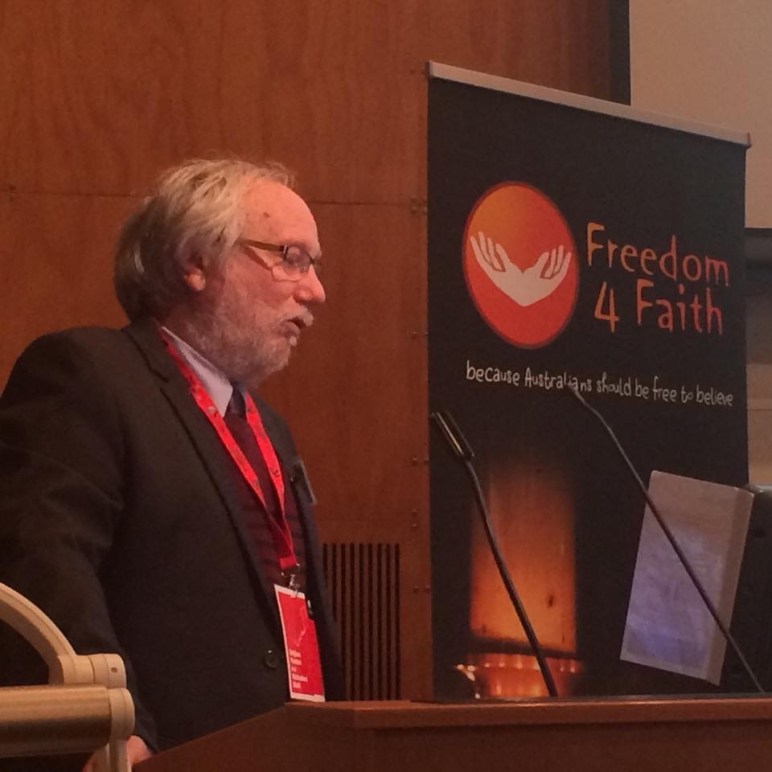
I am jointly organising a one-day conference co-sponsored by Freedom for Faith at Newcastle University on Friday 25 September 2015. All the details can now be found at the conference website:  http://www.newcastle.edu.au/freedomforfaith . The day will bring together speakers from a range of areas of public life to discuss the important issues of religious freedom, including:

  • Tim Wilson, Australian Human Rights Commissioner,
  • The Right Rev Dr Peter Jensen, General Secretary of the Fellowship of Confessing Anglicans,former Anglican Archbishop of Sydney;
  • Dr Paul Taylor, International Law Advisor and Barrister;
  • Dr Renae Barker, UWA School of Law and Honorary Research Fellow, Centre for Muslim States and Societies;
  • Dr Greg Walsh, from the University of Notre Dame Australia; and
  • myself!

There is also a flyer here which you should feel free to download and distribute as widely as possible! I hope that some of the readers of this blog may be able to join us on the day!

ReligiousFreedomConferenceInvite

“Extremism” in schools and religious freedom

The NSW Government is rightly concerned about reports from Epping High School, in Sydney, that a student at a “prayer group” meeting at the school was preaching Islamic State ideology to fellow students. It seems that an “audit” is being conducted of “prayer groups” generally to see if others are involved in spreading “extremist” ideology.

While there is no doubt some good reason to be concerned here, there are a number of potential problems flowing from this situation for religious freedom. One of the first issues to be cleared up is this: what is “extremist”? The press report linked above notes, thankfully, that some attempt is being made to give it a confined meaning:

[D]eputy police commissioner Catherine Burn… explained that police defined extremism as “willingness to use violence or support the use of violence by others to promote a political, ideological or religious goal”.

This seems like a reasonable approach. While students, like their parents, should be able to enjoy religious freedom to meet for prayer and discussion in their lunchtimes, it is clear that the limits of religious freedom are reached when this freedom is used for the purposes of generating violence. (I discussed religious freedom in Australia generally in a previous post, and there I noted that one of the earliest Australian decisions on the topic, the Jehovah’s Witness case from 1943, gave strong support to religious freedom as a value, but noted that it had to give way when questions of national security were at stake.)

However, it would be easy to slide from a justified concern about the preaching of religiously motivated violence, into a more “expansive” definition of “extremism” which really would challenge religious freedom in unjustified ways. We can see this danger emerging already in an article in the Newcastle Herald, “Preaching in playground: DET ‘ignored’ repeated warnings” (July 28, 2015). There a lobbyist previously associated with attacks on Special Religious Education in schools (see my previous posts here and here for reports of former attacks on SRE) jumps on the “extremism” bandwagon to claim that his previous “warnings” on the topic should have been heeded. But those warnings, so far as the article claims, seem mainly to have been about “religious groups trying to convert students in public schools”, not about the preaching of violence. Indeed, it seems highly unlikely that the student in Epping was speaking to non-Muslims; one would imagine his words were directed to other Muslim students.

But the difference between the two is elided in an article which seeks to tar any religious group which presents its teachings seriously, as being “extremist”. And, of course:

you can’t cherry pick which religions with extremist views you allow in, and which ones you don’t.

Well, with respect, you can distinguish between different “religious” groups, and have to, precisely on the grounds of what they teach. Some religious views are “extremist” and others are not. This means, of course, that schools are quite justified to generally monitor the content of what is being taught in school religious groups, so long as this is not done in such a heavy-handed way as to stifle all expressions of religious faith by students. And it will be perfectly rational to be more careful with religious groups where high-profile representatives of the religion concerned have been known to make clear public pronouncements about inflicting physical violence on non-believers.

Unfortunately the developing issues here in NSW reflect to a large extent developments on a far more serious scale in the United Kingdom. There, in a scandal in 2014 that engulfed a number of government-run schools which came to be known as the “Trojan Horse” incident:

An investigation ordered by the government.. found a “sustained, coordinated agenda to impose segregationist attitudes and practices of a hardline, politicised strain of Sunni Islam” on children in a number of Birmingham schools.

The investigation of this incident, of course, led to a Government determination not to allow hard-line Islamic views to dominate in government schools. Unfortunately, it seems that the lazy “all religions are the same” attitude of some bureaucrats has led to proposals to severely restrict all religious groups, not just those advocating religious violence, from presenting their views in schools. Indeed, in more recent times the UK Government has proposed a system of “Extremism Disruption Orders” which are seen as raising important challenges to freedom of speech and religious freedom. In an attempt to deal with the very real threats of religiously inspired violence, the danger of sweeping up religious views generally, especially those which do not conform to the current “sexual orthodoxy”, is a very real one. In an important article, Extremism and Censorship, the Gatestone Insitute notes that the definition of “extremism” that the UK Government seems to have adopted is:

vocal or active opposition to fundamental British values, including democracy, the rule of law, individual liberty and mutual respect and tolerance of different faiths and beliefs.

What, then, are “fundamental British values”? Again this is unclear, but one commentator has noted:

Those engaged in passionate debates — such as Christians objecting to gay marriage — could find themselves slapped down. Monarchists or communists could be swept up for peacefully expressing their political views.

Indeed, the Christian Concern group in the UK reports that recent comments of the Education Minister there seem to suggest that

the Christian teaching about marriage and sexual ethics would now be labelled as an “extremist view that needs to be monitored and punished.”

In short, we need to be discerning about the sort of views which are targeted when we start using the label “extremist”. The Gatestone Institute, in the post linked above, notes that governments will need to be discerning in deciding which religious groups receive funding and support, and which don’t. It will be necessary to “cherry-pick”- to listen to the views that are being presented by different groups, and where viewpoints are to be opposed, to only do so in the most serious cases of physical violence against others being advocated and supported. Differences of opinion on other matters, on sexuality, on abortion, on forms of government, on asylum seekers and climate change, need to be tolerated and debates allowed to continue. There will be no substitute for careful and thoughtful work with religious groups and their leaders, and on occasions the drawing of clear lines. But suppression of religious freedom can only be justified by the most serious forms of direct harm, and should never be engaged in merely to avoid “offence” or “annoyance”.