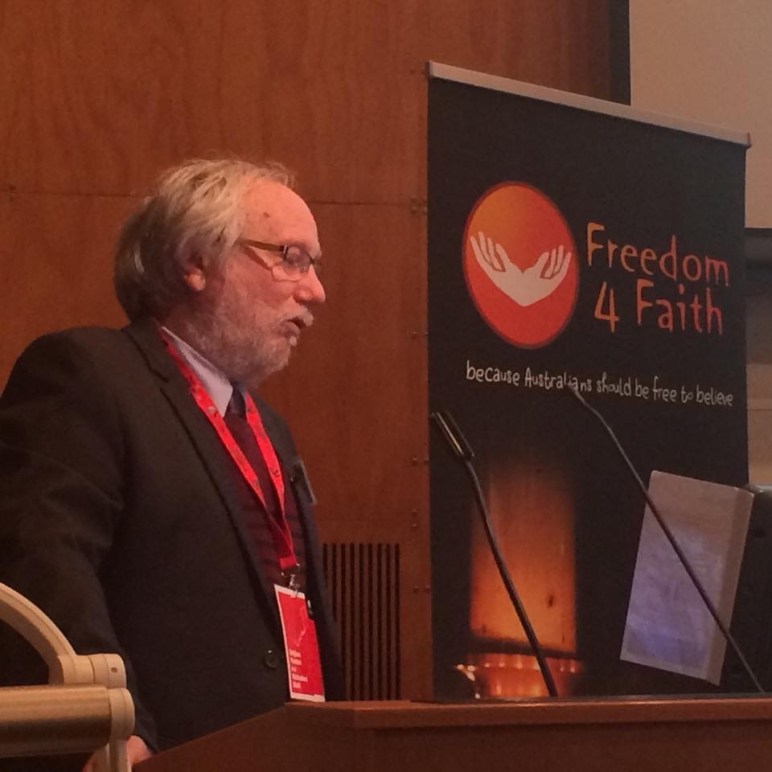
Interview on Religious Freedom in Australia

I sat down recently with a former student of mine, Ian Benson, who conducted an interview with me on behalf of the Sydney law firm A R Conolly & Co, on the subject of religious freedom in Australia. For those who have about 45 minutes or so, the video can be viewed here.

Paper on churches withdrawing from marriage if same sex marriage is introduced

We had what seemed to be a very well-received conference on Religious Freedom in a Multicultural World on Friday; we hope to make audio and possibly some video available soon, which I will mention here. In the meantime, for those who are interested, the paper I presented is available here. I hasten to add that regular readers of this blog will experience, as the recently deceased Yogi Berra used to say, “deja vu all over again”, because much of the content was taken from some blog posts and interaction with my friend John McClean. But I have added some more material at the beginning setting the scene, and hopefully bringing it all together into one spot will be useful.

Religious Freedom in the Newcastle Herald

Today I had an opinion piece in the Newcastle Herald entitled “Free to live by one’s beliefs“. The issues raised here are among those to be discussed at the Religious Freedom in a Multicultural World conference to be held at Newcastle University this Friday September 25. If you would like to come, see the website here for details and a link to register. (By the way, if you are a pensioner or in receipt of Government assistance generally, you can register at the Student rate of $25 rather than the full rate!)

After the conference I will be posting the paper I am presenting on this blog, and I hope that the other talks will be recorded so we can share them more generally.

Jail time for Kentucky County Clerk

Summary: Ms Davis was not setting herself “above the law” as so many commentators have suggested. She was attempting to act within the law.

The internet is full of reports and comments about Kim Davis, the Kentucky county clerk who has been sentenced to jail for contempt of court in refusing to issue marriage licenses. Ms Davis’s objection stems from the ruling in the US Supreme Court decision in Obergefell finding a constitutional right to same sex marriage. As a devout Christian she regards same sex marriages as contrary to the Bible’s teaching on God’s purposes for humanity, and she does not wish by her actions in issuing marriage licenses (whether for same sex or heterosexual marriages) to be complicit in supporting such a system.

Even some normally conservative Christian commentators have responded negatively to her decision, which involves not only not issuing these licenses herself, but also directing the other 6 clerks in her office not to issue the licenses. While at first this seems very odd, the explanation for the direction seems to lie in the fact that as Rowan County Clerk, under Kentucky law her name will appear at the foot of all licenses issued by her office. The latest news available at the time of writing suggests that deputies have issued licenses, while Ms Davis is in jail, although there is some doubt about whether the licenses bear Ms Davis’ name.

Questions raised by this incident are similar to those being raised all over the Western world in countries where same sex marriage has been recognised. To what extent should the religious freedom of those called on to celebrate or support such marriage ceremonies be recognised? This blog won’t be able to answer all those questions, but I would like to set out some considerations that I think policy and law makers should take into account, and to comment briefly on this decision. (For those interested a more in-depth consideration of a range of religious freedom issues, including some raised by the possible recognition of same sex marriage in Australia, let me remind you that the University of Newcastle, here in NSW, is running a one-day conference on these issues on Friday September 25- and the “early bird” registration has been extended now to Sept 7!)

  1. Religious freedom is a fundamental human right, not some excuse made up to allow homophobia. It seems bizarre to have to say this, but occasionally one comes across the view represented by the second clause in the previous sentence. Perhaps one reason that some might suspect this, is that religious freedom debates have mostly been fairly minor in Western societies until recent years, and where they occurred they often involved minority, non-Western religious groups. The reason for this may be that up until recently most Western societies have operated on a broad moral consensus which was shaped by Christianity. In the area of sexual behaviour, for example, while since the 1960’s increasingly many people have not behaved in accordance with Christian norms that sex should only be enjoyed in a married relationship between a man and woman, many of those people have at least conceded that this was an “ideal” to which it would be good to aspire. But in recent years the successful work of homosexual activists in transforming the societal consensus on this question has led to a number of challenges for those who wish to live in accordance with Biblical principles. Christian views on appropriate sexual behaviour can now be attacked, not merely as out-dated or archaic, but as positively evil and harmful. Yet those views, as with some other controversial views which differ from the mainstream of society, may be deeply held and based on fundamental religious convictions which are not new, but often go back many thousands of years.
  2. Of course this means that sometimes a person’s religious beliefs will impact on the way they conduct their “secular” job. In the private sphere this raises issues about whether an employer should provide “accommodation” (a term which in this context doesn’t mean, “a place to live”, but means “some adjustment of the usual requirements to allow religious freedom”.) The view that if a religious person doesn’t like what their job requires, they should just quit their job, has occasionally been put forward in the past. But in more recent years courts have recognised that where accommodation is possible, it should be provided if it can be without unduly impacting on others in the workplace- just as in the area of sex discrimination, we recognise that accommodation should be provided where female employees need leave to have babies, or “family friendly” arrangements so that they can continue in the workforce when a baby has arrived. An example of this was the UK case of the British Airways employee who wanted to wear a visible cross despite a blanket “no jewellery” rule by her employer. When the case of Nadia Eweida reached the European Court of Human Rights, that court held that a reasonable accommodation could have been provided to employees with strong religious views about wearing religious symbols. I have discussed other similar cases in the past, some to do with the wearing of a head scarf at work.
  3.  Religious freedom is about more than the right to hold certain beliefs internally, however; it is about a right of “free exercise” of religion which will mean that a person will live out their religious beliefs in everyday life. Indeed, it is a fair criticism of someone who claims to be a believer that their life does not match their claimed religious beliefs. All of us are grateful when people with deep religious beliefs live out those beliefs in caring for the poor and marginalised, in generous giving to worthy causes, and in looking after people in their local communities. So we need to resist the occasional “reframing” of religious freedom in terms of “a right to worship”; it is much more than that.
  4. Do these same principles apply, then, to a public servant? Or must we require all public servants to park their fundamental religious freedom rights at home when coming to work? The answer is that public servants do have, and should be allowed to exercise, religious freedom. It is not a question, as some have put it in recent days, of a public servant being “allowed to disobey the law”. The law should contain, and in most Western countries does contain, recognition of religious freedom rights, and relying on such a provision means that one would not be disobeying the law, one would be acting within the law.
  5. An example, closely analogous to the current matter, can be found in the case of Ms Lillian Ladele in the UK. Ms Ladele was employed by Islington Borough Council. In the UK, many registration functions are devolved to local Councils. The UK introduced legislation allowing parties to register a “civil union” (not at the time a “marriage”, but a formal procedure for recognising a same sex relationship which provided similar ancillary benefits.) Ms Ladele, an evangelical Christian, took the view that this type of procedure was authorising sexual behaviour contrary to the Bible, and she asked to not be placed on the list of registrars who would deal with these requests. She had joined the Borough long before this legislation was introduced, and there were other registrars who could easily have done the job.
  6. Despite the fact that no member of the public was in any way disadvantaged by her objection to dealing with such requests, Ms Ladele was fired for refusing to do so. Unlike Ms Eweida, the airlines employee noted previously, when Ms Ladele’s case went to the European Court of Human Rights the court by majority ruled that the Council had been entitled to dismiss her for not complying with their “equal opportunity” policy. The case has been criticised for failing to give due weight to Ms Ladele’s religious freedom.
  7. The point to note in the current context is that she was not acting “illegally” in the sense of high-handedly defying a clear law. She argued that regulations in force at the time provided that her religious freedom rights under art 9 of the European Convention on Human Rights should be taken into account. And indeed the European Court agreed that she had such rights, although they ruled in the end that these rights should, in the circumstances, be over-ruled. But she was not a “defiant lawbreaker”, because she believed on plausible grounds that she had religious freedom rights, which were part of UK law, which she could rely on.
  8. Let’s come to the case of Ms Davis. The main court decision here is the decision of Judge Bunning, in the Federal District Court, in Miller v Davis 2015 WL 4866729 (E.D.Ky.) (12 Aug 2015). Ms Miller, one of the various couples who had approached the clerk’s office to be told they could not have a license to marry, was suing Ms Davis in the Federal (not the Kentucky State) Court because she claimed that pursuant to 42 U.S.C. § 1983, a provision of Federal law, she as an official of the State was “subject[ing].. [the plaintiffs to] the deprivation of any rights, privileges, or immunities secured by the Constitution”; the “right” in question being the “right to same sex marriage” identified by the US Supreme Court in Obergefell. She sought an injunction to require Ms Davis to issue licenses for such marriages.
  9. Ms Davis in her defence spelled out a number of legal reasons which would justify her action; again, she was not claiming in a high-handed way the right to ignore the law. Her arguments referred to the fact that any constitutional right may be subject to being over-ridden in a particular case due to a sufficiently compelling State interest; that her own rights of freedom of speech and freedom of religious exercise, granted by the First Amendment to the US Constitution, were being unduly interfered with by the Governor of Kentucky’s order that all clerks personally issue same sex marriage licenses; and that her rights under Kentucky’s Religious Freedom Restoration Act were being breached. In this already too-long post I can’t adequately deal with all these arguments, although it seems to me that some indeed had much more merit than would be suggested by Judge Bunning’s dismissal of them. But I would like to comment on one in slightly more detail, the Kentucky RFRA.
  10. I have mentioned this type of legislation in a previous post here recounting controversy in the State of Indiana, and interestingly this very piece of Kentucky legislation was involved in a previous case mentioned here where a printer of T-shirts was allowed to decline to print a T-shirt supporting a “gay pride” march. The law, a State law and so clearly applicable to the decision of the Kentucky Governor to order clerks to issue licenses, provides that:

Government shall not substantially burden a person’s freedom of religion. The right to act or refuse to act in a manner motivated by a sincerely held religious belief may not be substantially burdened unless the government proves by clear and convincing evidence that it has a compelling governmental interest in infringing the specific act or refusal to act and has used the least restrictive means to further that interest (Ky.Rev.Stat. Ann. § 446.350)

  • In other words, before the Kentucky Governor required every county clerk in the State to issue same sex marriage licenses, it would seem reasonable that he have considered whether this would impose a substantial burden on religious freedom, whether this burden was justified by a “compelling governmental interest”, and whether there was a “less restrictive” way to achieve this interest. In this situation it seems fairly clear to me that this legislation should have applied in Ms Davis’ favour:
    1. While different believers may agree or not with the view that she would be “complicit” in same sex marriages by issuing licenses, there seems no doubt that this was a genuine belief strongly held on plausible religious grounds. The State should not be in the business of making up the minds of believers about these things; it seems reasonable where someone can articulate a plausible belief, that it be regarded as worthy of respect. One feature of the law here, noted above, is that every marriage license must have the name of the clerk who issued it, at the bottom of the license- not just the office, but the actual name. This as mentioned explains the otherwise odd fact that Ms Davis objected to other clerks issuing the licenses as well- for they would all have borne her name as the county clerk.
    2. The State no doubt has a “compelling interest” in allowing its residents to enjoy a constitutional right declared by the Supreme Court. One may perhaps doubt whether “compelling” is a good way to describe the interest in allowing people to get marriage licenses in their home town rather than merely driving half an hour to another town, but that can be conceded for the moment. (Note that a license once issued somewhere is good for the whole of the State, so the parties concerned would not have been prevented from holding a ceremony in their home town once they had got the license from elsewhere.)
    3. Still, there seems absolutely no doubt that a less restrictive means of furthering this interest could have been found. The law could be changed to allow licenses to be issued from an office, rather than personally under the clerk’s name. Once it became clear that some clerks would have problems, it may even have been possible to set up an online application system for issue of marriage licenses. Other solutions would no doubt present themselves, as has been made clear for example in Utah and other States.
  • Yet in his judgment on the issue, Judge Bunning glosses over the RFRA provisions far too quickly. In one paragraph he asserts that Ms Davis’ religious objection is misconceived, and in any event she can still go to church!

Davis is simply being asked to signify that couples meet the legal requirements to marry. The State is not asking her to condone same-sex unions on moral or religious grounds, nor is it restricting her from engaging in a variety of religious activities. Davis remains free to practice her Apostolic Christian beliefs. She may continue to attend church twice a week, participate in Bible Study and minister to female inmates at the Rowan County Jail.

  • With due respect, the Judge’s comments suggest he does not really understand the religious freedom issues. He is taking on himself the question whether Ms Davis’ religion really means what she says it means. As already noted, even other religious believers may agree that it is not “condoning” same sex marriages to issue a license; but the belief is a genuine one and should have been accommodated rather than being belittled (especially as the competing interest expressed by the couples is a “preference” for a marriage license to be issued in their local town, which on the most generous view seems not quite as heavy as a genuine conscientious objection which would lead one to prefer jail rather than issuing the license.) And the comments about her continuing freedom to go to church demonstrate a staggering mis-understanding of “free exercise” as limited to worship activities.

In other words, to conclude this lengthy discussion, Ms Davis was not setting herself “above the law” as so many commentators have suggested. She was attempting to act within the law, in a country which claims to recognise free exercise of religion at both the Federal and State level. It seems likely that her religious freedom should indeed have been recognised by the court, and it is to be hoped that other courts will correct what seems to have been a grave injustice in sending her to jail for contempt of court, when she was in fact acting within her rights.

Her case also demonstrates the importance that needs to be given to consideration of religious freedom issues if same sex marriage is to be recognised. In Australia that is a debate we are still having, and it is to be hoped that if this happens here, we can learn some lessons from cases like this to do a better job of recognising legitimate religious freedom claims when changing the law of marriage.

Schools, same sex politics and religion in NSW

The Minister for Education has asked that a controversial documentary, “Gayby Baby”, be shown outside school hours, rather than as part of the school day, at Burwood Girls High School, in Sydney’s inner West. As the ABC correctly reports:

Burwood Girls High School sent parents a flyer last week informing them that all students would attend a screening of the film Gayby Baby during class hours on Friday, as part of Wear It Purple Day — an initiative designed to promote acceptance and tolerance of diversity.

The PG-rated film follows the lives of four children — Gus, Ebony, Matt and Graham —growing up with gay parents.

No-one can deny that the film deals with an important issue being debated in Australian society today. Indeed, the trailer shows at one point some of the participants watching a television show where the merits of same-sex marriage are being debated. As pointed out in one media comment:

A review highlighted on the Gayby Baby website describes it as an “intrinsically political” documentary and says children of “queer” parents are being used to counter opponents of so-called marriage equality.

So there is no doubt the film is “political”, as dealing with a matter of highly charged debate in the Federal Parliament and in the public sphere. Yet the school was proposing to cancel classes and direct all students to attend, while also encouraging (if not directing) all of them to wear the colour purple as a mark of support for homosexuality. The original notice from the school to parents was very clear: “All students will attend a special screening….followed by purple cupcakes and fashion parade at lunchtime under the rainbow flag. Please wear purple.” A letter from the Principal enthused: “I look forward to seeing a sea of purple.” There seems to have even been a suggestion of a prize for the “most purple” outfit.

The Department of Education and Communities policy on “Controversial Issues in Schools” provides that:
1.1  Schools are neutral grounds for rational discourse and objective study. They are not arenas for opposing political views or ideologies…
3.1 Schools are places where students are preparing for informed and reasoned involvement in community life, including its politics, by calm and co-operative study of social issues. Schools are not places for recruiting into partisan groups…
4.1 The Principal is responsible for ensuring a balanced and reasonable consideration of various viewpoints is contained within curriculum content delivered by teachers, within presentations to students at schools by visiting speakers and while undertaking school excursions…
4.8 It is the responsibility of the Principal to ensure that staff are familiar with the substance of this policy, that parents are made aware of its implications and, where appropriate, are consulted with regard to the participation of their children in programs dealing with controversial issues. (emphasis added)
In light of these policies it seems fairly clear that this documentary would either be unsuitable for showing during class time, or parents ought to have been consulted as to whether they wished their children to attend. At the very least parents should have been provided with an opportunity to view the material beforehand, and to make their own judgment about its balance, and whether it presents a reasoned perspective on the issues. Yet the initial contact with parents made no such offer.
Subsequently, after it became apparent that a number of parents were concerned, and a local Presbyterian minister had made representations on their behalf, a belated letter from the school offered an option for children to be withdrawn from the activity and offered other activities in the library. (The letter appears in this press comment.)
By this time, however, the Minister for Education had become involved.

Education Minister Adrian Piccoli confirmed he had intervened.

“I have directed the Department of Education to ensure the film is not shown during school hours,” he said.

(The NSW Premier) Mr Baird said he supported schools screening the film, but not during class.

“I understand the intent of that is to provide an example of tolerance and that’s something I absolutely support,” he said.

“Should it be in class time? No, I don’t think so. Should it be optional? Yes, I do think so.”

Naturally there has now been strong criticism of the decision of the Minister not to allow the movie to be shown as part of formal school teaching time.
Some might suggest a similarity between this incident and a previous episode where the Department had attempted to exclude certain books from being used in Special Religious Education classes in high school, in part because those books taught the Biblical view that sex is only intended for the context of marriage between a man and a woman. I commented on that episode previously here and here. The Department’s decision was subsequently reversed.
But drawing those connections would, in my view, be wrong. SRE is provided in NSW Schools as an openly “confessional” program, teaching the beliefs of a particular religion from that religion’s perspective. It is explicitly authorised by legislation, and all parents have the right to withdraw their children from the classes at any time. By contrast, the mainstream teaching time in State schools is intended, as the Department’s legally binding policy quoted above makes clear, not to push a specific “political” agenda. And here, the school as it originally communicated to parents did not suggest that it was giving parents an option to withdraw their children from a film which would clearly, from viewing the trailer, be presenting a clear view in favour of homosexuality. Parents who hold a view that, in accordance with their religious commitments, such behaviour is wrong, should be entitled to not have that view undermined by powerful propaganda to the contrary, when that material is not part of the school curriculum.
It is obviously a good idea that a calm and reasoned debate be allowed to happen on same sex marriage and other issues to do with same sex attraction. There is no doubt that children of same sex parents have particular issues that they wrestle with, and that their situation needs to be understood. However, evenhanded discussion of these important issues cannot happen where there is an “official” assumption that anyone who holds to a traditional religious view on the morality of homosexuality is a “bigot” whose views can be ignored or marginalised in public life. The school’s apparently automatic assumption that a particular view on these matters could be presented in school hours alongside maths and chemistry, as a matter of established consensus, sends that signal.
The Departmental policy noted above seems a sensible one- where matters of this highly controversial nature are involved, they should and will be discussed within families and in other venues. They can be discussed in contexts that are set aside for presentation of religious perspectives, such as SRE classes, or among students themselves. But it does seem inappropriate that a school officially present one side of the debate as if all the issues were settled, without regard to deeply held views of parents and children.
(In the interests of full disclosure, I should mention that I have a relative attending the school in question. But all that means is that I saw some of the correspondence before it came into the public domain. I would be equally concerned about this sequence of events at any public school.)

Same sex marriage: referendum or plebiscite?

The debate on same sex marriage in Australia has changed dramatically in recent days. The current Liberal and National Party Coalition Government went into the last Federal election promising to maintain the definition of marriage as between a man and a woman. Subsequently some members of the Liberal Party indicated that they were personally in favour of recognising same sex marriage. (As previously noted here, in Australia at the moment it is clear that change in this area will have to come from the Federal Parliament in some way, as the High Court of Australia has made it clear that States and Territories cannot over-ride the Federal law on the matter, and that court is not at all likely to find an “implied constitutional right” to same sex marriage as was done recently by the US Supreme Court in the Obergefell decision.)

In response to pressure from the members of his own party, the Prime Minister, Tony Abbott, who has long signalled his desire to maintain traditional marriage, called a meeting of the party room to discuss whether or not members of the Coalition should be given a “conscience vote” on the issue. (In the Australian version of the Westminster system, party members almost always vote with their party on legislation in Parliament. Conscience votes, where members are free to express their own view without facing party censure in any way, are rare, and mostly reserved for the traditionally difficult “life or death” issues such as abortion and euthanasia. On the other side of politics, the opposition Australian Labor Party currently has a policy allowing its Parliamentary members such a vote on this issue; but at its most recent annual conference, it put in place a policy which means that support for same sex marriage will be a platform of the party from 2019, and at that point any ALP member of Parliament who disagrees will have to resign from the party.)

The result of the recent Coalition party meeting was that, by a 2/3 majority, the meeting voted to maintain support for traditional marriage as formal part of party policy. This means that, in theory, an individual Coalition MP or Senator could choose to “cross the floor” to support same sex marriage, but if they did so they would be unlikely to receive further advancement within the Government. In addition, members of the Cabinet are now bound to support traditional marriage, and if they wish to depart from that policy will have to resign their posts as Cabinet ministers.

Following the meeting, however, the Prime Minister announced that, at some stage in the future, the Coalition would undertake to hold a broad public vote to determine the extent of support for change in the Australian community. Some matters are still unclear, however. The timing of such a vote is uncertain: would it be prior to the next Federal election? Held at the same time? Following the election? In particular, there is ongoing debate over the legal form such a vote would take. The main choices seem to be between a referendum and a “plebiscite”.

There are important differences between these two options. A referendum is the means by which the Australian Constitution is amended, under s 128. (As this excellent review piece by electoral commentator Anthony Green notes, the word “referendum” is not used in the Constitution, but the word, in the Federal sphere at least, has come to be applied to the s 128 process). Procedures for setting and arguing a referendum question are reasonably clear. Such a vote could only be successful if supported by a “double majority”: an absolute majority of the voters, and also by a majority of voters in a majority of States. On the other hand, a plebiscite is a more generic term which simply refers to a vote on an issue, which presumably (unless Parliament decided otherwise) would simply require a majority of voters to approve it. Anthony Green notes that historically there have been only three plebiscites held in Australia, two during World War I about conscription, and one to vote on a new national anthem.

What are the relevant issues needing to be resolved to choose between these options, should they proceed? (It should be said that the ALP has indicated that, if they are returned at the next election, they will immediately put the matter to the Parliament. So there may not need to be such a vote in that case. On the other hand, if this happens before 2019, and given that there are some ALP members of Parliament who are known to support traditional marriage, the proposal might once again not succeed. In which case the national vote might come back onto the agenda!)

Jeremy Gans in a brilliant piece in the “Opinions on High” blog from Melbourne Law School does a great job of summarising the options. Which one is preferred by any particular commentator will be partly affected by their view on the best outcome.

Referendum

There are at least two important questions about a referendum on this topic. Is it necessary? What would be the effect of the vote?

As to the necessity of a referendum, opinions differ. What is clear is that, in its decision in Commonweath v ACT [2013] HCA 55 (12 Dec 2013) (the Same Sex Marriage case), the 6 judges of the High Court of Australia who decided that case took the view that the word “marriage” in s 51(xxi) of the Constitution was broad enough to allow the Federal Parliament to enact a law conferring that status on a same sex couple. However, with respect to the court, I disagree, and I am not the only commentator to suggest that this aspect of the Court’s decision is open to challenge (see articles by Professor Twomey, “Same-Sex Marriage and Constitutional Interpretation” (2014) 88 Aust Law Jnl 613- 616 and Professors Parkinson and Aroney, “The Territory of Marriage: Constitutional Law, Marriage Law and Family Policy in the ACT Same Sex Marriage Case” (2014) 28 Australian Journal of Family Law 160-192.)

The problem as I see it is that the 2013 case was not in essence about the power of the Federal Parliament. The issue in that case was whether the ACT legislature could pass its own legislation recognising same sex marriage, contrary to the clear words of the definition in s 5 of the Federal Marriage Act 1961 (Cth) providing that marriage is a relationship between a man and a woman. For reasons spelled out in my earlier paper (which I urge the reader to consult, if only for the opening cartoon!), I maintain that the Court’s decision on this main point, that the ACT law was invalid in light of the Federal law, was correct; but that it was not necessary for that decision for the Court to rule on the wider point as to whether such a Federal law would be within power. I appreciate that the Court itself took the view that this issue was necessary to decide; I am simply not persuaded that they were correct.

In the paper I use a somewhat far-fetched example about “bankruptcy”, mainly because it is also a specific head of Federal legislative power, and it is also a personal “status” which the law regulates, like “marriage’. I suggest that one may conclude that a State or Territory law declaring all red-headed persons to be “bankrupt” is invalid due to the “covering of the field” of bankruptcy by the Federal Parliament, without  also needing to conclude that the Federal Parliament’s power would entitle it in its turn to pass such a law. It may be that no legislature in Australia has the power to bankrupt persons on the basis of their hair colour. While such a result may seem odd for those committed to the most expansive possible definition of Parliamentary sovereignty, it seems consistent with the nature of our Federation that some matters may just not be capable of being legislated, at least as the Constitution currently stands.

Of course there is an ultimate sovereign Australian legislator who could enable such a law- it is the Australian people, acting through s 128 of the Constitution, who could provide the Federal Parliament with all the hair-colour-based bankruptcy powers they need. And so with same sex marriage: a referendum altering s 51(xxi) could allow a law to be passed to recognise a same sex relationship as a “marriage”.

In my view, if such a change were to be introduced into the Australian community, this is how it should be done. There is, after all, some lingering doubt that the comments of the High Court in the Same Sex Marriage case might be regarded as obiter dicta, which could be put to one side by a later bench squarely presented with the issue. (As I and others have pointed out, it is particularly unfortunate that these comments were made in a case where there was no “contradictor”, because the Commonwealth, for whatever reason, effectively conceded the issue without real arguments, and neither party had come prepared to argue the point in any detail.)

Jeremy Gans notes some of the consequences of a successful referendum:

One possibility is that the referendum will succeed, writing the view of six High Court judges in 2013 permanently into the Constitution. While that won’t change the law, it will have the effect of barring a future High Court from disagreeing with that particular holding. Specifically, it would remove the power to decide from four future High Court judges, for instance stopping Gageler, Nettle and Gordon JJ (none of whom participated in the 2013 decision) from getting together with French CJ’s successor sometime after 2017 to rule that the federal parliament lacks power to enact a same-sex marriage law (effectively putting the political ball in the court of state or territory parliaments.)

In other words, Gans concedes (though does not support) the possibility that at least 4 out of a future 7-member High Court bench might possibly conclude that the earlier decision was wrong. (Another possibility, of course, is that one of the members of the 2013 bench may be persuaded to change their mind.) For supporters of same sex marriage, that ought to encourage them to see the referendum as a positive step, especially if the oft-cited statistic of 64% of the Australian people supporting same sex marriage is correct.

It is important, however, to spell out the consequences of a referendum either way.

  1. A successful referendum changing the law

On the one hand, the referendum might succeed. But the result of such a vote would simply be to authorise the Federal Parliament to enact a law allowing same sex couples to marry. One may presume that a Government which had put the question to the people would, when confronted with a vote in favour, go ahead and implement the wishes of the people. (The current Prime Minister has given such an undertaking.) But there would be no mechanism requiring them to do so. Still, I think it can be assumed that even a Coalition Government faced with a successful referendum would enact a law on the topic.

However, one issue which has not been satisfactorily resolved is the question as to whether explicit protections are to be provided for religious freedom, once such a referendum had passed. A number of recent commentators, including the Human Rights Commissioner, Tim Wilson, a supporter of same sex marriage, have pointed out that such protection will be needed.

Interestingly, there is a precedent already for protection of competing rights to be provided for in a Constitutional referendum. Section 51(xxiiiA) was added to the Constitution in 1946, after World War 2, to allow the Commonwealth Government to continue to make payments of various pensions and benefits which it had been previously been making, but which had been found to be not supported by an existing Commonwealth head of power. It provides that the Commonwealth Parliament has power to legislate for:

“the provision of maternity allowances, widows’ pensions, child endowment, unemployment, pharmaceutical, sickness and hospital benefits, medical and dental services (but not so as to authorize any form of civil conscription), benefits to students and family allowances”.

The meaning of the bracketed words, “but not so as to authorise any form of civil conscription”, has been the subject of some debate in subsequent decisions of the High Court (see British Medical Association v Commonwealth [1949] HCA 44; (1949) 79 CLR 201 (7 October 1949); General Practitioners Society v Commonwealth [1980] HCA 30; (1980) 145 CLR 532 (2 September 1980); Wong v Commonwealth of Australia; Selim v Lele, Tan and Rivett constituting the Professional Services Review Committee No 309 [2009] HCA 3 (2 February 2009)). However, at the very least they provide protection to doctors and dentists from being “drafted” into government service against their will.

If a referendum is to add a specific provision allowing same sex marriage, it would seem to be wise to include some such words of protection for religious freedom and conscientious objection. Such protection is required, in the face of increasing evidence from other parts of the world where same sex marriage has been introduced, that “wedding support” businesses are being penalised where the business owners object to being “conscripted” into celebration of unions which they find, for deeply held reasons of religion or conscience, unable to support. (See previous posts here and here dealing with some of these cases.) Perhaps some such wording as the following would be suitable for an amended s 51(xxi):

“(xxi) Marriage, including marriage of persons of the same sex (but in that case not so as to authorize undue interference with the free exercise of religion or belief by those asked to celebrate or provide creative support for the relevant ceremony).”

The reference to “creative support” here is intended to cover those who are asked to devote artistic talents to a ceremony, such as wedding cake makers, florists or wedding photographers, but not to include those simply asked to provide ordinary commercial services such as the provision of food or the hiring of secular premises. (The only danger of including such a specific provision is that it might be said that this precludes recognition of other circumstances where religious freedom ought to be recognised, but it should be made clear in the enacting law that this is not the intention. Where s 116 of the Constitution would generally require protection of “free exercise” of religion in other circumstances, it should continue to do so.)

2. A referendum which fails to change the law

Suppose, on the other hand, that a referendum were unsuccessful? In that case presumably the Government of the day would feel free not to proceed with proposals to change the law. But then what would happen should that Government be replaced by another with the Parliamentary power to enact same sex marriage legislation? Would the failure of the referendum mean that legislation could not be enacted?

It seems fairly clear that this would not be the case. In other words, even if a referendum to introduce same sex marriage were to fail, there would be nothing to stop a later Parliament from enacting a law, based on a view that the comments in the 2013 High Court decision in the Same Sex Marriage case were correct.

Jeremy Gans puts it this way:

But what about the other possibility (one presumably hoped for by many of the referendum’s current proponents), that the referendum will fail (either by failing to attract a majority of Australian voters, or failing to attract a majority of voters in at least four states)? That would leave the Constitution unchanged, but could it affect a future High Court’s willingness to revisit its earlier rulings (e.g. on the basis that the referendum signals that the Australian people disagree with the 2013 ruling?) In a 1997 case on whether territory governments could acquire property without just terms, Gaudron J and Kirby J split on whether the fact that a majority of ACT residents voted against a 1988 referendum on this issue could be taken into account. In 2006, a majority of the High Court firmly rejected relying on failed referenda in the decision upholding the Howard government’s workplace relations law… {quoting that case}.

Assuming a future court agrees, this ruling implies that a failed referendum on same-sex marriage would have no legal effect at all on how that issue is eventually resolved. Of course, the referendum could well have a political effect, not only on politicians, but also, perhaps, on the willingness of Australia’s judges to issue holdings that differ from a clearly expressed public vote.

So the failure of a referendum, while one might think that it should send a signal to politicians that the Australian people as a whole disagree with the change, might not mean that the change could not be attempted; and in those circumstances, the High Court would simply have to interpret the Constitution as it stands.

A plebiscite?

Would a plebiscite give any more certainty? Fairly clearly it would not. Even after a successful plebiscite on the issue, Parliament would not be obliged to pass such a law (though the political pressure would be strong.) And similarly, should the plebiscite fail, supporters of same sex marriage would, if they could command a majority in both Houses of Parliament on the issue, pass a same sex marriage law.

That is not to say that such a vote would not be useful. It would provide some resolution to the perpetual debate over polls which seem to offer widely differing results, depending on the question which is asked. “Do you favour marriage equality?”, for example, seems to be bound to receive a positive answer. “Do you think a child should wherever possible be raised by their biological mother and father?” is likely to also receive a positive answer, even if the person being surveyed does not realise that a positive answer to question 1, may preclude, or at least impact on, a positive answer to question 2. The framing of a plebiscite question is likely to be one of the most contentious debates in the area.

Referendum or plebiscite?

Finally, to come at last to the question posed by the title to this post, which is preferable? I ought to make clear what most regular readers of this blog will know already: my own view is that same sex marriage will be bad for the community, and so I would be opposing the change in any vote, and would continue to argue against such a change whatever the outcome.

But I maintain that I still have a right to have a view on the process to be followed, if such a change is to be made. And my view on balance is that a referendum is preferable. The cynical may suggest that this is because I know that referenda in Australia rarely succeed. But even if that were not so, I believe that a foundational and fundamental societal change of this sort ought not to be made without providing a clear basis for it in the document which forms the grundnorm of the Australian legal system. As noted previously, if there is no such change the question of the validity of Federal legislation on the topic will remain in some, even if slight, doubt. In addition, a binding referendum can provide, if framed as I suggest above, religious freedom protections which are carved into the bedrock of the change, rather than being subject to the winds of Parliamentary change. That, at any rate, is my view at the moment.

Religious Freedom in a Multicultural World conference, 25 Sep 2015

I am jointly organising a one-day conference co-sponsored by Freedom for Faith at Newcastle University on Friday 25 September 2015. All the details can now be found at the conference website:  http://www.newcastle.edu.au/freedomforfaith . The day will bring together speakers from a range of areas of public life to discuss the important issues of religious freedom, including:

  • Tim Wilson, Australian Human Rights Commissioner,
  • The Right Rev Dr Peter Jensen, General Secretary of the Fellowship of Confessing Anglicans,former Anglican Archbishop of Sydney;
  • Dr Paul Taylor, International Law Advisor and Barrister;
  • Dr Renae Barker, UWA School of Law and Honorary Research Fellow, Centre for Muslim States and Societies;
  • Dr Greg Walsh, from the University of Notre Dame Australia; and
  • myself!

There is also a flyer here which you should feel free to download and distribute as widely as possible! I hope that some of the readers of this blog may be able to join us on the day!

ReligiousFreedomConferenceInvite

“Extremism” in schools and religious freedom

The NSW Government is rightly concerned about reports from Epping High School, in Sydney, that a student at a “prayer group” meeting at the school was preaching Islamic State ideology to fellow students. It seems that an “audit” is being conducted of “prayer groups” generally to see if others are involved in spreading “extremist” ideology.

While there is no doubt some good reason to be concerned here, there are a number of potential problems flowing from this situation for religious freedom. One of the first issues to be cleared up is this: what is “extremist”? The press report linked above notes, thankfully, that some attempt is being made to give it a confined meaning:

[D]eputy police commissioner Catherine Burn… explained that police defined extremism as “willingness to use violence or support the use of violence by others to promote a political, ideological or religious goal”.

This seems like a reasonable approach. While students, like their parents, should be able to enjoy religious freedom to meet for prayer and discussion in their lunchtimes, it is clear that the limits of religious freedom are reached when this freedom is used for the purposes of generating violence. (I discussed religious freedom in Australia generally in a previous post, and there I noted that one of the earliest Australian decisions on the topic, the Jehovah’s Witness case from 1943, gave strong support to religious freedom as a value, but noted that it had to give way when questions of national security were at stake.)

However, it would be easy to slide from a justified concern about the preaching of religiously motivated violence, into a more “expansive” definition of “extremism” which really would challenge religious freedom in unjustified ways. We can see this danger emerging already in an article in the Newcastle Herald, “Preaching in playground: DET ‘ignored’ repeated warnings” (July 28, 2015). There a lobbyist previously associated with attacks on Special Religious Education in schools (see my previous posts here and here for reports of former attacks on SRE) jumps on the “extremism” bandwagon to claim that his previous “warnings” on the topic should have been heeded. But those warnings, so far as the article claims, seem mainly to have been about “religious groups trying to convert students in public schools”, not about the preaching of violence. Indeed, it seems highly unlikely that the student in Epping was speaking to non-Muslims; one would imagine his words were directed to other Muslim students.

But the difference between the two is elided in an article which seeks to tar any religious group which presents its teachings seriously, as being “extremist”. And, of course:

you can’t cherry pick which religions with extremist views you allow in, and which ones you don’t.

Well, with respect, you can distinguish between different “religious” groups, and have to, precisely on the grounds of what they teach. Some religious views are “extremist” and others are not. This means, of course, that schools are quite justified to generally monitor the content of what is being taught in school religious groups, so long as this is not done in such a heavy-handed way as to stifle all expressions of religious faith by students. And it will be perfectly rational to be more careful with religious groups where high-profile representatives of the religion concerned have been known to make clear public pronouncements about inflicting physical violence on non-believers.

Unfortunately the developing issues here in NSW reflect to a large extent developments on a far more serious scale in the United Kingdom. There, in a scandal in 2014 that engulfed a number of government-run schools which came to be known as the “Trojan Horse” incident:

An investigation ordered by the government.. found a “sustained, coordinated agenda to impose segregationist attitudes and practices of a hardline, politicised strain of Sunni Islam” on children in a number of Birmingham schools.

The investigation of this incident, of course, led to a Government determination not to allow hard-line Islamic views to dominate in government schools. Unfortunately, it seems that the lazy “all religions are the same” attitude of some bureaucrats has led to proposals to severely restrict all religious groups, not just those advocating religious violence, from presenting their views in schools. Indeed, in more recent times the UK Government has proposed a system of “Extremism Disruption Orders” which are seen as raising important challenges to freedom of speech and religious freedom. In an attempt to deal with the very real threats of religiously inspired violence, the danger of sweeping up religious views generally, especially those which do not conform to the current “sexual orthodoxy”, is a very real one. In an important article, Extremism and Censorship, the Gatestone Insitute notes that the definition of “extremism” that the UK Government seems to have adopted is:

vocal or active opposition to fundamental British values, including democracy, the rule of law, individual liberty and mutual respect and tolerance of different faiths and beliefs.

What, then, are “fundamental British values”? Again this is unclear, but one commentator has noted:

Those engaged in passionate debates — such as Christians objecting to gay marriage — could find themselves slapped down. Monarchists or communists could be swept up for peacefully expressing their political views.

Indeed, the Christian Concern group in the UK reports that recent comments of the Education Minister there seem to suggest that

the Christian teaching about marriage and sexual ethics would now be labelled as an “extremist view that needs to be monitored and punished.”

In short, we need to be discerning about the sort of views which are targeted when we start using the label “extremist”. The Gatestone Institute, in the post linked above, notes that governments will need to be discerning in deciding which religious groups receive funding and support, and which don’t. It will be necessary to “cherry-pick”- to listen to the views that are being presented by different groups, and where viewpoints are to be opposed, to only do so in the most serious cases of physical violence against others being advocated and supported. Differences of opinion on other matters, on sexuality, on abortion, on forms of government, on asylum seekers and climate change, need to be tolerated and debates allowed to continue. There will be no substitute for careful and thoughtful work with religious groups and their leaders, and on occasions the drawing of clear lines. But suppression of religious freedom can only be justified by the most serious forms of direct harm, and should never be engaged in merely to avoid “offence” or “annoyance”.

Further comments on churches withdrawing from solemnising marriages

My previous post on the question of whether Christian churches who see same sex marriage as contrary to God’s word, should withdraw from solemnising marriages under Australian law if that law changes to recognise such unions, was followed by a helpful response from Dr John McClean. In this post I want to offer my response to John’s remarks. (Readers who are interested in this area should also see the detailed response of another Presbyterian minister, Nathan Campbell, whose views are very similar to mine, in 8 Reasons Withdrawing From The Marriage Act Is A Bad Idea For The Presbyterian Church.) Following John’s lead on academic style I will refer to him by his last name. (Again, this post furthers an “in-house” debate, which may not be of interest to those not involved in Christianity, who should feel free to move on at this point!)

Areas of agreement

Perhaps it would first be helpful to clarify areas where McClean and I are in full agreement. As I see it, as fellow evangelical Christians, we agree that

  • The Bible makes it clear that homosexual behaviour is contrary to God’s purposes for humanity and wrong.
  • We are also convinced that God’s grace offers forgiveness and salvation to those who trust in Jesus Christ, his death for sins and resurrection. For both of us, I take it, those issues are the most important. But this debate is one that needs to be had because Australian society, formerly based on a consensus ethical view drawn from the Bible, is now moving further and further away.
  • The introduction of same sex marriage in Australia would have serious long-term impacts on the institution of marriage generally.

Institutional Change of Marriage

However, where McClean and I differ is in the short-term response of the Christian church to the proposed change. He argues that the institution in some sense will be “corrupted” immediately; I take it that the institution of marriage, while it will be impacted in some areas, will continue to reflect God’s purposes for humanity in most marriages that will continue to take place, and that in those areas the institution should be supported by the churches.

I previously offered as a summary two main reasons I had seen in the literature for the move that McClean suggests: an “institutional change” reason, and a “clergy religious freedom” reason. We seem to agree that the second is not a very strong one (and should any proposed legislation not include recognition of the freedom of ministers of religion not to undertake same sex marriages, I would probably need to rethink my opposition to churches withdrawing from the system.) So the rest of my comments will mostly be directed to the institutional change arguments.

Detriments of withdrawal

Partly the difference between us is due to the weight we give the detriments flowing from withdrawal. I suggest that withdrawal will lead to a reduction in opportunities for positive contact between churches and members of the non-church community who still (though I concede, as McClean points out, in decreasing numbers) come to churches for weddings. I see this as an important and serious detriment. I don’t see it as bad, though, simply because of this loss of contact with particular couples. I see it as a negative because it involves yet another area where Christians are being asked to accept being forced out of a role in the public life of the community.

Christian groups have been the founders of, and continue to be the providers of, many important social services in our community. The Salvation Army and St Vincent de Paul continue to play important roles in caring for the most needy in our country. There are still many hospitals and schools run by Christians, with a specifically Christian ethos. The community benefits from these services, not simply because if they were not there then increased taxpayer funds would be needed to replace them, but because these organisations often attract people who see service of this sort as not simply a job, but as a vocation and a calling from God.

Yet there has been increased pressure in recent years from an “absolutist” form of secularism, which seems to be determined to drive Christians out of these forms of service. Overseas, a number of Catholic adoption agencies have been forced to shut their doors because they will not compromise their views on appropriate family structures in organising adoptive families. Pressure is mounting in some areas to revise the provisions of anti-discrimination laws, which allow Christian organisations to conduct their operations in accordance with their deeply held beliefs.

In this context, for a Christian denomination to withdraw from playing an important role in the public celebration of marriage in the community feels very much like a further “defeat,” and to send a message that Christianity is increasingly irrelevant to the lives of ordinary Australians. The public role of the church for many years has been to shepherd those who seek its services in the major life landmarks of “hatches, matches and dispatches”- baptising new born children, celebrating weddings, conducting funerals. Even if, as McClean suggests, churches would still offer ceremonies even to non-believers, following a civil service, the fact that what is offered could not, consistently with the Marriage Act 1961, be called a “marriage”, would I think deter many from bothering.

In my judgment, then, while I appreciate others may take a different view, the detriments of this move would in fact outweigh the detriments of continuing to be part of a changed institution, at least in the near future.

Models for withdrawal

I also noted my concerns about possible models for implementing the proposed withdrawal. McClean offers his view (as he says, no formal model has been adopted as part of the proposals at the moment). He describes one option as follows:

Given a covenantal view, the church should teach that couples are required to have a ‘wedding’ (a public exchange of vows) before they consider themselves married and live together and commence a sexual relationship. The wedding could take two forms: it could be conducted by a celebrant recognised under the Marriage Act (including a minister from a denomination which remains registered under the Act); or it could be one conducted by a Presbyterian minister following the rites of the Presbyterian Church of Australia, but which is not recognised under the Marriage Act. For matters of pastoral care or church discipline, the church would recognise either form of marriage.

He suggests that the church would “probably” favour the model where a civil ceremony was carried out first; but he leaves open the option that a couple may choose not to do this.

Here I have to say I see a major hurdle. In order to explain it clearly, however, I need to try my reader’s patience somewhat by an excursus.

Excursus: What does the Bible say about wedding ceremonies?

One would think that the issue of the Bible’s teaching about wedding ceremonies was something both McClean and I ought to have started with. We both agree on the nature of marriage as the Bible teaches it should be according to God’s purposes: heterosexual, monogamous, with each party entering the relationship undertaking to be sexually faithful and that the relationship will be for life, entered into by parties who are able to freely consent, and in the sight of the community. But what does God say about the wedding ceremony that initiates such a relationship?

The answer, perhaps surprisingly, is: not very much at all. I wrote about this a few years ago when responding to suggestions made by some Christians that we should regard a de facto couple, who had become believers and resolved now to stay together for life, as “married in God’s sight”. I disagree with that view. Let me repeat some of that earlier discussion (slightly edited).

As I see it, and I think this is the Bible’s view, a couple are married when they have made a public commitment to be husband and wife exclusively for life, and they have done so in accordance with the law of the community they live in. In Australia today (and for the last couple of centuries) that means a ceremony that complies with Australian law. To write this off as a “piece of paper”, as even some Christians occasionally do, is wrong. It is not simply a piece of paper; the ceremony is the way of expressing that life commitment which makes a marriage. If that has not happened, then the couple concerned, even if they are living and sleeping together, are not married. Whatever their private intentions, whatever their promises to each other within the privacy of the relationship, a marriage has not taken place until they have entered into that commitment in the sight of the community, in a way which engages all the rules that community has set up which apply to married people.

This view I think flows from the overall pattern of marriage in the Bible. In Gen 1:24 we see that a man leaves his previous membership of the family unit shared with his father and mother, and “holds fast” to his wife and they become “one flesh”. The change is from one family to another and this needs to be recognised in the community because a number of things flow from the status of marriage. (“One flesh” is about being “closest kin” now to the wife.)

Through the Bible there is never a suggestion that a couple are married by some private decision they make on their own. Marriage is seen to be celebrated in the face of the community (eg Gen 24:67, 29:23); indeed, Abraham nearly gets into trouble because Pharaoh in Gen 12:18 does not know Sarai is his wife.

This is just what the word “marriage” means. One obvious reason is that it would undermine the prohibition on adultery if we were never sure who was whose spouse. The forbidden degrees of marriage become impossible to sort out if we as a community don’t know who is married to whom. In light of this normally accepted meaning of the word, I think (if I can resort to a lawyer’s strategy!) that the onus lies on those who say that marriage between a man and a woman can take place other than in the face of the community and in public, to provide Biblical evidence for it. (1 Cor 6:15-16 does not mean that one act of intercourse makes a couple married, as I have occasionally heard said.)

To sum up- it seems to me that marriage is the status recognised in a particular society which leads to the creation of a new family and to an in-theory life long relationship between a man and a woman. (The “in-theory” bit is because most societies, and the Bible itself, recognise some possibility of divorce.) A man and a woman are not married under the law of Australia unless they have been through a legally recognised marriage ceremony.

Further, it seems likely that a man and a woman living under the Australian legal system are not married within the meaning of that term in the Bible until they are married for the purposes of Australian law. Otherwise, as noted previously, the Biblical commands about not committing adultery, etc, become impossible to sort out because we cannot know who is married to whom, until we assess intangibles like the depth of their commitment to God and to each other. To me this is impossibly subjective and not consistent with the fairly straightforward approach of the Biblical material, which all along assumes that it is quite obvious whether someone is married or not.

Support for this view can also be found in an excellent book on this area by Christopher Ash, Marriage: Sex in the Service of God (IVP, 2003). He carries out a very careful review of the Biblical evidence and comes to the conclusion that marriage according to the Bible is “the voluntary sexual and public social union of one man and one woman from different families”. Chapter 11 of the book is where he reviews the evidence that supports the “public” aspect of the definition. I can’t do justice to his careful analysis here, but he notes for example that “consent” is a key aspect of marriage, and that

“in the matter of consent… the nature of marriage as a public commitment (a “sexual and public social union”) comes to the fore… Consent is not a private matter of the thought-life but a public affair of the spoken word and deed.” (p 220)

He points out that the Hebrew and Greek words that are used for “marriage” only rarely refer to the “status”, and most often refer to the “wedding feast”, which of course is a public community affair (p 234). He notes that a requirement that there be public recognition of marriage benefits (i) outsiders who need to know who is married to whom; (ii) the weaker party who may be pressured into giving a consent they do not mean; (iii) the parties, because “public commitment buttresses a private pledge” (p 238) and hence it is harder to back out of. He concludes the chapter by stating:

“The public dimension of marriage is not an ethical extra to make marriage better, but is of the essence of marriage as instituted by God.” (p 245)

I can see that there are possible, unusual, circumstances where a couple could be regarded as married who have not gone through a legal marriage ceremony- for example, on a desert island after a plane crash. But there seems no good reason why a man and woman living in Australia today wouldn’t enter marriage in the way our society has chosen to recognise marriage- i.e., by going through a legal marriage ceremony. Why would a couple who want to consent to a lifelong exclusive sexual commitment to each other in the service of God together, not want to use the mechanism our society provides for formalising this? Indeed, it seems that in Australia today if they choose not to do so, then they are saying by their actions that they are not willing to take on the relationship of marriage.

For the church to decide that it will set up its own rules as to when a couple can be regarded as “married in God’s eyes” is both unhelpful and unnecessary. Indeed, it is arguable that the view that there is a concept of being “married in God’s sight”, as distinct from married according to the prevailing social rules, is probably not there in the Bible. People are either married or they are not; the way you determine this is to see if they have complied with the relevant social rules, which will include some public commitment formally expressed in some way.

This does raise the possibility that a couple could enter a marriage in accordance with Australia law that might be prohibited by the Bible. Actually, given the development of Australian marriage law from Christian origins, it has up to now been a bit difficult to find a good example of this. Australia law on prohibited relationships, for example, tends to be pretty close to that in the Old Testament law (assuming for the purposes of discussion that the OT law on this point is still binding on Christians.) There is one difference, however- under Australian law at the moment it is not unlawful to marry one’s uncle or aunt; s 23B(2) of the Marriage Act 1961 (Cth) forbids marriage with “ancestors” and “descendants” and “siblings” but does not catch, say, one’s father’s sister. Leviticus 18:12 is a direct prohibition of sexual relationship with such a person.

However, my inclination at the moment is to say that such a marriage, while it may be disobedient for the people concerned to enter, is indeed a “marriage” if lawful under Australian law. One might want to say to the couple- as a matter of obedience to God you ought not to sleep together. But in my view the couple would still be married. Again, I say this because in my view the Bible’s approach to marriage is to pick up the laws of the local society to determine the status.

Take another example. Suppose that someone comes to Australia from a country overseas that allows polygamy, along with his two wives. All parties would, it seems, be recognised as “married” for the purposes of Australian law so long as the parties concerned were married lawfully in an overseas country with which they were all appropriately connected. (This is different to someone who was Australian seeking to “evade” the law of Australia by marrying overseas. The difference lies in the rules of “private international law” which we can’t go into here.)

Should the church treat the parties as married? I think so. We would want to say, polygamy is not God’s ideal purpose for marriage. But it has happened, and so the status exists. In this case I think I have the support of the Bible, which in the OT of course records cases of polygamy with no indication that any of the wives were not “really” married, and even the NT, where in 1Tim 3:2 Paul requires that an elder be the “husband of one wife” (clearly implying that there were some in the church who did not satisfy this criterion).

(This does not, by the way, mean that polygamy is good. There are sound reasons why the Bible teaches monogamy as the right model, both from a theological perspective and for social reasons. But it means that a polygamous marriage may, in some circumstances, be a “marriage”.)

Back to the main question

So- if I am right to say that marriage according to the Bible is created under the laws of the community we live in- then the flaw in McClean’s proposal from my perspective become even clearer. If the Presbyterian church allowed couples to make promises in a “marriage” ceremony of some sort, in the absence of a prior civil ceremony recognised by the law of the land– the fact is, that couple would not be married. Their sleeping together would be an act of fornication, to use the old word.

I concede that I have not found my view on this matter shared in other sources. I welcome critique from a Biblical perspective. But the evidence suggests to me that a couple are only “married” when they are so regarded by their local community.

(In private discussions John has graciously drawn to my attention the fact that Calvin seems to have had a similar view, that the “magistrate”, the State authority, was an indispensable part of God’s means to constitute a valid marriage. See Witte, John and Nichols, Joel A., “More than a Mere Contract: Marriage as Contract and Covenant in Law and Theology” (2008), University of St. Thomas Law Journal, Vol. 5, p. 595, summarising Calvin’s views: “This involvement of parents, peers, ministers, and magistrates in the formation of marriage was not an idle or dispensable ceremony. These four parties represented different dimensions of God’s involvement in the marriage covenant, and they were thus essential to the legitimacy of the marriage itself.”)

One reason why this is the best model is the need to avoid confusion noted previously. If the private “covenantal” model is adopted, and if it involves an option for couples to be “married” in church but not in a prior civil ceremony, the potential for confusion and difficulty is quite high. (McClean correctly notes that my previous comments on “confusion” were intended to be directed to this situation.)

The confusion, I suggest, would arise even if every Presbyterian minister did the right thing by, say, handing the parties a letter beforehand saying that “this ceremony does not amount to a marriage under the law of Australia”, and a certificate afterwards with these words included. For how many starry-eyed brides and grooms read all the fine print of the documents they sign? There will always be a danger that, if the ceremony adopted by the church for “covenantal marriage” strongly resembles the traditional “white wedding” ceremony that has been conducted for years, the parties, and their families, will assume that they are actually “married”.

The scenarios that might follow are as varied as human relationships and human sinfulness. A “covenantal husband” leaves his “covenantal wife” 18 months later and then enters into a civil marriage ceremony with someone else. In the church’s eyes he will presumably be subject to ecclesiastical discipline. But how are the property relationships between the parties to be sorted out? As McClean points out, the jurisdiction of the Family Court to deal with property issues on break-up of what the law will regard as a de facto relationship does not usually arise until the parties have lived together for 2 years.

Suppose that the “husband” and his new “legal wife” now decide to go to another church. Does that church regard them as married, or not? Should it counsel them not to sleep together, as the husband is “really” still married to his “covenantal wife”?

With respect to McClean, it seems to me that these and a number of other nightmare scenarios are perfectly possible. Bifurcation of relationships into marriages “in God’s sight” and those which are “legal” is generally a bad idea. Of course it is possible to have such an arrangement. McClean is correct to point out that prior to 1753 or thereabouts in England, and after that date for some time in Scotland, “common law marriage” was not uncommon. But the sort of confusion and potential for abuse already noted were rife in this context, which is why we moved away from that system to the one we have operated under for hundreds of years, where we formally register and note marriages so that we are clear who is married to whom, and who is not.

Similarly, it is sometimes noted by proponents of withdrawal that France and some other European countries require a civil ceremony as well as a church ceremony. But one of the reasons that France does this is that it has a very strong streak of antipathy to Christianity, and religion in general, stretching all the way back to the French Revolution. Religion is almost completely excluded from the public sphere in France. Is this in fact a model we want to encourage? Or rather, while churches are able to play a role in the legal solemnisation of the good institution of marriage, should they not continue to do so as long as the society still allows?

Political Theology

Near the conclusion of his piece McClean sums up some views on “political theology” which he says support his approach. With respect, I think my views are perfectly consistent with the Bible’s views about the State from Romans 13, where in general Christians respect the State where it organises the community (although the overall context of the Bible, of course, means that there are some lines which we cannot cross in obedience to God’s word.) Since the Bible does not deal with the situation of State recognition of church wedding ceremonies, whether or not the point of disobedience has been reached is a matter of judgment where, as we see, believers may differ. In my judgment at the moment remaining within the system is the wisest course of action.

Readers who are more interested in discussion of the Westminster Confession on political theology may find Nathan Campbell’s post (noted previously) of some assistance.

Implied affirmation

I note from re-reading Nathan’s post that proposals similar to those put forward by the PC(NSW) people were canvassed by Tasmanian Campbell Markham not long ago (see the article here.) Perhaps the main additional point made by Markham, not stressed by McClean, is the fear that those who see a Christian minister continuing to solemnise marriages if same sex marriage were introduced would be led to believe that the minister supported same sex marriage. Again, this is a question of judgment, but in my view this is not so. The community recognises that marriages are solemnised by clergy with a very wide range of views. That a Presbyterian minister solemnises a marriage at his church, while a Muslim Imam solemnises a marriage at a mosque down the road, does not lead members of the public to think that Presbyterians and Muslims have identical beliefs, even on the topic of the principles governing marriage.

Interestingly similar suggestions to those made by the Presbyterians have been made in relation to the Roman Catholic church in the United States. For a Catholic canon lawyer’s comments on proposals by some Catholic clergy to “withdraw” from the marriage system, see this post, and for a full list of posts on the topic see here.

Conclusion

In conclusion, I am grateful for John’s response to my comments and the thoughtful and helpful manner in which they were presented. This debate may well be one that continues for some time, and I trust that Christians will continue together to commend God’s good purposes for humanity in creation and in the gospel of Jesus Christ, to seek the good of society, and to encourage God’s people to live lives that are worthy of that gospel.

More on withdrawal of churches from solemnising marriage

My friend Dr John McClean has posted a thoughtful response to my previous post on this topic; John’s response can be read here. I will have my own response once I have had a chance to think it over, but in the meantime I recommend it to those who are interested in this “internal” debate among those concerned about the consequences of same sex marriage from a shared commitment to the truth of the Bible.