Parliamentary reports recommend passage of Religious Discrimination Bills

Two committees of the Australian Federal Parliament examining proposed legislation on religious discrimination handed down their reports on Friday 4 February, 2022. Both committees recommended that the Bills introduced in November 2021 be passed by the Parliament, with some minor amendments. The report of the Parliamentary Joint Committee on Human Rights (“PJCHR”) can be found here, and that of the Senate Legal and Constitutional Affairs Legislation Committee can be found here.

While each report mentions a number of objections to the legislative package, it is significant that these cross-party committees both end up by recommending the enactment of the laws in substantially their current form. In my view this is an encouraging sign, that may signal that the legislation might find sufficient support to pass the Parliament before an election is called this year.

(There were “additional comments” made by ALP members of both Committees, but they did not formally dissent from the majority recommendations. There was a formal dissent from the Greens Senator Janet Rice to both reports, joined in the Senate Committee by fellow Green Senator Lidia Thorpe. Liberal Senator Andrew Bragg provided “additional comments” to the Senate Committee report without formally dissenting.)

In this post I will briefly summarise the recommended amendments put forward by the committees, and some other issues that have been raised this week following events at Citipointe college which I discussed in a previous post.

Continue reading

Challenge to “Gay Marriage Cake” decision dismissed

Some years ago now the UK Supreme Court ruled that a Christian bakery company had not been guilty of sexual orientation discrimination when it declined to produce a cake for an activist designed to convey a political slogan in favour of same-sex marriage- see Lee v Ashers Baking Company Ltd [2018] UKSC 49 (10 Oct 2018) and my comment at the time. Now, after a long delay, an challenge to that decision by the customer, Mr Lee, has been finally dismissed by the European Court of Human Rights: see here where a copy of the judgment in Lee v United Kingdom (ECHR 4th section, Application no. 18860/19, 6 Jan 2022) can be downloaded. (A short summary is available on this page.)

(A preliminary comment on the nature of this challenge should be made. The details are spelled out clearly in an excellent comment on the decision by Prof Mark Hill QC, available here. This was not a formal “appeal”- the initial defendants, Ashers, were not parties to the case. Instead it was a claim by Mr Lee that the UK government should be held accountable for the decision of the UK Supreme Court not upholding his rights. Still, a finding against the UK would have cast into doubt the legal validity of the decision of the Supreme Court. This comment has been amended since first posted to take into account these matters.)

The grounds for refusing the challenge can be stated fairly shortly. Under the rules of the European Court of Human Rights, if that court is to hear an case based on a breach of the European Convention on Human Rights, the applicant must have raised specific convention rights in his or her claim at the local level. But unfortunately for Mr Lee, none of his claims explicitly raised Convention arguments; he had made his case entirely based on the domestic UK laws. As they said near the conclusion of their decision:

[77]…In a case such as the present, where the applicant is complaining that the domestic courts failed properly to balance his Convention rights against those of another private individual, who had expressly advanced his or her Convention rights throughout the domestic proceedings, it is axiomatic that the applicant’s Convention rights should also have been invoked expressly before the domestic courts…

This was the case even though the defendants in the case, the Ashers, had relied extensively on the Convention rights of freedom of religion and free speech. But the ECHR held that this did not overcome the problem that the applicant himself had not raised those issues.

The result is that the challenge has failed, although the ECHR has avoided making any clear comment on the substantive issues as to whether a business owner should be allowed to decline to make an artistic product which expresses a view which the owner fundamentally disagrees with. They do say at one point however:

[73]…What was principally at issue, therefore, was not the effect on the applicant’s private life or his freedom to hold or express his opinions or beliefs, but rather whether Ashers’ bakery was required to produce a cake expressing the applicant’s political support for gay marriage.

The decision of the UK Supreme Court in 2018 stands as good law, and in my view this is a good thing for free speech and religious freedom. It should perhaps be stressed that the cake concerned was not a wedding cake, it was simply a cake designed to celebrate and support a view on the political issue of recognition of same sex marriage. Lady Hale in the Supreme Court, as the ECHR noted here, pointed out that :

“ … People of all sexual orientations, gay, straight or bi-sexual, can and do support gay marriage. Support for gay marriage is not a proxy for any particular sexual orientation.”

Lady Hale, Ashers (2018) at [25], quoted by the ECHR in Lee v UK at [24].

The ECHR summed up the decision in this way:

36. In summarising the court’s position, Lady Hale noted that the defendants would have refused to supply this particular cake to anyone, whatever their personal characteristics. As such, there had been no discrimination on grounds of sexual orientation.

This remains as true today as when it was stated in 2018.

Clarifying “transgender hate speech”

An important appeal decision in November 2021, Rep v Clinch [2021] ACAT 106 (3 November 2021), provides significant clarification on what amounts to “transgender hate speech”, and what does not, under the law of Australian Capital Territory- and provides a helpful and persuasive set of reasons which may be influential in other jurisdictions. Is it unlawful to say that “a trans woman is a man”? Not according to the Appeal Tribunal in the Rep decision- see [117]. While none of the relevant parties seem to have referred to religious reasons for their comments, the question of what can be lawfully said in public contexts about issues raised by the “gender identity” debates has some importance for religious groups which take the view that religious texts teach that sex is determined at birth, not fluid, and not able to be changed.

Continue reading

Submission to Parliamentary committee on the Religious Discrimination Bill

The submission of Freedom for Faith to the Parliamentary Joint Committee on Human Rights inquiry into the Religious Discrimination Bill is now available for download here. I prepared the submission with input from other board members. Submissions to this committee can be made at their website here, but only until 5 pm Tuesday 21 December. There is also a short survey that the Committee have released which it would be good for anyone concerned with religious freedom in Australia to fill in before that same deadline.

Australian “conversion therapy” laws and religious freedom

I recently presented a paper to a legal seminar which summarised the effect of three Australian laws on “conversion therapy” and their impact on religious freedom. The paper can be downloaded here: “Religious Freedom, Australian ‘Conversion Practices’ Laws & the Enforceability of Court Orders“.

The Religious Discrimination Bill arrives

After a long wait, the Federal government has released the text of the Religious Discrimination Bill 2021 which is about to be introduced into the Parliament. There has been no general Federal law dealing with detrimental treatment of Australians on the basis of their religious faith and activities, and this is a welcome development, implementing a recommendation of the Ruddock Review which reported in 2018.

The government previously released two “Exposure Drafts” of the Bill (see some comments on those in previous posts, here, and here.) Having promised prior to the last election that he would advance this law, Prime Minister Morrison will now introduce it into the House of Representatives. If passed by the House, the Bill will then need to approved by the Senate, where it seems likely to be referred to (yet another) committee before being voted on there, probably sometime in the New Year.

In this post I will aim to provide an overview of the Bill, and also to indicate briefly where it differs from previous drafts.

Continue reading

Fined for declining to make a “transgender cake”

A Colorado District Court has handed down a decision imposing a penalty on a cake-maker for declining to provide a cake designed to celebrate a “gender transition”, in Scardina v Masterpiece Cakeshop Inc (Denver District Ct, Co; 19CV32214, 15 June 2021). If the name of the shop sounds familiar, it will be to those interested in “law and religion” issues in recent years. Jack Phillips and his Masterpiece Cakes business were previously sued, all the way to the US Supreme Court, because he had declined to make a cake designed to celebrate a same-sex wedding (for my comment on the Supreme Court decision, see “Colorado Wedding Cake Baker wins before US Supreme Court” (June 5, 2018). Sadly it seems that Mr Phillips will need to appeal this latest decision as well.

Continue reading

Belief that sex is immutable can be a protected belief

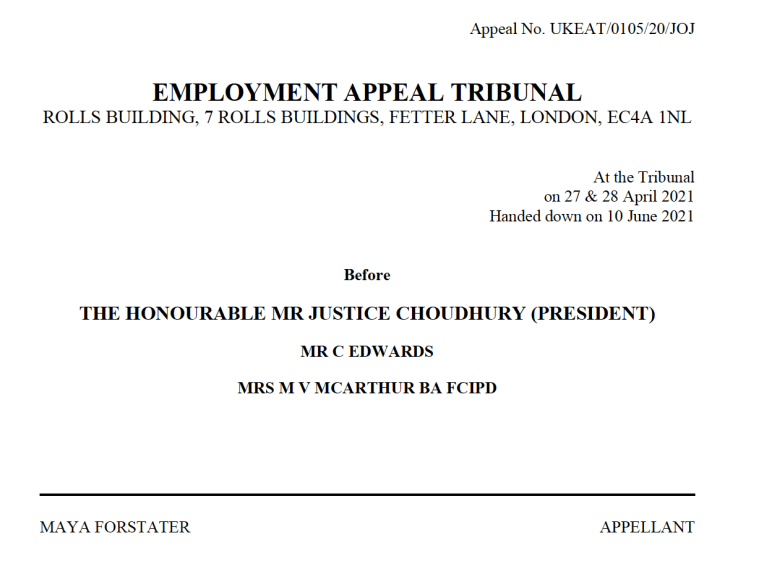
The view that biological sex is immutable and that a man cannot become a woman is, of course, controversial today. But in a very welcome decision, the UK Employment Appeal Tribunal in Forstater v CGD Europe [2021] UKEAT 0105_20_1006 (10 June 2021) has now overturned a previous single judge decision, and ruled that such a belief is “worthy of protection” as a “philosophical belief” under UK discrimination law. The decision, while not based on religious belief, will have important implications for protection of religious freedom in the UK, and hopefully in other parts of the world as well.

Continue reading

NSW Parliamentary report supports religious discrimination law

The recently released NSW Parliamentary Report of the Joint Select Committee on the Anti-Discrimination Amendment (Religious Freedoms and Equality) Bill 2020 (handed down on 31 March 2021) has recommended that the NSW government introduce amendments to make it unlawful in NSW to discriminate on irrelevant grounds relating to religious belief or activity. The proposals supported by the Committee are a good idea and I think their recommendations (with a couple of minor reservations noted below) should be implemented.

Continue reading

Collision of laws: the impact of Commonwealth law on the Victorian CSP law

The Victorian  Change or Suppression (Conversion) Practices Prohibition Bill 2020 (Vic) (which I will call the “CSP” law for short) passed the Upper House on 4 Feb, 2021. As I write it seems not to have yet received the Royal Assent and become an “Act” but that will no doubt happen soon. The government has signalled that the legislation will not come into operation for another 12 months (see the final sentence in this article.)

My previous posts (see here for the most recent) have expressed grave concerns about the effect of the law on religious freedom and specifically on the freedom of parents and others to encourage children to live in accordance with Biblical standards of sexual behaviour. It is astonishing that the Bill was rushed through Parliament in the face of concerns also being expressed by the Law Institute of Victoria, the Australian Medical Association (AMA) and the Royal Australian and New Zealand College of Psychiatrists (RANZCP). (See this excellent post from Murray Campbell noting these issues.) 

There are, it seems, very few legal avenues available to challenge the many problems created by this law. But in this post I want to suggest one which may be available- where the CSP Law purports to take away rights of religious freedom granted by the Commonwealth Parliament.

Continue reading