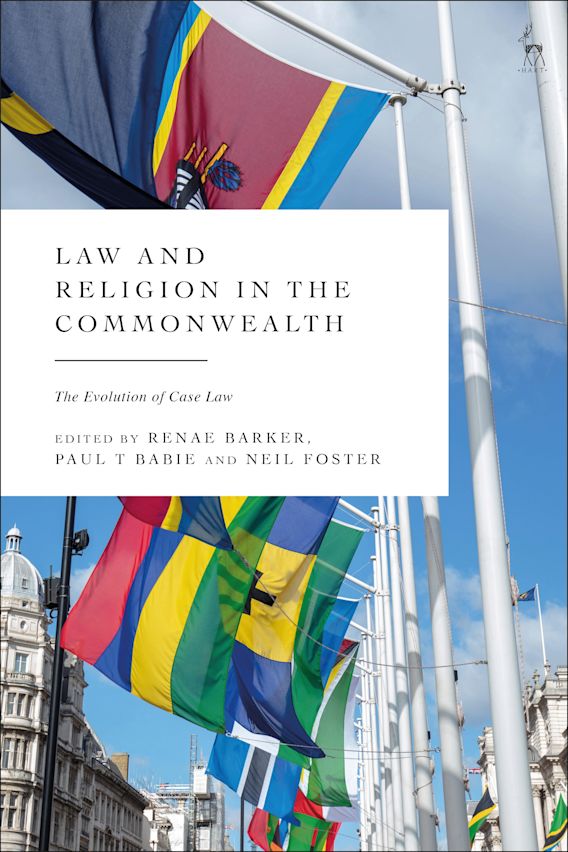
Law and Religion in the Commonwealth- paperback version

I previously posted about the publication of an edited collection of papers on Law and Religion issues around the Commonwealth, of which I am one of the editors. The book was available in hardcover and in an ebook version, but is now about to be released as a paperback in December. (The only difference is the reduced price!)

The publication date in Australia and New Zealand is 28 December 2023 and the webpage can be found here: https://www.bloomsbury.com/au/law-and-religion-in-the-commonwealth-9781509950188/

Readers of this blog can use the discount code GLR AQ7 , which entitles you to a 20% discount off a purchase of the book made on the Bloomsbury website

Just as a reminder:

Each chapter focuses on a specific case from a Commonwealth jurisdiction, examining the history and impact of the case, both within the originating jurisdiction and its wider global context.  

The book contains chapters from leading and emerging scholars from across the Commonwealth, including from the United Kingdom, Canada, Australia, Pakistan, Malaysia, India and Nigeria. 

The cases are divided into four sections covering:
– Foundational Questions in Law and Religion
– Freedom of Religion around the Commonwealth
– Religion and state relations around the Commonwealth
– Rights, Relationships and Religion around the Commonwealth.

Like religion itself, the case law covers a wide spectrum of life. This diversity is reflected in the cases covered in this book, which include: 
– Titular Roman Catholic Archbishop of Kuala Lumpur v Home Minister on the use of the Muslim name for God by non-Muslims in Malaysia
– The Church of the New Faith v Commissioner of Pay-roll Tax (Vic) which determined the meaning of religion in Australia 
– Eweida v UK which clarified the application of Article 9 of the European Convention on Human Rights 
– R v Big M Drug Mart on the individual protections of religious freedom under the Canadian Charter of Rights.  

The book examines how legal disputes involving religion are among the most contested in the courts and shows that in these cases, passions run high and the outcomes can have significant consequences for all involved.

My chapter is an analysis of the key Australian case, Christian Youth Camps Limited v Cobaw Community Health Services Limited and is sub-titled “Balancing Discrimination Rights with Religious Freedom of Organisations”.

The Ethics of Freedom: Religious Freedom in the Workplace

I am presenting a paper at the annual City Legal conference on August 25 on The Ethics of Freedom: Religious Freedom in the Workplace. It considers issues around religious freedom of employees and also touches on issues arising for Christian lawyers in particular. It can be downloaded here.

Vilification claims based on critique of drag queens event dismissed

The Queensland Civil and Administrative Tribunal, in its decision yesterday in Valkyrie and Hill v Shelton [2023] QCAT 302 (18 August 2023), has dismissed claims of vilification based on sexual orientation or gender identity, made against conservative commentator Lyle Shelton. The careful decision of Member Gordon reveals a number of uncertainties still surround the interpretation of this and other similar laws around Australia, but finds in the end that comments critical of the participation of the complainants in a “drag queen library event for children”, did not amount to the incitement of hatred towards, serious contempt for, or severe ridicule of the complainants on the ground of their sexuality or gender identity in contravention of section 124A of the Anti-Discrimination Act 1991 (Qld). There are a number of points in the decision worth noting.

Continue reading

Christian graphic designer not required to produce websites for same sex weddings

In a much anticipated decision, the US Supreme Court (by 6-3) in  303 CREATIVE LLC v. ELENIS 600 U. S. _ (2023) (30 June 2023) has ruled that a Christian graphic designer cannot be required by Colorado law to produce websites supporting and celebrating same-sex weddings, contrary to her religious beliefs. The ruling was based on the US First Amendment protection of free speech, and sets out a principle that the government cannot compel citizens to say what they object to saying, in an “expressive” business like web design, even if that business provides services to the public. It seems clearly correct, and will be helpful in protecting free speech on a range of issues, but in particular will support religious freedom. But, contrary to some comment, it is not a “license to discriminate”. The decision does not allow refusal of ordinary commercial services to same-sex attracted people. It only relates to the sort of artistic and expressive work engaged in by the designer.

Continue reading

Chart a better course? Guest Post on an Australian Human Rights Charter- part 2

Recently the Australian Human Rights Commission has issued a Position Paper entitled A Human Rights Act for Australia . In a previous guest post, Dr Paul Taylor provided some preliminary comments on the proposals. I am pleased to have an opportunity to provide his more recent comments.

As noted previously, Dr Taylor is an Honorary Senior Lecturer in the T.C. Beirne School of Law, a Fellow of the Centre for Public, International and Comparative Law, and an Adjunct Professor at the School of Law, The University of Notre Dame Australia. His principal academic interests are international human rights law and conflict of laws (private international law). He has held Visiting Fellowships at Wolfson College, Cambridge and at the Centre for International and Public Law, College of Law, Australian National University. He is the author of A Commentary on the International Covenant on Civil and Political Rights: The UN Human Rights’ Committee’s Monitoring of ICCPR Rights (Cambridge University Press, 2020); and Freedom of Religion: UN and European Human Rights Law and Practice (Cambridge University Press, 2005).

Dr Taylor has provided the following comments as a guest blogger. The comments are of course written in a personal capacity, and do not reflect any views of any institution to which he is or has been affiliated.

Continue reading

A Human Rights Charter for Australia? A Guest Blog Post.

Recently the Australian Human Rights Commission has issued a Position Paper entitled A Human Rights Act for Australia . I have often commented here on the gaps in protection for religious freedom under Australian federal law, and one suggestion that has sometimes been made is that Australia should implement internationally recognised rights such as those contained in art 18 of the International Covenant on Civil and Political Rights. But is doing this by way of a federal Human Rights Charter the right way to go?

I asked one of Australia’s leading commentators on international human rights issues, Dr Paul Taylor, to offer some preliminary comments on the proposals that have been put forward. Dr Taylor is an Honorary Senior Lecturer in the T.C. Beirne School of Law, a Fellow of the Centre for Public, International and Comparative Law, and an Adjunct Professor at the School of Law, The University of Notre Dame Australia. His principal academic interests are international human rights law and conflict of laws (private international law). He has held Visiting Fellowships at Wolfson College, Cambridge and at the Centre for International and Public Law, College of Law, Australian National University. He is the author of A Commentary on the International Covenant on Civil and Political Rights: The UN Human Rights’ Committee’s Monitoring of ICCPR Rights (Cambridge University Press, 2020); and Freedom of Religion: UN and European Human Rights Law and Practice (Cambridge University Press, 2005).

Dr Taylor has provided the following comments as a guest blogger. The comments are of course written in a personal capacity, and do not reflect any views of any institution to which he is or has been affiliated.

Continue reading

Whose conscience deserves protection in Australia?

I am presenting a short paper at the University of Notre Dame, Sydney, Ninth Annual Religious Liberty Lecture and Conference, on February 24, 2023, as part of a panel on “The Importance of Conscience”. The paper is linked here:

Is declining to print a Pride poster unlawful?

Press reports today record that a local franchisee of company “Kwik Kopy” declined a request to print posters for an event associated with the “World Pride” events happening in Sydney at the moment- see this report from Nine News. The World Pride events are in effect an extension of the Sydney “Gay and Lesbian Mardi Gras” parade which has been running for many years, although extended over 17 days. Their website refers to it as “a glittering celebration for the global LGBTQIA+ community”. 

But, of course, not everyone is on board with an event celebrating sexual activity outside heterosexual marriage. Mr Wing Khong, a Christian man who runs the Sydney CBD franchise of Kwik Kopy, declined to accept an order from Skater Leo Bunch, who emailed to ask for a quote to print “roller derby” flyers with a World Pride theme. Mr Khong commented:

“There was no offence meant. Everyone is entitled is to their own position. I don’t believe it was discrimination, rather I was just obeying the Word of God.” 

The news report linked above contains video comments from the reporter and also Anna Brown, from Equality Australia, that Mr Khong’s action was “clearly unlawful”. With respect, I beg to differ, and would like to explain why.

Continue reading

Football CEO dismissed for religious beliefs

The recently appointed new CEO of the Essendon Football Club in Victoria, Andrew Thorburn, has been pushed out of his job on account of views expressed by the church he belongs to and on whose board of management he sits. Those views, which even the club itself accepts were not stated personally by Mr Thorburn and which had to be found by scouring a database of sermons back to 2013, represent views on moral issues that have been shared by Christians, Muslims, Jews and many other religious believers for a long time. They are not “radical” or “hateful” or “bigoted”. It is arguable that the Club has breached Victorian anti-discrimination law.

Continue reading