Two cases on sex and gender identity

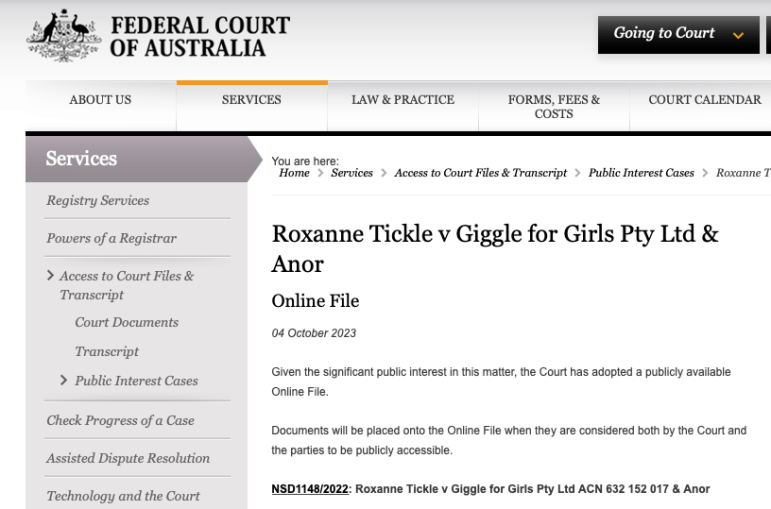
Two recent Australian cases raise important questions about sex and gender identity as legal categories. One, a decision of the highest appellate court in NSW, held that a change in sex under the law of a State does not require a change to be made in a marriage certificate issued under Commonwealth law. The other is a decision still awaiting a final hearing in the Federal Court, where the operator of a females-only only social networking site is being sued for her decision to exclude an applicant who was born biologically male but has since undergone “gender affirming surgery”. Though neither case explicitly involves anyone whose views are based on religious beliefs, both raise important issues which connect with “law and religion” interests, and are worthy of noting.

Continue reading

Vilification claims based on critique of drag queens event dismissed

The Queensland Civil and Administrative Tribunal, in its decision yesterday in Valkyrie and Hill v Shelton [2023] QCAT 302 (18 August 2023), has dismissed claims of vilification based on sexual orientation or gender identity, made against conservative commentator Lyle Shelton. The careful decision of Member Gordon reveals a number of uncertainties still surround the interpretation of this and other similar laws around Australia, but finds in the end that comments critical of the participation of the complainants in a “drag queen library event for children”, did not amount to the incitement of hatred towards, serious contempt for, or severe ridicule of the complainants on the ground of their sexuality or gender identity in contravention of section 124A of the Anti-Discrimination Act 1991 (Qld). There are a number of points in the decision worth noting.

Continue reading

Removing fences: the ALRC Consultation Paper on Religious Educational Institutions and Discrimination Laws

The Australian Law Reform Commission has now released a Consultation Paper for its current reference on “Religious Educational Institutions and Anti-Discrimination Laws”. The paper, while formally acknowledging the importance of religious freedom and parental rights, will be a serious disappointment to those involved in religious schools and colleges. It effectively recommends the removal of protections enjoyed by religious educational institutions which have been designed to safeguard the ability of these organisations to operate in accordance with their religious beliefs. The “fences” protecting these bodies from being forced to conform to majority views on sexual behaviour and identity (and hence losing their distinctiveness as religious bodies) are to be knocked down, the ALRC says. But the paper offers no convincing reasons for this wholesale demolition of a structure which has served the diversity and plurality of the Australian community for many years. Rather than supporting “Diversity, Equity and Inclusion”, the paper’s recommendations would require a compulsory uniformity which would undermine the reasons for the existence of faith-based educational institutions.

Continue reading

ALRC inquiry into Religious Educational Institutions and Anti-Discrimination Laws

The Commonwealth Attorney-General has announced that the Australian Law Reform Commission will be conducting an inquiry into the general area of “Religious Educational Institutions and Anti-Discrimination Laws”. Detailed information about the inquiry can be seen at their home page.

Readers may recall that the ALRC had previously been given a wider inquiry by the former government: the web-page notes that

The Terms of Reference replace a previous Inquiry into religious exemptions in anti-discrimination legislation that has been on hold since March 2020.

This new inquiry, while narrower in terms of being limited to religious educational institutions, comes with a number of assumptions that some may find problematic:

The Terms of Reference describe the Government’s commitments as ensuring ‘that an educational institution conducted in accordance with the doctrines, tenets, beliefs or teachings of a particular religion or creed:

  • must not discriminate against a student on the basis of sexual orientation, gender identity, marital or relationship status or pregnancy;
  • must not discriminate against a member of staff on the basis of sex, sexual orientation, gender identity, marital or relationship status or pregnancy;
  • can continue to build a community of faith by giving preference, in good faith, to persons of the same religion as the educational institution in the selection of staff’.

The Commission has indicated that it will have regard to submissions made to the previous inquiry, but that it also “will undertake further consultations”. Organisations and individuals who are interested in making submissions to the inquiry (when public submissions are called for) can “subscribe” to email updates from the ALRC here. Given that the inquiry has quite a tight timeline (it is due to report on 21 April 2023) I suspect that submissions may need to be put together fairly quickly over the Christmas/New Year period.

Update

The ALRC has now released a consultation timetable (which can be seen here) which indicates that they will be releasing a discussion paper for general comments on 27 January 2023, to which responses need to be provided by 24 February 2023.

Legal issues arising for Christian schools in NSW

I recently presented a paper exploring legal issues arising for Christian schools in NSW, which I thought may be of general interest. It also discusses developments in other Australian jurisdictions which may have an impact on NSW law in the future. The paper can be downloaded here:

First volume of Australian Journal of Law and Religion published

Great to see that the first volume of the Australian Journal of Law and Religion has been published: see here. All articles are free to download. Congratulations to editors Alex Deagon and Jeremy Patrick on this new venture! I am honoured to have an article in this first issue on “Religious Freedom, Section 109 of the Constitution, and Anti-discrimination Laws”.

For convenience, here is a copy of the first table of contents:

Articles

Law and Religion in the Classroom: Teaching Church-State Relationships: Renae Barker

The Formation of Islamic Law in Indonesia: The Interplay Between Islamic Authorities and the State: Muhammad Latif Fauzi

Religious Freedom, Section 109 of the Constitution, and Anti-discrimination Laws: Neil Foster

Why the Jury in Pell v The Queen Must Have Had a Doubt and the High Court was Right to Quash the Guilty Verdicts: Andrew Hemming

Adolescent Gender Identity and the Sex Discrimination Act: The Case for Religious Exemptions: Patrick Parkinson

Book Reviews

Christians: The Urgent Case for Jesus in Our World by Greg Sheridan: Katie Murray

Law and Religion in the Liberal State edited by Md Jahid Hossain Bhuiyan and Darryn Jensen: Jeremy Patrick

Special Topic Forum: The Future of Law and Religion in Australia

The Continued Existence of the Crime of Blasphemy in Australia: Luke Beck

Proportionality in Australian Constitutional Law: Next Stop Section 116?: Anthony Gray

The Liberal and Post-Liberal Futures of Law and Religion in Australia: Joel Harrison

Happy reading!

Religious school tells parents it will apply its religious beliefs

The above heading doesn’t sound very exciting, does it? Isn’t that what one would expect, that a school set up to educate students in a particular religious view would apply those beliefs in its practices? But the press in Australia sees it differently, apparently. “School rules: Brisbane college expects students to denounce homosexuality” is the way that the Sydney Morning Herald puts it (Jan 31). Citipointe Christian College has sent a letter to parents spelling out its views on a number of issues, letting them know that the College expects students and parents to be aware of these views if students are to be sent there. Here I will comment on whether the College is legally justified in so doing.

Continue reading

Clarifying “transgender hate speech”

An important appeal decision in November 2021, Rep v Clinch [2021] ACAT 106 (3 November 2021), provides significant clarification on what amounts to “transgender hate speech”, and what does not, under the law of Australian Capital Territory- and provides a helpful and persuasive set of reasons which may be influential in other jurisdictions. Is it unlawful to say that “a trans woman is a man”? Not according to the Appeal Tribunal in the Rep decision- see [117]. While none of the relevant parties seem to have referred to religious reasons for their comments, the question of what can be lawfully said in public contexts about issues raised by the “gender identity” debates has some importance for religious groups which take the view that religious texts teach that sex is determined at birth, not fluid, and not able to be changed.

Continue reading

Fined for declining to make a “transgender cake”

A Colorado District Court has handed down a decision imposing a penalty on a cake-maker for declining to provide a cake designed to celebrate a “gender transition”, in Scardina v Masterpiece Cakeshop Inc (Denver District Ct, Co; 19CV32214, 15 June 2021). If the name of the shop sounds familiar, it will be to those interested in “law and religion” issues in recent years. Jack Phillips and his Masterpiece Cakes business were previously sued, all the way to the US Supreme Court, because he had declined to make a cake designed to celebrate a same-sex wedding (for my comment on the Supreme Court decision, see “Colorado Wedding Cake Baker wins before US Supreme Court” (June 5, 2018). Sadly it seems that Mr Phillips will need to appeal this latest decision as well.

Continue reading

Belief that sex is immutable can be a protected belief

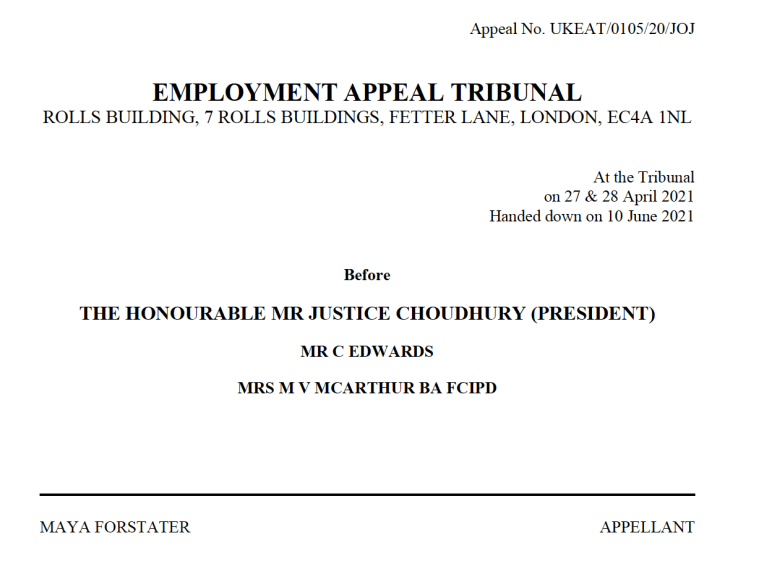
The view that biological sex is immutable and that a man cannot become a woman is, of course, controversial today. But in a very welcome decision, the UK Employment Appeal Tribunal in Forstater v CGD Europe [2021] UKEAT 0105_20_1006 (10 June 2021) has now overturned a previous single judge decision, and ruled that such a belief is “worthy of protection” as a “philosophical belief” under UK discrimination law. The decision, while not based on religious belief, will have important implications for protection of religious freedom in the UK, and hopefully in other parts of the world as well.

Continue reading