Pathways to Justice conference

I will be one of a number of speakers at a conference to be held next month entitled “Pathways to Justice for Survivors of Institutional Child Abuse”. The conference will be held on Sept 19-20 at the University of Technology, in Sydney- more details here. To be clear, it is not a specific “law and religion” event, and many speakers will not come from a faith-based perspective.

Of course institutional child abuse did not only take place in churches and religious institutions. But the great tragedy is that some did happen in those contexts, and churches and religious bodies need to be aware of appropriate legal responses, as well as changes to practices and pastoral care for victims. My presentation will discuss the possible development of an area of civil liability called “non-delegable duty”, whereby churches (and other bodies) may be held civilly liable for abuse committed by those who were caring for children while working for the body, even if the perpetrators were not employees (which would include most ministers of religion.)

Many of the papers will be from a fairly technical legal perspective, but for those interested this may provide an opportunity to find out how the law is responding to these issues. And as a presenter, I have been offered a discount code for registration which is available to readers of this blog! Using the code below will provide a 10% discount from registration up to the end of August.

FAVRAZJT
Simply visit our website and enter this code during checkout to receive the discount.
Register Now with Discount
Website: pathways.openlaw.com.au

The new Federal privacy tort and religious freedom

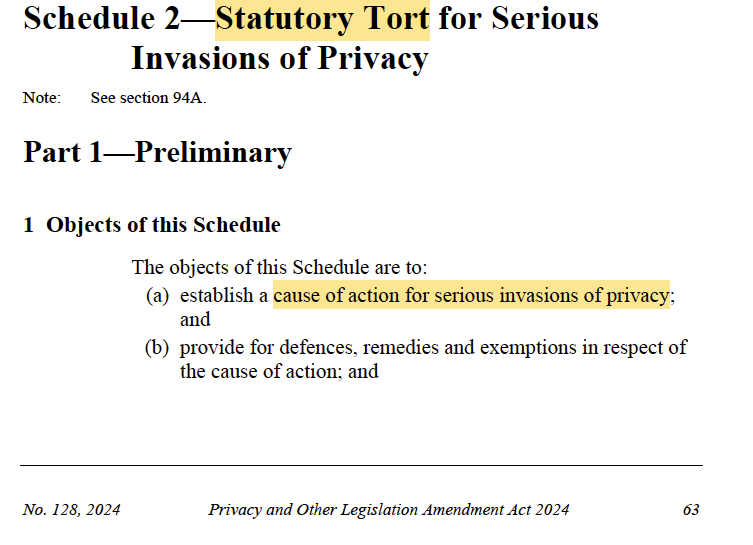
In the closing Parliamentary days of 2024, the Australian Federal Parliament created a new statutory privacy tort action, which may have a significant impact on churches and other religious groups. In the context of a possible disciplinary action against someone who has behaved contrary to the principles of a religious group to which they belong, it may be necessary to inform other members of the group about the person’s behaviour. In doing so the group will be in danger of breaching a right of privacy set up by the new law. The tort action (which will probably come into operation on 11 June 2025) seems to cut across important rights of religious freedom, and the exemptions under the law do not take this into account.

In this post I aim to outline some aspects of the operation of the new law, and recommend that before it commences Parliament provide specific recognition of religious freedom as an exemption to the availability of the action. In this discussion I will specifically refer to the impact on Christian churches, but my comments will in most cases be also applicable to other religious traditions and to other organisations operating with a religious ethos.

Continue reading

Bishop not vicariously liable for abuse by clergy

The High Court of Australia has handed down a significant decision on the law of “vicarious liability”, ruling that a church body is not automatically liable for sexual assault carried out by priests or ministers, where those persons are not employed by the church. In Bird v DP (a pseudonym) [2024] HCA 41 (13 November 2024) the court ruled (by 6-1 majority) that the doctrine of vicarious liability should not be extended to apply to relationships “akin to employment”. In doing so it upheld an appeal against the decision of the Victorian Court of Appeal that the Roman Catholic Bishop of Ballarat (and the diocese) should be held to be vicariously liable for historic acts of child abuse committed by one Coffey, who at the time was an assistant priest in the diocese. It was accepted at all times that a priest is not an employee of the bishop or diocese. (For reasons why this is correct, see my previous post on employment status of clergy).

While I think this decision on vicarious liability is the correct application of the law of Australia, I want to stress that this does not mean I think churches should not be able to be held civilly liable for abuse committed by clergy. I have argued that an alternative doctrine, known as “non-delegable duty” (NDD), should apply even in cases of intentional sexual abuse, where a church has accepted the care of children and young people into its activities. However, NDD was not argued at the initial stages of this litigation, and the High Court held in Bird that they would defer until another day a ruling on whether NDD can apply in cases of intentional wrongdoing.

Continue reading

The Calculus of Christianity

Applying the “calculus” of negligence spelled out in Wyong Shire Council v Shirt (1980) 146 CLR 40, this paper aims to show that the reasonable person will carefully investigate the claims of Jesus Christ:

The Calculus of Christianity- breakfast seminar Oct 30

For those who are in or can make it to Newcastle, I am speaking at a breakfast seminar on Wednesday Oct 30 (7:30-8:30 am) in the Newcastle CBD (Nuspace, the Uni city campus) x703. The topic is “The Calculus of Christianity”! Here is what it is about:

Both professionally and personally, we are constantly making calculations around risk. What would happen if we were to extend those calculations to the claims of Jesus Christ? Join us at our next Newcastle City Legal as Torts Lecturer Assoc. Prof. Neil Foster uses Wyong Shire Council v Shirt to do just that.

What would a “reasonable person” (for local purposes, the user of the Newcastle Light Rail!) make of the claims of Jesus, and how should they respond?

Registrations here. All welcome, but would be especially good to see local lawyers and anyone else interested in the law!

Church liability for clergy abuse

The High Court of Australia recently heard an appeal in a case involving an allegation that a Bishop in the Roman Catholic church can be held vicariously liable for an act of child abuse committed by a member of the clergy. The case is Bird v DP (a pseudonym) and I have previously mentioned the earlier stages of the proceedings here and here.

I have written a note outlining the arguments being made and offering my view on what I think should be the outcome of the appeal, which can be downloaded here. Here is the summary of the note:

In Bird v DP (A Pseudonym) the High Court will address two important questions about the civil liability of institutions for child sexual abuse perpetrated by representatives of the institution. The case involves a claim against the Roman Catholic Bishop of Ballarat as liable for child abuse committed in 1971 by Father Coffey, a priest working for the diocese. The trial judge and the Victorian Court of Appeal have ruled that while Coffey was not an employee, the diocese is nevertheless vicariously liable for the abuse. This involves an extension of the ‘stage 1’ issue of vicarious liability (the question as to which legal relationships allow attribution ofliability) which is being challenged in the appeal. The High Court has also been asked in a notice of contention to consider whether, if the Court of Appeal was wrong on the vicarious liability issue, liability might alternatively be sheeted home to the diocese under the principle of non-delegable duty (NDD). This would require the High Court to overturn its previous decision in NSW v Lepore on the point that the NDD doctrine cannot be applied to intentional torts. This article argues that the appeal should be allowed, the notice of contention upheld, and Lepore be overruled on this issue.

Religion and Private Law

I am presenting some brief comments on the background of private law, especially the law of torts, in the doctrines of Christianity, for a seminar organised by the law student association at my University. The paper can be downloaded here.

Liability of a bishop for abuse by clergy- on appeal

Can a bishop be held personally liable for child sexual abuse committed by a member of the clergy under their authority? The Victorian Court of Appeal has recently held that they can, in its decision in Bird v DP (a pseudonym) [2023] VSCA 66 (3 April 2023) (“the Bird appeal decision“). That decision upheld an earlier trial decision to the same effect in DP (a pseudonym) v Bird [2021] VSC 850 (22 December 2021), which I commented on previously here. In that earlier comment I suggested that there were reasons to conclude that the trial judge was wrong. In this comment I will be briefly noting why I continue to hold that view, and hence conclude that the Victorian Court of Appeal is also wrong, on the specific question of what is known as “vicarious liability”.

I want to stress that, despite my view that this decision is incorrect as a matter of Australian common law on the question of vicarious liability, I fully support churches being held liable for child abuse perpetrated by clergy who have been entrusted with the care of children. As I said in my previous post, my doubt about the decision on vicarious liability:

does not mean that I think that the organised church ought to be allowed to escape liability for harm committed by clergy to children in its care. To the contrary… I think the High Court ought to revisit another area of common law which prevents many such claims at the moment. But the decision in DP is not consistent with the course of development of the law of vicarious liability and will, in my judgment, be overturned if there is an appeal on this point

Clearly I was wrong about the appeal decision in Victoria. But I still maintain that the decision may be overturned if taken to the High Court of Australia. Below I briefly explain why.

Continue reading

Vicarious Liability of Bishop for abuse committed by clergy

In a decision handed down just prior to Christmas, DP (a pseudonym) v Bird [2021] VSC 850 (22 December 2021), a judge of the Victorian Supreme Court ruled that the Roman Catholic Bishop of the Diocese of Ballarat could be sued as vicariously liable for child sexual abuse committed by an assistant parish priest against the plaintiff DP when he was 5 years old (in 1971). The decision (as noted in a recent online press report) seems to be the first time a diocese has been found vicariously liable under common law principles for the actions of a priest, in Australia. In this note I will suggest that the reason for this is that the decision is wrong, as inconsistent with clear High Court of Australia authority. This does not mean that I think that the organised church ought to be allowed to escape liability for harm committed by clergy to children in its care. To the contrary, as explained below, I think the High Court ought to revisit another area of common law which prevents many such claims at the moment. But the decision in DP is not consistent with the course of development of the law of vicarious liability and will, in my judgment, be overturned if there is an appeal on this point.

Continue reading

Civil Liability for injury in church hall

Workplace Health and Safety Law in Australia 300

There was a recent reference in the excellent “Law and Religion UK” blog to a decision on the liability of a Church of England vicar and Parish Council for an injury suffered in a church hall: see “Church liability: fall from ladder” (David Pocklington, 8 March 2017). Since this case brings together two of my main academic interests, Law & Religion and Workplace Health & Safety (see my book on the topic, 2nd ed 2016, the cover of which is above), I couldn’t resist a comment on how this sort of case may have been resolved in Australia. 

Continue reading