The NSW Conversion Practices law, religious freedom and Government “guidance”

The Conversion Practices Ban Act 2024 (NSW) (“the Act”) is now in force, having commenced operation on 4 April 2025. I have previously posted a paper expressing concerns about the operation of the Act in relation to religious freedom. In this post I want to re-iterate briefly some of those concerns, and comment on “guidance” on the operation of the Act provided by NSW government officials.

I commend the previous paper to readers for more details. But the following are some extracts which may help to set the scene for my comments on the NSW government guidance. Below I will be referring to the “Frequently Asked Questions” (“FAQ”) page produced by “Anti-Discrimination NSW” (ADNSW)- the version I am commenting on was dated 7 April 2025. (ADNSW is the “online identity” of the body formally known as the “Anti-Discrimination Board” established under the Anti-Discrimination Act 1977 (NSW); the President of the Board receives initial complaints under the Act- see s 14- and the Board has a number of other functions under the Act.)

Continue reading

Challenges to Religious Freedom: Conversion Practices law passed, ALRC report released

A brief update on two significant challenges to religious freedom which have emerged over the last few days.

First, in NSW, the Conversion Practices Ban Bill 2024 has been rushed through both Houses of Parliament, receiving final approval on Friday March 22 after an all-night debate in the Legislative Council, and is now awaiting the Royal Assent. I posted about this Bill recently. There I said:

Legislation of this sort has been introduced in other jurisdictions around Australia and elsewhere. The aim of banning oppressive and violent practices designed to “convert” someone’s sexual orientation from homosexual to heterosexual is good, of course. But those practices, while they may have existed some time ago, are really no longer around. The problem with these laws now is that their drafting can be so broad that they interfere with the ordinary teaching of religious doctrines and life within families. These laws are also often premised on the assumption that “gender transition” is a good thing which should be freely available to children, whether or not with parental permission. They raise important issues of concern to all those interested in the welfare of children, whether or not from a religious perspective.

In that more detailed post I outlined the problems with the Bill. I noted that it is at least better than some others which have passed, especially the bad Victorian law. But none of the suggested amendments put forward by faith groups and the Opposition and other members were accepted by the government, which had the numbers with the Greens to push it through unchanged.

So churches and other religious groups will need to consider carefully where the line can be drawn between counselling which urges someone to live in accordance with God’s will (by not engaging in sex outside a man/woman marriage, or by living in line with one’s biological reality), and counselling which “suppresses” a person’s “sexual orientation” or “gender identity”. The Bill (soon to be an Act) will also put a thumb on the scales of advice to those wrestling with gender confusion, in favour of “affirming” treatment, when the scientific evidence is becoming increasingly clear that for young people, puberty blockers and other such treatments are not shown to be of help, and lead to massive bodily change which can usually not be reversed.

The Act, once given assent, is due to come into operation in one year.

The second concerning development is that on Wednesday 21 March the Australian Law Reform Commission released its report Maximising the Realisation of Human Rights: Religious Educational Institutions and Anti-Discrimination Laws (ALRC Report 142). Far from “maximising” human rights, the report (as expected by those who spoke to some of its researchers) would have the effect, if adopted, of seriously impairing the operation of faith-based schools around Australia. In brief, it recommends removal of all of “balancing clauses” in the federal Sex Discrimination Act 1984 which currently recognise the need to balance the religious freedom of faith-based schools with rights of teachers and students not to be detrimentally treated on the basis of sexual activity or “gender identity”. In particular, this would remove (among other provisions) section 38 of that Act, which allows faith schools to operate in accordance with their religious ethos when making staffing and educational decisions.

The Prime Minister has noted that the government has not made a decision to formally accept these recommendations. He has indicated, however, that since the report was made available to the government in December, two draft pieces of legislation have been prepared (though not made publicly available). He has indicated he would like bi-partisan support from the federal Opposition. It has to be said that views on these issues seem so strongly held that this seems unlikely. But it will all depend on the wording of any proposed laws.

Australia needs to decide if it wants to offer parents the option of having their children educated in faith-based schools, or not. Many parents have signalled they want this option, by sending their children to such schools. But if those schools find that their very reason for existence, operating in accordance with a religious world-view, is taken away, it seems likely that many will decide it is not worth continuing operations. The federal government needs to listen very carefully to all sides of this debate.


More issues with the Queensland Anti-Discrimination Bill 2024

I am happy to present a guest post today from Associate Professor Mark Fowler, raising more issues of concern from a religious freedom perspective with the recently released proposed Anti-Discrimination Bill 2024 . Dr Mark Fowler is Principal, Fowler Charity Law, Adjunct Associate Professor, University of Notre Dame, School of Law, Sydney and an External Fellow at the Centre for Public, International and Comparative Law, University of Queensland.

The concerns can be broadly grouped as follows:

  1. The Bill’s exception for employment by religious institutions would enact the most restrictive regime in Australia;
  2. The Bill will require religious institutions to provide services against their religious beliefs;
  3. The imposed ‘duty to eliminate discrimination’ will require religious institutions to proactively engage in activities that do not conform to their religious beliefs; and
  4. The Bill fails to protect religious individuals from discrimination when they engage in collaborative effort with fellow believers. 

Continue reading

NSW Conversion Practices Bill- risks to religious freedom

The NSW government has introduced a Conversion Practices Ban Bill 2024 into the Parliament, with the apparent aim of moving it through very quickly. Legislation of this sort has been introduced in other jurisdictions around Australia and elsewhere. The aim of banning oppressive and violent practices designed to “convert” someone’s sexual orientation from homosexual to heterosexual is good, of course. But those practices, while they may have existed some time ago, are really no longer around. The problem with these laws now is that their drafting can be so broad that they interfere with the ordinary teaching of religious doctrines and life within families. These laws are also often premised on the assumption that “gender transition” is a good thing which should be freely available to children, whether or not with parental permission. They raise important issues of concern to all those interested in the welfare of children, whether or not from a religious perspective.

But laws of this sort can in particular have significant implications for religious freedom. I have previously provided a detailed analysis of the Victorian legislation on this topic, noting the serious problems that law has created. The good news in NSW is that the government does seem to have listened to some of the concerns about the law raised by religious leaders and other concerned citizens. The Bill is certainly an improvement on the Victorian model. But there are a number of areas where it could be clearer in protecting important rights of all members of the community, to speak and act freely in accordance with their convictions and biological reality.

Continue reading

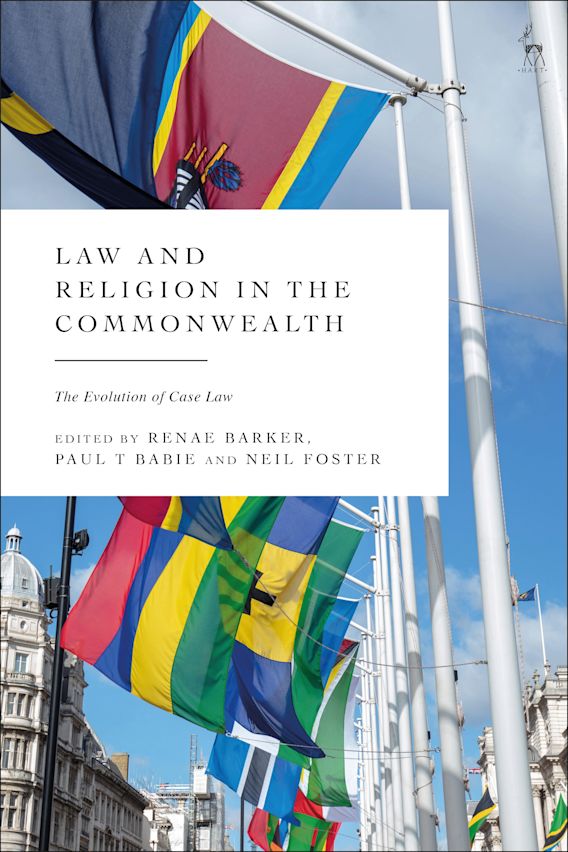
Law and Religion in the Commonwealth- paperback version

I previously posted about the publication of an edited collection of papers on Law and Religion issues around the Commonwealth, of which I am one of the editors. The book was available in hardcover and in an ebook version, but is now about to be released as a paperback in December. (The only difference is the reduced price!)

The publication date in Australia and New Zealand is 28 December 2023 and the webpage can be found here: https://www.bloomsbury.com/au/law-and-religion-in-the-commonwealth-9781509950188/

Readers of this blog can use the discount code GLR AQ7 , which entitles you to a 20% discount off a purchase of the book made on the Bloomsbury website

Just as a reminder:

Each chapter focuses on a specific case from a Commonwealth jurisdiction, examining the history and impact of the case, both within the originating jurisdiction and its wider global context.  

The book contains chapters from leading and emerging scholars from across the Commonwealth, including from the United Kingdom, Canada, Australia, Pakistan, Malaysia, India and Nigeria. 

The cases are divided into four sections covering:
– Foundational Questions in Law and Religion
– Freedom of Religion around the Commonwealth
– Religion and state relations around the Commonwealth
– Rights, Relationships and Religion around the Commonwealth.

Like religion itself, the case law covers a wide spectrum of life. This diversity is reflected in the cases covered in this book, which include: 
– Titular Roman Catholic Archbishop of Kuala Lumpur v Home Minister on the use of the Muslim name for God by non-Muslims in Malaysia
– The Church of the New Faith v Commissioner of Pay-roll Tax (Vic) which determined the meaning of religion in Australia 
– Eweida v UK which clarified the application of Article 9 of the European Convention on Human Rights 
– R v Big M Drug Mart on the individual protections of religious freedom under the Canadian Charter of Rights.  

The book examines how legal disputes involving religion are among the most contested in the courts and shows that in these cases, passions run high and the outcomes can have significant consequences for all involved.

My chapter is an analysis of the key Australian case, Christian Youth Camps Limited v Cobaw Community Health Services Limited and is sub-titled “Balancing Discrimination Rights with Religious Freedom of Organisations”.

The Ethics of Freedom: Religious Freedom in the Workplace

I am presenting a paper at the annual City Legal conference on August 25 on The Ethics of Freedom: Religious Freedom in the Workplace. It considers issues around religious freedom of employees and also touches on issues arising for Christian lawyers in particular. It can be downloaded here.

Vilification claims based on critique of drag queens event dismissed

The Queensland Civil and Administrative Tribunal, in its decision yesterday in Valkyrie and Hill v Shelton [2023] QCAT 302 (18 August 2023), has dismissed claims of vilification based on sexual orientation or gender identity, made against conservative commentator Lyle Shelton. The careful decision of Member Gordon reveals a number of uncertainties still surround the interpretation of this and other similar laws around Australia, but finds in the end that comments critical of the participation of the complainants in a “drag queen library event for children”, did not amount to the incitement of hatred towards, serious contempt for, or severe ridicule of the complainants on the ground of their sexuality or gender identity in contravention of section 124A of the Anti-Discrimination Act 1991 (Qld). There are a number of points in the decision worth noting.

Continue reading

Volume 2 of Australian Journal of Law and Religion available

The second issue of the Australian Journal of Law and Religion is now available online here. There are a number of important issues covered. The Table of Contents gives an idea:

 Editorial i 

Articles 

May Australian States Impose Sexual Orientation and Gender Identity Non-Discrimination Obligations on Religious Schools? A Rejoinder to Foster Nicholas Butler

Reconciling Freedom and Equality for Peaceful Coexistence: On the Need to Reframe the Religious Exemptions in the Sex Discrimination Act Alex Deagon 20 

The Position of Religious Schools Under International Human Rights Law Mark Fowler 36 

Legislating Gender Prejudice: Religion and the Overturning of Roe v Wade Rena MacLeod 56 

Conversion Practices Legislation in Victoria – A Potential Crisis for Church Authority? Rhett Martin 70 

Statements of Belief as Political Communication Timothy Nugent 81 

Book Reviews 

Law and Religion in the Commonwealth: The Evolution of Case Law edited by Renae Barker, Paul T. Babie, and Neil Foster Barry W. Bussey 90 

The Transgender Issue: An Argument for Justice by Shon Faye Jeremy Patrick 93 

Special Topic Forum: Religious Freedom, Sexuality, and Gender Identity 

Cherry Picking Human Rights Nicholas Aroney 95 

What Does Gender Identity Mean in the Sex Discrimination Act 1984Patrick Byrne 101 

The Politics of Indonesia’s New Criminal Code Robert W. Hefner 104 

Of course each reader will have their own specific areas of interest. I was obviously very interested to see that one of the articles is a rejoinder to an article I had published in volume 1, dealing with the impact of differing discrimination laws applying to faith based schools (and other institutions) in Commonwealth and State laws (see Butler, from p 1.) Readers will have to make up their own minds as to whether Mr Butler’s critique of my position is valid or not. I was also pleased to see an encouraging review of the edited volume Law and Religion in the Commonwealth , of which I was a co-editor (see Bussey, from p 90).

I look forward to reading the other articles in due course! I very much commend the editors for their decision to make all the articles freely available for download.

Whose conscience deserves protection in Australia?

I am presenting a short paper at the University of Notre Dame, Sydney, Ninth Annual Religious Liberty Lecture and Conference, on February 24, 2023, as part of a panel on “The Importance of Conscience”. The paper is linked here:

Is declining to print a Pride poster unlawful?

Press reports today record that a local franchisee of company “Kwik Kopy” declined a request to print posters for an event associated with the “World Pride” events happening in Sydney at the moment- see this report from Nine News. The World Pride events are in effect an extension of the Sydney “Gay and Lesbian Mardi Gras” parade which has been running for many years, although extended over 17 days. Their website refers to it as “a glittering celebration for the global LGBTQIA+ community”. 

But, of course, not everyone is on board with an event celebrating sexual activity outside heterosexual marriage. Mr Wing Khong, a Christian man who runs the Sydney CBD franchise of Kwik Kopy, declined to accept an order from Skater Leo Bunch, who emailed to ask for a quote to print “roller derby” flyers with a World Pride theme. Mr Khong commented:

“There was no offence meant. Everyone is entitled is to their own position. I don’t believe it was discrimination, rather I was just obeying the Word of God.” 

The news report linked above contains video comments from the reporter and also Anna Brown, from Equality Australia, that Mr Khong’s action was “clearly unlawful”. With respect, I beg to differ, and would like to explain why.

Continue reading