Pronouns, employment and religious schools

Recent press reports (such as this one from the Guardian) say that an employed teacher at a Victorian Roman Catholic school has taken action against the school for “gender identity” discrimination. The school apparently has refused to allow the teacher, Myka Sanders, who identifies as “non-binary”, to use “Mx” as a title (instead of the usual “Mr”). The school has referred to the teacher as “he” rather than using “they” as a preferred pronoun.

The complication in the action is that it seems that the school, Sacred Heart Girls College in Oakleigh, Melbourne, run by Melbourne Archdiocese Catholic Schools (MACS), has raised the fact that the Commonwealth law on this issue of “gender identity discrimination”, would allow the school to operate in accordance with its religious ethos and affirm their view that there are only 2 genders (corresponding to biological sex). So the case has the potential to require the courts hearing the matter to address the question (not so far resolved) whether an organisation can rely on a religious freedom right granted by Commonwealth law, if that right is not recognised by State law. I will explain here why I think this argument made by MACS is correct and any action against the school should fail.

Continue reading

Religious Freedom and the NSW Conversion Practices Ban Act 2024

I have prepared a paper exploring the operation of the NSW Conversion Practices Ban Act 2024 in relation to the freedom of churches and other religious groups to continue to provide teaching and guidance based on the tenets of their faith. The Act has received assent but will not commence operation until 3 April 2025.

Overall, the Act contains much better protections for religious freedom and the welfare of vulnerable children and young people than similar legislation elsewhere. But there are some areas where it is not clear, and it will require careful consideration by religious groups, as well those interested in so-called “gender transition” issues even from a non-religious background.

The paper can be downloaded here:

Challenges to Religious Freedom: Conversion Practices law passed, ALRC report released

A brief update on two significant challenges to religious freedom which have emerged over the last few days.

First, in NSW, the Conversion Practices Ban Bill 2024 has been rushed through both Houses of Parliament, receiving final approval on Friday March 22 after an all-night debate in the Legislative Council, and is now awaiting the Royal Assent. I posted about this Bill recently. There I said:

Legislation of this sort has been introduced in other jurisdictions around Australia and elsewhere. The aim of banning oppressive and violent practices designed to “convert” someone’s sexual orientation from homosexual to heterosexual is good, of course. But those practices, while they may have existed some time ago, are really no longer around. The problem with these laws now is that their drafting can be so broad that they interfere with the ordinary teaching of religious doctrines and life within families. These laws are also often premised on the assumption that “gender transition” is a good thing which should be freely available to children, whether or not with parental permission. They raise important issues of concern to all those interested in the welfare of children, whether or not from a religious perspective.

In that more detailed post I outlined the problems with the Bill. I noted that it is at least better than some others which have passed, especially the bad Victorian law. But none of the suggested amendments put forward by faith groups and the Opposition and other members were accepted by the government, which had the numbers with the Greens to push it through unchanged.

So churches and other religious groups will need to consider carefully where the line can be drawn between counselling which urges someone to live in accordance with God’s will (by not engaging in sex outside a man/woman marriage, or by living in line with one’s biological reality), and counselling which “suppresses” a person’s “sexual orientation” or “gender identity”. The Bill (soon to be an Act) will also put a thumb on the scales of advice to those wrestling with gender confusion, in favour of “affirming” treatment, when the scientific evidence is becoming increasingly clear that for young people, puberty blockers and other such treatments are not shown to be of help, and lead to massive bodily change which can usually not be reversed.

The Act, once given assent, is due to come into operation in one year.

The second concerning development is that on Wednesday 21 March the Australian Law Reform Commission released its report Maximising the Realisation of Human Rights: Religious Educational Institutions and Anti-Discrimination Laws (ALRC Report 142). Far from “maximising” human rights, the report (as expected by those who spoke to some of its researchers) would have the effect, if adopted, of seriously impairing the operation of faith-based schools around Australia. In brief, it recommends removal of all of “balancing clauses” in the federal Sex Discrimination Act 1984 which currently recognise the need to balance the religious freedom of faith-based schools with rights of teachers and students not to be detrimentally treated on the basis of sexual activity or “gender identity”. In particular, this would remove (among other provisions) section 38 of that Act, which allows faith schools to operate in accordance with their religious ethos when making staffing and educational decisions.

The Prime Minister has noted that the government has not made a decision to formally accept these recommendations. He has indicated, however, that since the report was made available to the government in December, two draft pieces of legislation have been prepared (though not made publicly available). He has indicated he would like bi-partisan support from the federal Opposition. It has to be said that views on these issues seem so strongly held that this seems unlikely. But it will all depend on the wording of any proposed laws.

Australia needs to decide if it wants to offer parents the option of having their children educated in faith-based schools, or not. Many parents have signalled they want this option, by sending their children to such schools. But if those schools find that their very reason for existence, operating in accordance with a religious world-view, is taken away, it seems likely that many will decide it is not worth continuing operations. The federal government needs to listen very carefully to all sides of this debate.


More issues with the Queensland Anti-Discrimination Bill 2024

I am happy to present a guest post today from Associate Professor Mark Fowler, raising more issues of concern from a religious freedom perspective with the recently released proposed Anti-Discrimination Bill 2024 . Dr Mark Fowler is Principal, Fowler Charity Law, Adjunct Associate Professor, University of Notre Dame, School of Law, Sydney and an External Fellow at the Centre for Public, International and Comparative Law, University of Queensland.

The concerns can be broadly grouped as follows:

  1. The Bill’s exception for employment by religious institutions would enact the most restrictive regime in Australia;
  2. The Bill will require religious institutions to provide services against their religious beliefs;
  3. The imposed ‘duty to eliminate discrimination’ will require religious institutions to proactively engage in activities that do not conform to their religious beliefs; and
  4. The Bill fails to protect religious individuals from discrimination when they engage in collaborative effort with fellow believers. 

Continue reading

“Equality” Bill threatens religious freedom in NSW

Independent MP Mr A H Greenwich last year introduced a private member’s bill called the Equality Legislation Amendment (LGBTIQA+) Bill 2023 (“the Bill”) into the NSW Parliament. It is understood that time will be allowed for debate on the Bill on February 8, 2024. Freedom for Faith has an excellent overview of the many areas covered by the Bill and why the Bill should not proceed. Most private member’s Bills are not approved, but there is a danger that some MP’s might support some of the provisions of this Bill. In this post I will focus on some of the dangers to religious freedom in NSW if the Bill were passed. (There are so many that I may not cover them all in one post, and if I can I will try to pick up those I miss here in a later post.)

In this post I will focus on the proposed amendments to the NSW Anti-Discrimination Act 1977 (“ADA”).

Continue reading

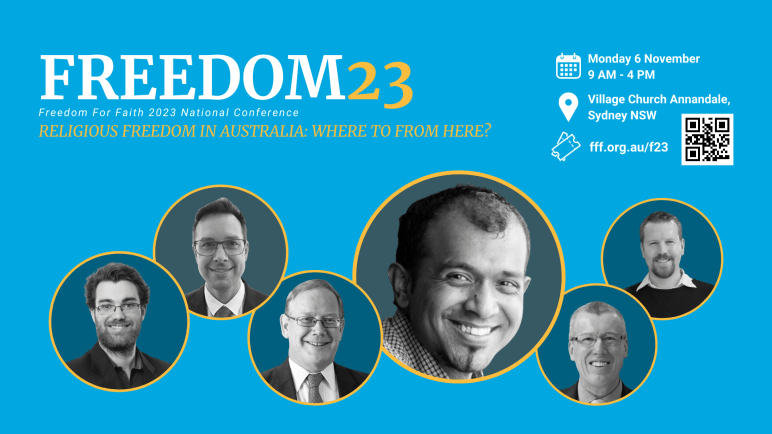
Freedom for Faith conference- Nov 6, 2023

I am pleased to share details of the Freedom for Faith annual conference- this should be a great day to consider religious freedom issues in Australia. (I am on the board of Freedom for Faith, and would encourage anyone interested in this area to support the organisation as it seeks to advocate for religious freedom for all!)

Freedom for Faith invites you to its annual conference, FREEDOM23, on November 6th at Village Church Annandale (Sydney) and live streamed.

FREEDOM23 will inform you about the current threats to religious freedom and their effects on families, churches and faith organisations, equip you to be ready for what lies ahead, and to advocate for religious freedom now, and encourage you in the knowledge that together, our voices can be heard.

The day will be particularly helpful for church and other religious leaders, those working in faith organisations, and anyone concerned about threats to religious freedom.

FREEDOM23 speakers include:

  • Max Jeganathan – Senior Research Fellow at the Centre for Public Christianity (CPX), former lawyer and policy advisor.
  • Mike Southon – Executive Director of Freedom for Faith
  • Dr Alex Deagon – Associate Professor of Law, QUT
  • Nick Jensen – Political liaison for the Australian Christian Higher Education Alliance (ACHEA)
  • Peter Fowler – CEO of The Anglican Schools Corporation

For in-person and streaming tickets: https://fff.org.au/f23.

Volume 2 of Australian Journal of Law and Religion available

The second issue of the Australian Journal of Law and Religion is now available online here. There are a number of important issues covered. The Table of Contents gives an idea:

 Editorial i 

Articles 

May Australian States Impose Sexual Orientation and Gender Identity Non-Discrimination Obligations on Religious Schools? A Rejoinder to Foster Nicholas Butler

Reconciling Freedom and Equality for Peaceful Coexistence: On the Need to Reframe the Religious Exemptions in the Sex Discrimination Act Alex Deagon 20 

The Position of Religious Schools Under International Human Rights Law Mark Fowler 36 

Legislating Gender Prejudice: Religion and the Overturning of Roe v Wade Rena MacLeod 56 

Conversion Practices Legislation in Victoria – A Potential Crisis for Church Authority? Rhett Martin 70 

Statements of Belief as Political Communication Timothy Nugent 81 

Book Reviews 

Law and Religion in the Commonwealth: The Evolution of Case Law edited by Renae Barker, Paul T. Babie, and Neil Foster Barry W. Bussey 90 

The Transgender Issue: An Argument for Justice by Shon Faye Jeremy Patrick 93 

Special Topic Forum: Religious Freedom, Sexuality, and Gender Identity 

Cherry Picking Human Rights Nicholas Aroney 95 

What Does Gender Identity Mean in the Sex Discrimination Act 1984Patrick Byrne 101 

The Politics of Indonesia’s New Criminal Code Robert W. Hefner 104 

Of course each reader will have their own specific areas of interest. I was obviously very interested to see that one of the articles is a rejoinder to an article I had published in volume 1, dealing with the impact of differing discrimination laws applying to faith based schools (and other institutions) in Commonwealth and State laws (see Butler, from p 1.) Readers will have to make up their own minds as to whether Mr Butler’s critique of my position is valid or not. I was also pleased to see an encouraging review of the edited volume Law and Religion in the Commonwealth , of which I was a co-editor (see Bussey, from p 90).

I look forward to reading the other articles in due course! I very much commend the editors for their decision to make all the articles freely available for download.

Removing fences: the ALRC Consultation Paper on Religious Educational Institutions and Discrimination Laws

The Australian Law Reform Commission has now released a Consultation Paper for its current reference on “Religious Educational Institutions and Anti-Discrimination Laws”. The paper, while formally acknowledging the importance of religious freedom and parental rights, will be a serious disappointment to those involved in religious schools and colleges. It effectively recommends the removal of protections enjoyed by religious educational institutions which have been designed to safeguard the ability of these organisations to operate in accordance with their religious beliefs. The “fences” protecting these bodies from being forced to conform to majority views on sexual behaviour and identity (and hence losing their distinctiveness as religious bodies) are to be knocked down, the ALRC says. But the paper offers no convincing reasons for this wholesale demolition of a structure which has served the diversity and plurality of the Australian community for many years. Rather than supporting “Diversity, Equity and Inclusion”, the paper’s recommendations would require a compulsory uniformity which would undermine the reasons for the existence of faith-based educational institutions.

Continue reading

ALRC inquiry into Religious Educational Institutions and Anti-Discrimination Laws

The Commonwealth Attorney-General has announced that the Australian Law Reform Commission will be conducting an inquiry into the general area of “Religious Educational Institutions and Anti-Discrimination Laws”. Detailed information about the inquiry can be seen at their home page.

Readers may recall that the ALRC had previously been given a wider inquiry by the former government: the web-page notes that

The Terms of Reference replace a previous Inquiry into religious exemptions in anti-discrimination legislation that has been on hold since March 2020.

This new inquiry, while narrower in terms of being limited to religious educational institutions, comes with a number of assumptions that some may find problematic:

The Terms of Reference describe the Government’s commitments as ensuring ‘that an educational institution conducted in accordance with the doctrines, tenets, beliefs or teachings of a particular religion or creed:

  • must not discriminate against a student on the basis of sexual orientation, gender identity, marital or relationship status or pregnancy;
  • must not discriminate against a member of staff on the basis of sex, sexual orientation, gender identity, marital or relationship status or pregnancy;
  • can continue to build a community of faith by giving preference, in good faith, to persons of the same religion as the educational institution in the selection of staff’.

The Commission has indicated that it will have regard to submissions made to the previous inquiry, but that it also “will undertake further consultations”. Organisations and individuals who are interested in making submissions to the inquiry (when public submissions are called for) can “subscribe” to email updates from the ALRC here. Given that the inquiry has quite a tight timeline (it is due to report on 21 April 2023) I suspect that submissions may need to be put together fairly quickly over the Christmas/New Year period.

Update

The ALRC has now released a consultation timetable (which can be seen here) which indicates that they will be releasing a discussion paper for general comments on 27 January 2023, to which responses need to be provided by 24 February 2023.

Legal issues arising for Christian schools in NSW

I recently presented a paper exploring legal issues arising for Christian schools in NSW, which I thought may be of general interest. It also discusses developments in other Australian jurisdictions which may have an impact on NSW law in the future. The paper can be downloaded here: