Recent cases on transgender vilification

I am presenting some material on vilification laws, and this paper deals with some recent cases on “transgender vilification”: Blanch v Smith (Local Court of NSW; 26 Aug 2025) and Dennis v Smith (Local Court of NSW, 26 Aug 2025). The paper can be downloaded below. It supplements material presented in a previous paper linked here.

Religious Liberty conference at Uni of Notre Dame, Sydney

 The University of Notre Dame Australia School of Law and Business will hold its 11th Annual Religious Liberty Lecture on Thursday 11th September 2025 – 5:30pm for 6pm, at St Benedict’s Hall, 104 Broadway, Chippendale, Sydney. A full day Annual Religious Liberty Conference will follow on Friday 12th September 2025 from 9am. 

More details and registration information can be seen in this flyer:

While the official RSVP date has passed, the organisers assure me they would still welcome registrations! I will be speaking on the vilification and hate speech issues, and there will be a number of other important papers presented on the day.

Freedom for Faith conference

Freedom for Faith is holding its annual conference on religious freedom and the law on September 27th, and is offering a student ticket discount. There is a great line-up of speakers- do come along!

The conference will be held on Saturday September 27th, 10am-3:30pm, at Village Church Annandale (Sydney) and the Student price: is $45 .

Speakers include Prof Patrick Parkinson and Ass Prof Alex Deagon – both of whom will be launching books – as well as Monica Doumit, the head of public affairs for the Catholic Archdiocese of Sydney. 

There will also be a conversation between Julian Leeser MP, the Federal Liberal Member for Berowra and Shadow Attorney General, and Dr Hugh McDermott, the NSW Labor Member for Prospect and Parliamentary Secretary (Assistant Minister) to the NSW Attorney General. 

Ticket includes lunch and unlimited coffee from the in-house coffee cart.

More information and tickets at: https://fff.org.au/f25 .

Vilification laws and religious free speech

I am presenting a paper on “Hate Speech – Vilification Laws and Threats to Freedom” this week, and a copy is available here to download for those interested. As well as comment on a number of other cases, there is some comment on the recent Wertheim v Haddad s 18C decision, and the litigation involving “Billboard Chris”.

The meaning of “sex” – in the UK and Australia

A high profile decision from the UK Supreme Court this week, For Women Scotland Ltd v The Scottish Ministers [2025] UKSC 16 (16 April 2025) (“FWS“), holds that the word “sex” as used in the UK anti-discrimination legislation the Equality Act 2010 (UK) (“the EA 2010”), means biological sex, and that the term does not change its meaning in relation to those who have obtained a gender recognition certificate (“GRC”) under the Gender Recognition Act 2004 (UK) (“the GRA 2004”). In the circumstances of this case, this meant that where a “quota” had been established for certain governance roles requiring 50% of non-executive members to be women, that quota could not be met by including those with an “acquired gender” of female due to their holding a GRC.

But the ramifications of the decision go far beyond the specific quota legislation. The question that the court had to address was whether references to “sex”, “women” and “men” in the EA 2010 included those who held GRC’s and had an “acquired” or “certificated” sex. After an extensive review of the general provisions of the discrimination law, the court unanimously concluded that a GRC did not have the effect of deeming someone to have changed their sex for the purposes of the EA 2010.

As they sum up near the end of the decision, at [265] item (xviii):

The meaning of the terms “sex”, “man” and “woman” in the EA 2010 is biological and not certificated sex. Any other interpretation would render the EA 2010 incoherent and impracticable to operate. 

As they point out, this does not remove other protections provided by the EA 2010 to transgender persons, whether or not they hold a GRC. But the ruling will have the effect that it will be possible to establish rules requiring that single-sex spaces such as changing rooms, bathrooms, and other areas designed for the use of one sex, can be reserved for those who have that biological sex and will not have to be made available to those who have the relevant sex through a GRC or claim to be of that sex on some other ground (see references to those issues in para [265] items (xiv) and (xv).)

While the decision itself does not refer to religious belief issues, the case will have important implications for religious groups whose conviction is that a person’s sex is that given at conception biologically, and cannot be later changed by other processes. (For a recent careful and scholarly analysis of the Christian perspective on these issues, see Robert S Smith, The Body God Gives (Lexham Academic, 2025), esp Part 3.) In the UK, those groups will be able to apply this view in the way that they provide services for men or women, or for girls or boys, in accordance with their faith commitments.

Of course the decision is not directly relevant to the law of Australia. But in this post I want to briefly compare the reasoning of the UK Supreme Court in its consideration of the EA 2010, with how a court in Australia might approach similar issues under Australian law, in particular in relation to the federal Sex Discrimination Act 1984 (Cth) (“SDA 1984”). Readers of this blog may recall that we have had a decision of a single judge commenting on some of these issues in the Tickle v Giggle litigation, which I previously suggested was wrongly decided. The reasoning of the Supreme Court of the UK here strongly supports my view that comments about the meaning of the category of “sex” made by the judge in that case were incorrect and should not be supported on appeal. (For an excellent overview of the FWS decision by a UK legal scholar cited by the court, see Michael Foran, “Sex has always meant biological sex“.)

Continue reading

The NSW Conversion Practices law, religious freedom and Government “guidance”

The Conversion Practices Ban Act 2024 (NSW) (“the Act”) is now in force, having commenced operation on 4 April 2025. I have previously posted a paper expressing concerns about the operation of the Act in relation to religious freedom. In this post I want to re-iterate briefly some of those concerns, and comment on “guidance” on the operation of the Act provided by NSW government officials.

I commend the previous paper to readers for more details. But the following are some extracts which may help to set the scene for my comments on the NSW government guidance. Below I will be referring to the “Frequently Asked Questions” (“FAQ”) page produced by “Anti-Discrimination NSW” (ADNSW)- the version I am commenting on was dated 7 April 2025. (ADNSW is the “online identity” of the body formally known as the “Anti-Discrimination Board” established under the Anti-Discrimination Act 1977 (NSW); the President of the Board receives initial complaints under the Act- see s 14- and the Board has a number of other functions under the Act.)

Continue reading

“Hate speech” and religious freedom- recent developments in Australia

Recently there have been a number of legislative moves or proposals attempting to deal with issues around the area of “hate speech”. The term of course is problematic- we will try to unpack it shortly. But the context, in Australia at least, is the shocking rise in the number of anti-semitic slogans and actual violence being seen in the last few months. Insults have been daubed on buildings and cars, fires lit at buildings associated with the Jewish community. And more recently, we have the shocking spectacle of two nurses from Bankstown Hospital saying on a video which has gone all over the world, that they would either like to kill their Israeli patients, or have already done so!

Part of the response of governments, at the Federal and State level, has been to either enact or propose laws punishing “hate speech”. The term itself is ambiguous. Does it mean speech “motivated” by hate? Or speech expressing hate? Or speech encouraging others to hate? I think we can all agree that, at one end of a spectrum, speech urging commission of violence against others should be unlawful. But what about expressing disagreement with moral choices made about sexual activity? Such speech might not be motivated by hate, but by concern for the bad effects of the behaviour, including contravening of divine law. Yet it might be perceived to be “hateful” by some who hear it.

It is regularly asserted that religiously based violence is somehow connected to speech insulting people on the basis of their religion. Yet some scholars note that there is little evidence produced that this is actually the case- that there is in truth no clear causal connection between speech of this sort and the issuing of threats or perpetration of violence.

Still, let’s concede that such is possible. It may be that regular assertions about how terrible people from a certain religious background are, will “normalise” the idea that threats and violence are appropriate responses. But will laws against such speech actually reduce the threats and violence? Or will they simply result in the speech being hidden from the community before it erupts in the actual acts?

The other problem with hate speech laws, of course, is that there is a serious danger that punishing speech on religious topics will unduly impair free speech on such topics generally. In the rest of this post I want to mention three recent Australian legislative initiatives on “hate speech” and note their possible impact on religious freedom. One is a new provision of Federal law which has already commenced. Second, I will be noting some changes that have been enacted and may commence soon under NSW law. Finally, I will briefly note some concerning legislation currently before the Victorian Parliament.

Before I do so, though, let me be very clear. The right to religious freedom cannot include the right to advocate for physical violence against other members of the community, nor of course a right to actual commit such violence or issue threats of such violence. Note that I have added the word “physical” here to be clear about the sort of “violence” I am referring to. The word “violence” should not be extended in metaphorical directions to refer to “criticising someone’s moral choices” or “upsetting someone”. These matters are not appropriately dealt with by the law. But no community can tolerate physical violence or threats against other members of the community justified by religious beliefs. As we will see, some recent laws are generally in the appropriate area of preventing actual violence; others are more problematic.

Continue reading

The new Federal privacy tort and religious freedom

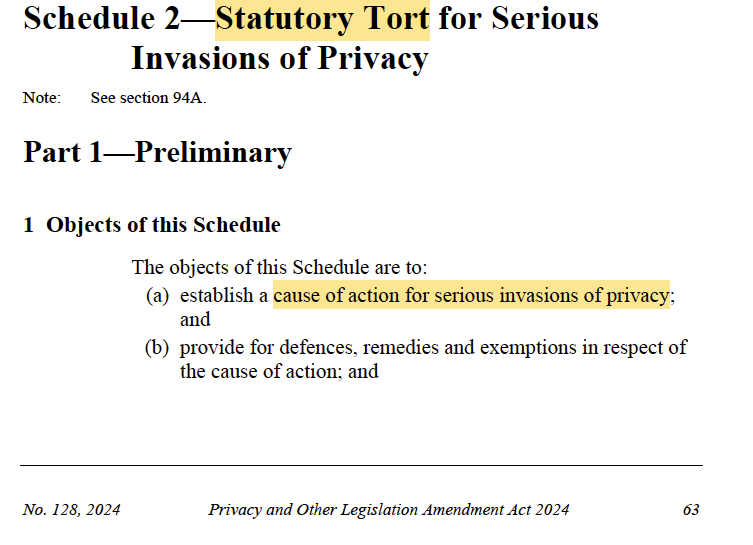
In the closing Parliamentary days of 2024, the Australian Federal Parliament created a new statutory privacy tort action, which may have a significant impact on churches and other religious groups. In the context of a possible disciplinary action against someone who has behaved contrary to the principles of a religious group to which they belong, it may be necessary to inform other members of the group about the person’s behaviour. In doing so the group will be in danger of breaching a right of privacy set up by the new law. The tort action (which will probably come into operation on 11 June 2025) seems to cut across important rights of religious freedom, and the exemptions under the law do not take this into account.

In this post I aim to outline some aspects of the operation of the new law, and recommend that before it commences Parliament provide specific recognition of religious freedom as an exemption to the availability of the action. In this discussion I will specifically refer to the impact on Christian churches, but my comments will in most cases be also applicable to other religious traditions and to other organisations operating with a religious ethos.

Continue reading

Tickle v Giggle: Sex and Gender Identity

In his decision in Tickle v Giggle for Girls Pty Ltd (No 2) [2024] FCA 960 (23 August 2024) Bromwich J in the Federal Court of Australia found that the company Giggle had been guilty of indirect gender identity discrimination when its director, Sall Grover (who was also sued), had removed Roxy Tickle from her women-only social media app. Roxanne Tickle (“the applicant”), as Bromwich J noted:

was of the male sex at the time of birth, but is now recognised by an official updated Queensland birth certificate, issued under the Births, Deaths and Marriages Registration Act 2003 (Qld) (Qld BDM Registration Act), as being of the female sex.  This followed from, and was predicated on, sexual reassignment surgery, being the term used in the Qld BDM Registration Act.. (at [3])

I commented on earlier stages of this litigation in a previous post. The question as to whether sex as a legal category is changeable, and the implications of this for discrimination law, are of great concern to many concerned with protection of traditional female-only spaces. It is a question which raises concerns for religious folk, many of whom see sex as a biological category determined at conception and ordained by God. Hence a review of the decision seems justified on this blog concerned with law and religion, although I note that none of the participants in the case professed any religious reasons for their views. The view that sex is determined by fundamental biological facts is shared by many, on both religious and scientific grounds.

In short, I think this decision is incorrect as a matter of law, and the implications of the decision are bad for society as a whole, and women in particular. I hope it will be overturned on appeal.

Continue reading

Hate Speech – Vilification Laws and Threats to Religious Speech

I have presented a paper today surveying Australia laws on “hate speech” and “vilification”, as they have an impact on religious free speech. The paper can be downloaded here: