New NSW “Religious Vilification” law

An amendment to the NSW Anti-Discrimination Act 1977, making certain types of speech connected with religion unlawful, commenced operation on 12 November 2023. The amendment, made by the Anti-Discrimination Amendment (Religious Vilification) Act 2023 (No 15 of 2023) (“the ADA”), is a form of “religious vilification” law which has not previously been in force in NSW. It is not as bad as some forms of such laws in terms of its effect on religious freedom, but it is worth being aware of its potential operation. It will be important, for example, for those preaching and teaching the Bible (or other religious texts) to understand what the law does, and perhaps more importantly, does not, prohibit.

Continue reading

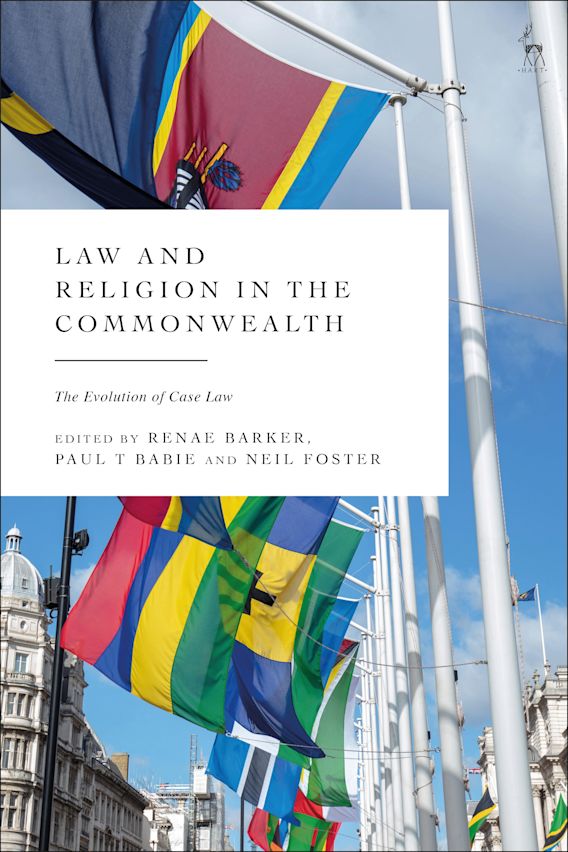
Law and Religion in the Commonwealth- paperback version

I previously posted about the publication of an edited collection of papers on Law and Religion issues around the Commonwealth, of which I am one of the editors. The book was available in hardcover and in an ebook version, but is now about to be released as a paperback in December. (The only difference is the reduced price!)

The publication date in Australia and New Zealand is 28 December 2023 and the webpage can be found here: https://www.bloomsbury.com/au/law-and-religion-in-the-commonwealth-9781509950188/

Readers of this blog can use the discount code GLR AQ7 , which entitles you to a 20% discount off a purchase of the book made on the Bloomsbury website

Just as a reminder:

Each chapter focuses on a specific case from a Commonwealth jurisdiction, examining the history and impact of the case, both within the originating jurisdiction and its wider global context.  

The book contains chapters from leading and emerging scholars from across the Commonwealth, including from the United Kingdom, Canada, Australia, Pakistan, Malaysia, India and Nigeria. 

The cases are divided into four sections covering:
– Foundational Questions in Law and Religion
– Freedom of Religion around the Commonwealth
– Religion and state relations around the Commonwealth
– Rights, Relationships and Religion around the Commonwealth.

Like religion itself, the case law covers a wide spectrum of life. This diversity is reflected in the cases covered in this book, which include: 
– Titular Roman Catholic Archbishop of Kuala Lumpur v Home Minister on the use of the Muslim name for God by non-Muslims in Malaysia
– The Church of the New Faith v Commissioner of Pay-roll Tax (Vic) which determined the meaning of religion in Australia 
– Eweida v UK which clarified the application of Article 9 of the European Convention on Human Rights 
– R v Big M Drug Mart on the individual protections of religious freedom under the Canadian Charter of Rights.  

The book examines how legal disputes involving religion are among the most contested in the courts and shows that in these cases, passions run high and the outcomes can have significant consequences for all involved.

My chapter is an analysis of the key Australian case, Christian Youth Camps Limited v Cobaw Community Health Services Limited and is sub-titled “Balancing Discrimination Rights with Religious Freedom of Organisations”.

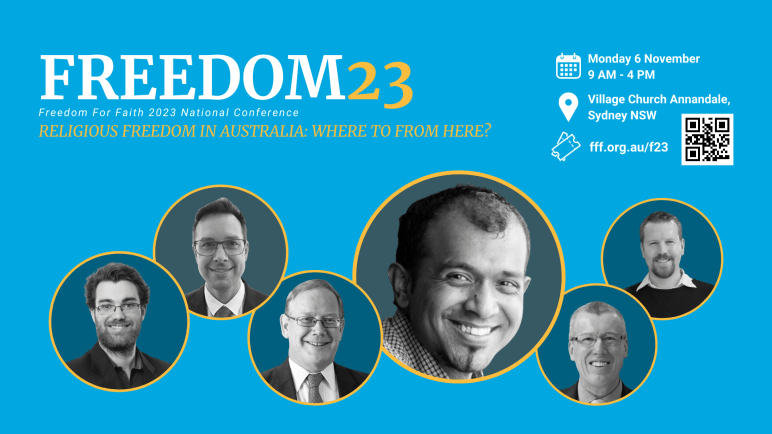
Freedom for Faith conference- Nov 6, 2023

I am pleased to share details of the Freedom for Faith annual conference- this should be a great day to consider religious freedom issues in Australia. (I am on the board of Freedom for Faith, and would encourage anyone interested in this area to support the organisation as it seeks to advocate for religious freedom for all!)

Freedom for Faith invites you to its annual conference, FREEDOM23, on November 6th at Village Church Annandale (Sydney) and live streamed.

FREEDOM23 will inform you about the current threats to religious freedom and their effects on families, churches and faith organisations, equip you to be ready for what lies ahead, and to advocate for religious freedom now, and encourage you in the knowledge that together, our voices can be heard.

The day will be particularly helpful for church and other religious leaders, those working in faith organisations, and anyone concerned about threats to religious freedom.

FREEDOM23 speakers include:

  • Max Jeganathan – Senior Research Fellow at the Centre for Public Christianity (CPX), former lawyer and policy advisor.
  • Mike Southon – Executive Director of Freedom for Faith
  • Dr Alex Deagon – Associate Professor of Law, QUT
  • Nick Jensen – Political liaison for the Australian Christian Higher Education Alliance (ACHEA)
  • Peter Fowler – CEO of The Anglican Schools Corporation

For in-person and streaming tickets: https://fff.org.au/f23.

The Ethics of Freedom: Religious Freedom in the Workplace

I am presenting a paper at the annual City Legal conference on August 25 on The Ethics of Freedom: Religious Freedom in the Workplace. It considers issues around religious freedom of employees and also touches on issues arising for Christian lawyers in particular. It can be downloaded here.

Is taking over Calvary Hospital a religious freedom breach?

There has been a lot of controversy around the recent decision of the ACT government to compulsorily acquire Canberra’s Calvary Hospital. One question that is worth asking is this: could this move be an unlawful breach of religious freedom rights? In this post I want to consider the possibilities.

Continue reading

Christian graphic designer not required to produce websites for same sex weddings

In a much anticipated decision, the US Supreme Court (by 6-3) in  303 CREATIVE LLC v. ELENIS 600 U. S. _ (2023) (30 June 2023) has ruled that a Christian graphic designer cannot be required by Colorado law to produce websites supporting and celebrating same-sex weddings, contrary to her religious beliefs. The ruling was based on the US First Amendment protection of free speech, and sets out a principle that the government cannot compel citizens to say what they object to saying, in an “expressive” business like web design, even if that business provides services to the public. It seems clearly correct, and will be helpful in protecting free speech on a range of issues, but in particular will support religious freedom. But, contrary to some comment, it is not a “license to discriminate”. The decision does not allow refusal of ordinary commercial services to same-sex attracted people. It only relates to the sort of artistic and expressive work engaged in by the designer.

Continue reading

Volume 2 of Australian Journal of Law and Religion available

The second issue of the Australian Journal of Law and Religion is now available online here. There are a number of important issues covered. The Table of Contents gives an idea:

 Editorial i 

Articles 

May Australian States Impose Sexual Orientation and Gender Identity Non-Discrimination Obligations on Religious Schools? A Rejoinder to Foster Nicholas Butler

Reconciling Freedom and Equality for Peaceful Coexistence: On the Need to Reframe the Religious Exemptions in the Sex Discrimination Act Alex Deagon 20 

The Position of Religious Schools Under International Human Rights Law Mark Fowler 36 

Legislating Gender Prejudice: Religion and the Overturning of Roe v Wade Rena MacLeod 56 

Conversion Practices Legislation in Victoria – A Potential Crisis for Church Authority? Rhett Martin 70 

Statements of Belief as Political Communication Timothy Nugent 81 

Book Reviews 

Law and Religion in the Commonwealth: The Evolution of Case Law edited by Renae Barker, Paul T. Babie, and Neil Foster Barry W. Bussey 90 

The Transgender Issue: An Argument for Justice by Shon Faye Jeremy Patrick 93 

Special Topic Forum: Religious Freedom, Sexuality, and Gender Identity 

Cherry Picking Human Rights Nicholas Aroney 95 

What Does Gender Identity Mean in the Sex Discrimination Act 1984Patrick Byrne 101 

The Politics of Indonesia’s New Criminal Code Robert W. Hefner 104 

Of course each reader will have their own specific areas of interest. I was obviously very interested to see that one of the articles is a rejoinder to an article I had published in volume 1, dealing with the impact of differing discrimination laws applying to faith based schools (and other institutions) in Commonwealth and State laws (see Butler, from p 1.) Readers will have to make up their own minds as to whether Mr Butler’s critique of my position is valid or not. I was also pleased to see an encouraging review of the edited volume Law and Religion in the Commonwealth , of which I was a co-editor (see Bussey, from p 90).

I look forward to reading the other articles in due course! I very much commend the editors for their decision to make all the articles freely available for download.

Chart a better course? Guest Post on an Australian Human Rights Charter- part 2

Recently the Australian Human Rights Commission has issued a Position Paper entitled A Human Rights Act for Australia . In a previous guest post, Dr Paul Taylor provided some preliminary comments on the proposals. I am pleased to have an opportunity to provide his more recent comments.

As noted previously, Dr Taylor is an Honorary Senior Lecturer in the T.C. Beirne School of Law, a Fellow of the Centre for Public, International and Comparative Law, and an Adjunct Professor at the School of Law, The University of Notre Dame Australia. His principal academic interests are international human rights law and conflict of laws (private international law). He has held Visiting Fellowships at Wolfson College, Cambridge and at the Centre for International and Public Law, College of Law, Australian National University. He is the author of A Commentary on the International Covenant on Civil and Political Rights: The UN Human Rights’ Committee’s Monitoring of ICCPR Rights (Cambridge University Press, 2020); and Freedom of Religion: UN and European Human Rights Law and Practice (Cambridge University Press, 2005).

Dr Taylor has provided the following comments as a guest blogger. The comments are of course written in a personal capacity, and do not reflect any views of any institution to which he is or has been affiliated.

Continue reading

A Human Rights Charter for Australia? A Guest Blog Post.

Recently the Australian Human Rights Commission has issued a Position Paper entitled A Human Rights Act for Australia . I have often commented here on the gaps in protection for religious freedom under Australian federal law, and one suggestion that has sometimes been made is that Australia should implement internationally recognised rights such as those contained in art 18 of the International Covenant on Civil and Political Rights. But is doing this by way of a federal Human Rights Charter the right way to go?

I asked one of Australia’s leading commentators on international human rights issues, Dr Paul Taylor, to offer some preliminary comments on the proposals that have been put forward. Dr Taylor is an Honorary Senior Lecturer in the T.C. Beirne School of Law, a Fellow of the Centre for Public, International and Comparative Law, and an Adjunct Professor at the School of Law, The University of Notre Dame Australia. His principal academic interests are international human rights law and conflict of laws (private international law). He has held Visiting Fellowships at Wolfson College, Cambridge and at the Centre for International and Public Law, College of Law, Australian National University. He is the author of A Commentary on the International Covenant on Civil and Political Rights: The UN Human Rights’ Committee’s Monitoring of ICCPR Rights (Cambridge University Press, 2020); and Freedom of Religion: UN and European Human Rights Law and Practice (Cambridge University Press, 2005).

Dr Taylor has provided the following comments as a guest blogger. The comments are of course written in a personal capacity, and do not reflect any views of any institution to which he is or has been affiliated.

Continue reading

Whose conscience deserves protection in Australia?

I am presenting a short paper at the University of Notre Dame, Sydney, Ninth Annual Religious Liberty Lecture and Conference, on February 24, 2023, as part of a panel on “The Importance of Conscience”. The paper is linked here: