Pronouns, employment and religious schools

Recent press reports (such as this one from the Guardian) say that an employed teacher at a Victorian Roman Catholic school has taken action against the school for “gender identity” discrimination. The school apparently has refused to allow the teacher, Myka Sanders, who identifies as “non-binary”, to use “Mx” as a title (instead of the usual “Mr”). The school has referred to the teacher as “he” rather than using “they” as a preferred pronoun.

The complication in the action is that it seems that the school, Sacred Heart Girls College in Oakleigh, Melbourne, run by Melbourne Archdiocese Catholic Schools (MACS), has raised the fact that the Commonwealth law on this issue of “gender identity discrimination”, would allow the school to operate in accordance with its religious ethos and affirm their view that there are only 2 genders (corresponding to biological sex). So the case has the potential to require the courts hearing the matter to address the question (not so far resolved) whether an organisation can rely on a religious freedom right granted by Commonwealth law, if that right is not recognised by State law. I will explain here why I think this argument made by MACS is correct and any action against the school should fail.

Continue reading

Challenges to Religious Freedom: Conversion Practices law passed, ALRC report released

A brief update on two significant challenges to religious freedom which have emerged over the last few days.

First, in NSW, the Conversion Practices Ban Bill 2024 has been rushed through both Houses of Parliament, receiving final approval on Friday March 22 after an all-night debate in the Legislative Council, and is now awaiting the Royal Assent. I posted about this Bill recently. There I said:

Legislation of this sort has been introduced in other jurisdictions around Australia and elsewhere. The aim of banning oppressive and violent practices designed to “convert” someone’s sexual orientation from homosexual to heterosexual is good, of course. But those practices, while they may have existed some time ago, are really no longer around. The problem with these laws now is that their drafting can be so broad that they interfere with the ordinary teaching of religious doctrines and life within families. These laws are also often premised on the assumption that “gender transition” is a good thing which should be freely available to children, whether or not with parental permission. They raise important issues of concern to all those interested in the welfare of children, whether or not from a religious perspective.

In that more detailed post I outlined the problems with the Bill. I noted that it is at least better than some others which have passed, especially the bad Victorian law. But none of the suggested amendments put forward by faith groups and the Opposition and other members were accepted by the government, which had the numbers with the Greens to push it through unchanged.

So churches and other religious groups will need to consider carefully where the line can be drawn between counselling which urges someone to live in accordance with God’s will (by not engaging in sex outside a man/woman marriage, or by living in line with one’s biological reality), and counselling which “suppresses” a person’s “sexual orientation” or “gender identity”. The Bill (soon to be an Act) will also put a thumb on the scales of advice to those wrestling with gender confusion, in favour of “affirming” treatment, when the scientific evidence is becoming increasingly clear that for young people, puberty blockers and other such treatments are not shown to be of help, and lead to massive bodily change which can usually not be reversed.

The Act, once given assent, is due to come into operation in one year.

The second concerning development is that on Wednesday 21 March the Australian Law Reform Commission released its report Maximising the Realisation of Human Rights: Religious Educational Institutions and Anti-Discrimination Laws (ALRC Report 142). Far from “maximising” human rights, the report (as expected by those who spoke to some of its researchers) would have the effect, if adopted, of seriously impairing the operation of faith-based schools around Australia. In brief, it recommends removal of all of “balancing clauses” in the federal Sex Discrimination Act 1984 which currently recognise the need to balance the religious freedom of faith-based schools with rights of teachers and students not to be detrimentally treated on the basis of sexual activity or “gender identity”. In particular, this would remove (among other provisions) section 38 of that Act, which allows faith schools to operate in accordance with their religious ethos when making staffing and educational decisions.

The Prime Minister has noted that the government has not made a decision to formally accept these recommendations. He has indicated, however, that since the report was made available to the government in December, two draft pieces of legislation have been prepared (though not made publicly available). He has indicated he would like bi-partisan support from the federal Opposition. It has to be said that views on these issues seem so strongly held that this seems unlikely. But it will all depend on the wording of any proposed laws.

Australia needs to decide if it wants to offer parents the option of having their children educated in faith-based schools, or not. Many parents have signalled they want this option, by sending their children to such schools. But if those schools find that their very reason for existence, operating in accordance with a religious world-view, is taken away, it seems likely that many will decide it is not worth continuing operations. The federal government needs to listen very carefully to all sides of this debate.


More issues with the Queensland Anti-Discrimination Bill 2024

I am happy to present a guest post today from Associate Professor Mark Fowler, raising more issues of concern from a religious freedom perspective with the recently released proposed Anti-Discrimination Bill 2024 . Dr Mark Fowler is Principal, Fowler Charity Law, Adjunct Associate Professor, University of Notre Dame, School of Law, Sydney and an External Fellow at the Centre for Public, International and Comparative Law, University of Queensland.

The concerns can be broadly grouped as follows:

  1. The Bill’s exception for employment by religious institutions would enact the most restrictive regime in Australia;
  2. The Bill will require religious institutions to provide services against their religious beliefs;
  3. The imposed ‘duty to eliminate discrimination’ will require religious institutions to proactively engage in activities that do not conform to their religious beliefs; and
  4. The Bill fails to protect religious individuals from discrimination when they engage in collaborative effort with fellow believers. 

Continue reading

Queensland – new proposed discrimination law

The Queensland government has released a draft of a proposed new discrimination law for public comment. The proposed Anti-Discrimination Bill 2024 will make some radical changes to Queensland law, and of interest here is that it will seriously impact religious freedom in that State. One of the ways that religious freedom is protected in Australia is through the inclusion in discrimination laws of “balancing clauses” (provisions that balance the right not to be discriminated against, with the important right of religious freedom). But the new Bill will dramatically narrow those clauses.

I am pleased to present a guest blog post commenting on some religious freedom impacts of the draft Bill, from Dr Alex Deagon, an Associate Professor in the School of Law at QUT, and an internationally recognised researcher in religious freedom.

Continue reading

“Equality” Bill threatens religious freedom in NSW

Independent MP Mr A H Greenwich last year introduced a private member’s bill called the Equality Legislation Amendment (LGBTIQA+) Bill 2023 (“the Bill”) into the NSW Parliament. It is understood that time will be allowed for debate on the Bill on February 8, 2024. Freedom for Faith has an excellent overview of the many areas covered by the Bill and why the Bill should not proceed. Most private member’s Bills are not approved, but there is a danger that some MP’s might support some of the provisions of this Bill. In this post I will focus on some of the dangers to religious freedom in NSW if the Bill were passed. (There are so many that I may not cover them all in one post, and if I can I will try to pick up those I miss here in a later post.)

In this post I will focus on the proposed amendments to the NSW Anti-Discrimination Act 1977 (“ADA”).

Continue reading

New NSW “Religious Vilification” law

An amendment to the NSW Anti-Discrimination Act 1977, making certain types of speech connected with religion unlawful, commenced operation on 12 November 2023. The amendment, made by the Anti-Discrimination Amendment (Religious Vilification) Act 2023 (No 15 of 2023) (“the ADA”), is a form of “religious vilification” law which has not previously been in force in NSW. It is not as bad as some forms of such laws in terms of its effect on religious freedom, but it is worth being aware of its potential operation. It will be important, for example, for those preaching and teaching the Bible (or other religious texts) to understand what the law does, and perhaps more importantly, does not, prohibit.

Continue reading

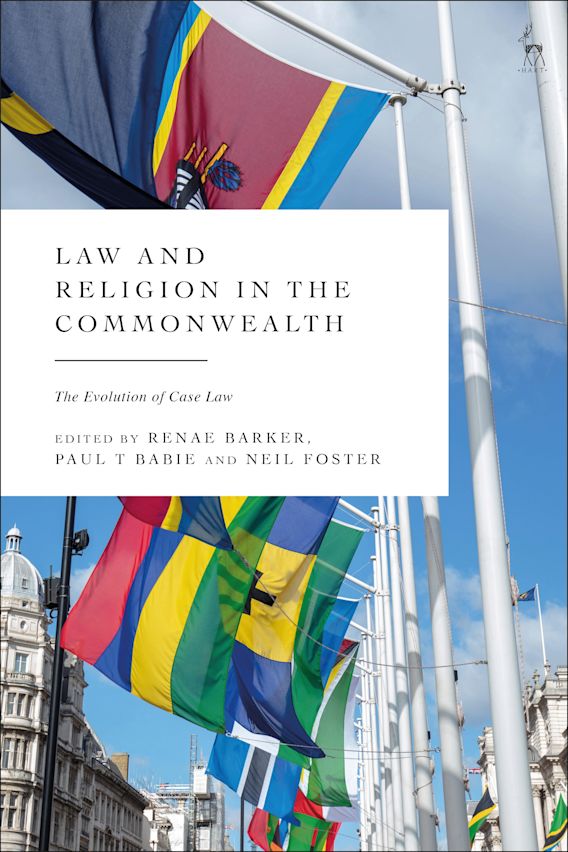
Law and Religion in the Commonwealth- paperback version

I previously posted about the publication of an edited collection of papers on Law and Religion issues around the Commonwealth, of which I am one of the editors. The book was available in hardcover and in an ebook version, but is now about to be released as a paperback in December. (The only difference is the reduced price!)

The publication date in Australia and New Zealand is 28 December 2023 and the webpage can be found here: https://www.bloomsbury.com/au/law-and-religion-in-the-commonwealth-9781509950188/

Readers of this blog can use the discount code GLR AQ7 , which entitles you to a 20% discount off a purchase of the book made on the Bloomsbury website

Just as a reminder:

Each chapter focuses on a specific case from a Commonwealth jurisdiction, examining the history and impact of the case, both within the originating jurisdiction and its wider global context.  

The book contains chapters from leading and emerging scholars from across the Commonwealth, including from the United Kingdom, Canada, Australia, Pakistan, Malaysia, India and Nigeria. 

The cases are divided into four sections covering:
– Foundational Questions in Law and Religion
– Freedom of Religion around the Commonwealth
– Religion and state relations around the Commonwealth
– Rights, Relationships and Religion around the Commonwealth.

Like religion itself, the case law covers a wide spectrum of life. This diversity is reflected in the cases covered in this book, which include: 
– Titular Roman Catholic Archbishop of Kuala Lumpur v Home Minister on the use of the Muslim name for God by non-Muslims in Malaysia
– The Church of the New Faith v Commissioner of Pay-roll Tax (Vic) which determined the meaning of religion in Australia 
– Eweida v UK which clarified the application of Article 9 of the European Convention on Human Rights 
– R v Big M Drug Mart on the individual protections of religious freedom under the Canadian Charter of Rights.  

The book examines how legal disputes involving religion are among the most contested in the courts and shows that in these cases, passions run high and the outcomes can have significant consequences for all involved.

My chapter is an analysis of the key Australian case, Christian Youth Camps Limited v Cobaw Community Health Services Limited and is sub-titled “Balancing Discrimination Rights with Religious Freedom of Organisations”.

Whose conscience deserves protection in Australia?

I am presenting a short paper at the University of Notre Dame, Sydney, Ninth Annual Religious Liberty Lecture and Conference, on February 24, 2023, as part of a panel on “The Importance of Conscience”. The paper is linked here:

Removing fences: the ALRC Consultation Paper on Religious Educational Institutions and Discrimination Laws

The Australian Law Reform Commission has now released a Consultation Paper for its current reference on “Religious Educational Institutions and Anti-Discrimination Laws”. The paper, while formally acknowledging the importance of religious freedom and parental rights, will be a serious disappointment to those involved in religious schools and colleges. It effectively recommends the removal of protections enjoyed by religious educational institutions which have been designed to safeguard the ability of these organisations to operate in accordance with their religious beliefs. The “fences” protecting these bodies from being forced to conform to majority views on sexual behaviour and identity (and hence losing their distinctiveness as religious bodies) are to be knocked down, the ALRC says. But the paper offers no convincing reasons for this wholesale demolition of a structure which has served the diversity and plurality of the Australian community for many years. Rather than supporting “Diversity, Equity and Inclusion”, the paper’s recommendations would require a compulsory uniformity which would undermine the reasons for the existence of faith-based educational institutions.

Continue reading

ALRC inquiry into Religious Educational Institutions and Anti-Discrimination Laws

The Commonwealth Attorney-General has announced that the Australian Law Reform Commission will be conducting an inquiry into the general area of “Religious Educational Institutions and Anti-Discrimination Laws”. Detailed information about the inquiry can be seen at their home page.

Readers may recall that the ALRC had previously been given a wider inquiry by the former government: the web-page notes that

The Terms of Reference replace a previous Inquiry into religious exemptions in anti-discrimination legislation that has been on hold since March 2020.

This new inquiry, while narrower in terms of being limited to religious educational institutions, comes with a number of assumptions that some may find problematic:

The Terms of Reference describe the Government’s commitments as ensuring ‘that an educational institution conducted in accordance with the doctrines, tenets, beliefs or teachings of a particular religion or creed:

  • must not discriminate against a student on the basis of sexual orientation, gender identity, marital or relationship status or pregnancy;
  • must not discriminate against a member of staff on the basis of sex, sexual orientation, gender identity, marital or relationship status or pregnancy;
  • can continue to build a community of faith by giving preference, in good faith, to persons of the same religion as the educational institution in the selection of staff’.

The Commission has indicated that it will have regard to submissions made to the previous inquiry, but that it also “will undertake further consultations”. Organisations and individuals who are interested in making submissions to the inquiry (when public submissions are called for) can “subscribe” to email updates from the ALRC here. Given that the inquiry has quite a tight timeline (it is due to report on 21 April 2023) I suspect that submissions may need to be put together fairly quickly over the Christmas/New Year period.

Update

The ALRC has now released a consultation timetable (which can be seen here) which indicates that they will be releasing a discussion paper for general comments on 27 January 2023, to which responses need to be provided by 24 February 2023.