The Queensland Civil and Administrative Tribunal, in its decision yesterday in Valkyrie and Hill v Shelton [2023] QCAT 302 (18 August 2023), has dismissed claims of vilification based on sexual orientation or gender identity, made against conservative commentator Lyle Shelton. The careful decision of Member Gordon reveals a number of uncertainties still surround the interpretation of this and other similar laws around Australia, but finds in the end that comments critical of the participation of the complainants in a “drag queen library event for children”, did not amount to the incitement of hatred towards, serious contempt for, or severe ridicule of the complainants on the ground of their sexuality or gender identity in contravention of section 124A of the Anti-Discrimination Act 1991 (Qld). There are a number of points in the decision worth noting.
On behalf of the organisers, I am happy to post (for academic, and academically inclined, readers!) a call for papers for a symposium to be held in Toowoomba, Queensland, in February 2024.
There has been a lot of controversy around the recent decision of the ACT government to compulsorily acquire Canberra’s Calvary Hospital. One question that is worth asking is this: could this move be an unlawful breach of religious freedom rights? In this post I want to consider the possibilities.
In a much anticipated decision, the US Supreme Court (by 6-3) in 303 CREATIVE LLC v. ELENIS 600 U. S. _ (2023) (30 June 2023) has ruled that a Christian graphic designer cannot be required by Colorado law to produce websites supporting and celebrating same-sex weddings, contrary to her religious beliefs. The ruling was based on the US First Amendment protection of free speech, and sets out a principle that the government cannot compel citizens to say what they object to saying, in an “expressive” business like web design, even if that business provides services to the public. It seems clearly correct, and will be helpful in protecting free speech on a range of issues, but in particular will support religious freedom. But, contrary to some comment, it is not a “license to discriminate”. The decision does not allow refusal of ordinary commercial services to same-sex attracted people. It only relates to the sort of artistic and expressive work engaged in by the designer.
The Newcastle Lawyers’ Christian fellowship is running another of our breakfast meetings for lawyers (and other interested folk!) in Newcastle, on Wednesday 14 June 2023, from 7:30-8:30 am. Our venue will once again be the Moot Court with-the-best-views-of-a-harbour (aka Room X-703) in the NuSpace Building, the University of Newcastle (corner of Hunter St and Auckland St). We are glad to welcome David Robertson back to speak about what the ancient Hebrew Book of Job can tell us about wanting God to speak in the midst of suffering.
No matter what our occupation or where we’re from, we’re all familiar with suffering. The enigmatic 3,000 year old man Job & his story of suffering must rank as one of the most gut-wrenching, eye-watering tales in the great catalogue of human misery down the centuries. Join Newcastle City Legal presenter David Robertson as he brings this ancient story to life – and shows us the surprising comfort it offers.
More information is available here, where you can also register. Cost is $5 (which includes a coffee) or $10 for pastries for breakfast.
I should also mention that I will be speaking at the upcoming City Legal National Conference in Canberra on 24-25 August, on ‘The Ethics of Freedom: Religious Freedom in the Workplace’. This Seminar is one of the 2 CPD points on offer at the Conference in the areas of Ethics & Professional Responsibility along with Practice Management & Business Skills. See Conference Brochure here. There will also be great speakers like Max Jeganathan, John Bales, Dan Anderson & Wilbur Longbottom. More details and Conference Rego are available here.
The second issue of the Australian Journal of Law and Religion is now available online here. There are a number of important issues covered. The Table of Contents gives an idea:
Editorial i
Articles
May Australian States Impose Sexual Orientation and Gender Identity Non-Discrimination Obligations on Religious Schools? A Rejoinder to Foster Nicholas Butler 1
Reconciling Freedom and Equality for Peaceful Coexistence: On the Need to Reframe the Religious Exemptions in the Sex Discrimination Act Alex Deagon 20
The Position of Religious Schools Under International Human Rights Law Mark Fowler 36
Legislating Gender Prejudice: Religion and the Overturning of Roe v Wade Rena MacLeod 56
Conversion Practices Legislation in Victoria – A Potential Crisis for Church Authority? Rhett Martin 70
Statements of Belief as Political Communication Timothy Nugent 81
Book Reviews
Law and Religion in the Commonwealth: The Evolution of Case Law edited by Renae Barker, Paul T. Babie, and Neil Foster Barry W. Bussey 90
The Transgender Issue: An Argument for Justice by Shon Faye Jeremy Patrick 93
Special Topic Forum: Religious Freedom, Sexuality, and Gender Identity
Cherry Picking Human Rights Nicholas Aroney 95
What Does Gender Identity Mean in the Sex Discrimination Act 1984? Patrick Byrne 101
The Politics of Indonesia’s New Criminal Code Robert W. Hefner 104
Of course each reader will have their own specific areas of interest. I was obviously very interested to see that one of the articles is a rejoinder to an article I had published in volume 1, dealing with the impact of differing discrimination laws applying to faith based schools (and other institutions) in Commonwealth and State laws (see Butler, from p 1.) Readers will have to make up their own minds as to whether Mr Butler’s critique of my position is valid or not. I was also pleased to see an encouraging review of the edited volume Law and Religion in the Commonwealth , of which I was a co-editor (see Bussey, from p 90).
I look forward to reading the other articles in due course! I very much commend the editors for their decision to make all the articles freely available for download.
Recently the Australian Human Rights Commission has issued a Position Paper entitled A Human Rights Act for Australia . In a previous guest post, Dr Paul Taylor provided some preliminary comments on the proposals. I am pleased to have an opportunity to provide his more recent comments.
As noted previously, Dr Taylor is an Honorary Senior Lecturer in the T.C. Beirne School of Law, a Fellow of the Centre for Public, International and Comparative Law, and an Adjunct Professor at the School of Law, The University of Notre Dame Australia. His principal academic interests are international human rights law and conflict of laws (private international law). He has held Visiting Fellowships at Wolfson College, Cambridge and at the Centre for International and Public Law, College of Law, Australian National University. He is the author of A Commentary on the International Covenant on Civil and Political Rights: The UN Human Rights’ Committee’s Monitoring of ICCPR Rights (Cambridge University Press, 2020); and Freedom of Religion: UN and European Human Rights Law and Practice (Cambridge University Press, 2005).
Dr Taylor has provided the following comments as a guest blogger. The comments are of course written in a personal capacity, and do not reflect any views of any institution to which he is or has been affiliated.
Can a bishop be held personally liable for child sexual abuse committed by a member of the clergy under their authority? The Victorian Court of Appeal has recently held that they can, in its decision in Bird v DP (a pseudonym) [2023] VSCA 66 (3 April 2023) (“the Bird appeal decision“). That decision upheld an earlier trial decision to the same effect in DP (a pseudonym) v Bird [2021] VSC 850 (22 December 2021), which I commented on previously here. In that earlier comment I suggested that there were reasons to conclude that the trial judge was wrong. In this comment I will be briefly noting why I continue to hold that view, and hence conclude that the Victorian Court of Appeal is also wrong, on the specific question of what is known as “vicarious liability”.
I want to stress that, despite my view that this decision is incorrect as a matter of Australian common law on the question of vicarious liability, I fully support churches being held liable for child abuse perpetrated by clergy who have been entrusted with the care of children. As I said in my previous post, my doubt about the decision on vicarious liability:
does not mean that I think that the organised church ought to be allowed to escape liability for harm committed by clergy to children in its care. To the contrary… I think the High Court ought to revisit another area of common law which prevents many such claims at the moment. But the decision in DP is not consistent with the course of development of the law of vicarious liability and will, in my judgment, be overturned if there is an appeal on this point
Clearly I was wrong about the appeal decision in Victoria. But I still maintain that the decision may be overturned if taken to the High Court of Australia. Below I briefly explain why.
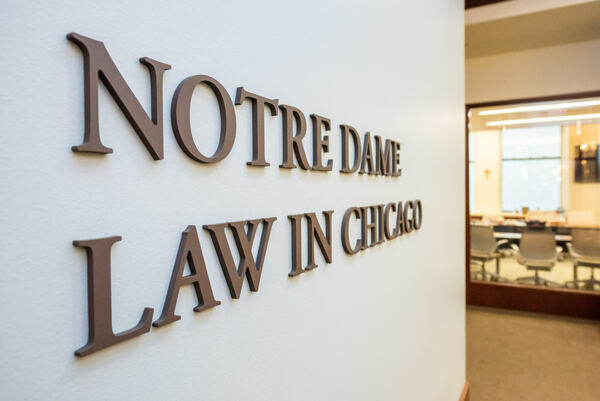
Academics who are working in the Law & Religion area may be interested in this upcoming conference at the University of Notre Dame in Chicago, especially those who are in the first decade of their academic career. I am informed that offers of papers will be considered even from those based outside the US. Here are the details:
Notre Dame Law School in Chicago
The University of Notre Dame Law School’s Religious Liberty Initiative invites junior faculty to submit abstracts of works in progress to be considered for presentation at a Law & Religion Junior Faculty Conferenceto be held at Notre Dame Law School’s Chicago Campus October 27-28, 2023.
We are looking for submissions of proposed articles that will make significant contributions in the field of law and religion. If your paper is selected, you will receive a $1,500 honorarium + travel costs, and dedicated commentary on your paper from a distinguished scholar in this field. You also commit that you will have a working draft circulated at least one month before the Conference. For more information and to submit a 500-word abstract of your proposed article by April 28th, 2023, visit our website. If you already have a working draft of your article, you may also submit that with your abstract for consideration during the selection process.
Qualifications: Submissions are limited to unpublished papers by junior faculty, meaning tenure-track law faculty who have been teaching for no more than 10 years. Aspiring scholars who have not yet obtained their first tenure-track appointments, including teaching or other fellows and visiting assistant professors, are also welcome to submit papers for consideration.
Submissions may not have been accepted for publication by a journal, and the article must remain substantively revisable (for purposes of incorporating changes resulting from conference feedback).
There is a limit of one submission per person.
Co-authored pieces will be accepted only if both authors are junior faculty members. Any honorarium awarded on the basis of a co-authored piece must be shared.
Selection: Submissions will be competitively selected by a jury of distinguished scholars in the field of law and religion.
Recently the Australian Human Rights Commission has issued a Position Paper entitled A Human Rights Act for Australia . I have often commented here on the gaps in protection for religious freedom under Australian federal law, and one suggestion that has sometimes been made is that Australia should implement internationally recognised rights such as those contained in art 18 of the International Covenant on Civil and Political Rights. But is doing this by way of a federal Human Rights Charter the right way to go?
I asked one of Australia’s leading commentators on international human rights issues, Dr Paul Taylor, to offer some preliminary comments on the proposals that have been put forward. Dr Taylor is an Honorary Senior Lecturer in the T.C. Beirne School of Law, a Fellow of the Centre for Public, International and Comparative Law, and an Adjunct Professor at the School of Law, The University of Notre Dame Australia. His principal academic interests are international human rights law and conflict of laws (private international law). He has held Visiting Fellowships at Wolfson College, Cambridge and at the Centre for International and Public Law, College of Law, Australian National University. He is the author of A Commentary on the International Covenant on Civil and Political Rights: The UN Human Rights’ Committee’s Monitoring of ICCPR Rights (Cambridge University Press, 2020); and Freedom of Religion: UN and European Human Rights Law and Practice (Cambridge University Press, 2005).
Dr Taylor has provided the following comments as a guest blogger. The comments are of course written in a personal capacity, and do not reflect any views of any institution to which he is or has been affiliated.
Professor of Law whose research interrogates the interaction between law and humanities, with particular expertise in Law and Religion and Legal History. All views my own.







 Law and Religion Australia