“Gender critical” victories in tribunal cases

Over the last month there have been three important tribunal decisions (two in the UK, one in Australia) in favour of women who had been disciplined or dismissed or sued for expressing “gender critical” views. This phrase, broadly, refers to those who believe that sex is a biological reality and that someone’s gender aligns with their sex. Allegations of “transgender vilification” or claims that someone’s views on this matter can be a ground for workplace penalties have been common over the last few years. But the three cases I want to mention here (involving social worker Rachel Meade, academic Dr Jo Phoenix, and commentator Kirralie Smith) suggest that the tide may be turning in favour of those who hold the view that biology matters.

Continue reading

“Equality” Bill threatens religious freedom in NSW

Independent MP Mr A H Greenwich last year introduced a private member’s bill called the Equality Legislation Amendment (LGBTIQA+) Bill 2023 (“the Bill”) into the NSW Parliament. It is understood that time will be allowed for debate on the Bill on February 8, 2024. Freedom for Faith has an excellent overview of the many areas covered by the Bill and why the Bill should not proceed. Most private member’s Bills are not approved, but there is a danger that some MP’s might support some of the provisions of this Bill. In this post I will focus on some of the dangers to religious freedom in NSW if the Bill were passed. (There are so many that I may not cover them all in one post, and if I can I will try to pick up those I miss here in a later post.)

In this post I will focus on the proposed amendments to the NSW Anti-Discrimination Act 1977 (“ADA”).

Continue reading

Voluntary assisted dying laws partly invalid

An important decision handed down recently in the Federal Court of Australia rules that part of Victoria’s euthanasia law (the Voluntary Assisted Dying Act 2017 (Vic)(“VADA 2017”)) is invalid, as it authorises assistance with suicide, which is prohibited by Federal law. The decision, of Abrahams J as a single judge in the Federal Court, is Carr v Attorney-General (Cth) [2023] FCA 1500 (30 November 2023). The implication is that similar provisions of other State and Territory laws are also invalid. The relevant federal law, sections 474.29A and 474.29B of the Commonwealth Criminal Code, contained in the Schedule to the Criminal Code Act 1995 (Cth), in broad terms, makes it an offence to assist or encourage someone to commit suicide through use of a “carriage service”, most commonly by use of a telephone (either a voice call or a text message), email, or some internet service.

In my opinion laws like the VADA 2017 are bad for the community. Western society has long had strong prohibitions on taking one’s own life. At the end of life when terminal illness is involved, we have developed palliative care now to the point where on the whole serious pain is not an issue. Of course decisions can be taken when death is imminent to make someone comfortable, even if this incidentally leads to a small hastening of death. But VAD 2017 and similar laws have crossed the line into a world where a person can give up on life even when serious pain and imminent death are not involved, and these laws force doctors to be takers of life, rather than healers. They also often impose serious burdens on the religious freedom of practitioners and organisations with a strong commitment to the value of life who are pressured, or sometimes forced, to take part in these procedures.

(For excellent commentary on end of life issues generally, see this page of resources from Ethicentre. In particular, see this comment from Megan Best on problems with the current assisted dying laws. For previous comment on this blog about these laws, see here and here.)

In this context it is good to see a narrowing of the operation of the laws. The effect of the decision in Carr will not be to remove all the bad features of the laws- face to face consultations and advice by post are still available. But they should give medical practitioners asked to participate in these processes serious cause to reflect as to whether they might be subject to penalties under federal law.

Continue reading

New NSW “Religious Vilification” law

An amendment to the NSW Anti-Discrimination Act 1977, making certain types of speech connected with religion unlawful, commenced operation on 12 November 2023. The amendment, made by the Anti-Discrimination Amendment (Religious Vilification) Act 2023 (No 15 of 2023) (“the ADA”), is a form of “religious vilification” law which has not previously been in force in NSW. It is not as bad as some forms of such laws in terms of its effect on religious freedom, but it is worth being aware of its potential operation. It will be important, for example, for those preaching and teaching the Bible (or other religious texts) to understand what the law does, and perhaps more importantly, does not, prohibit.

Continue reading

Two cases on sex and gender identity

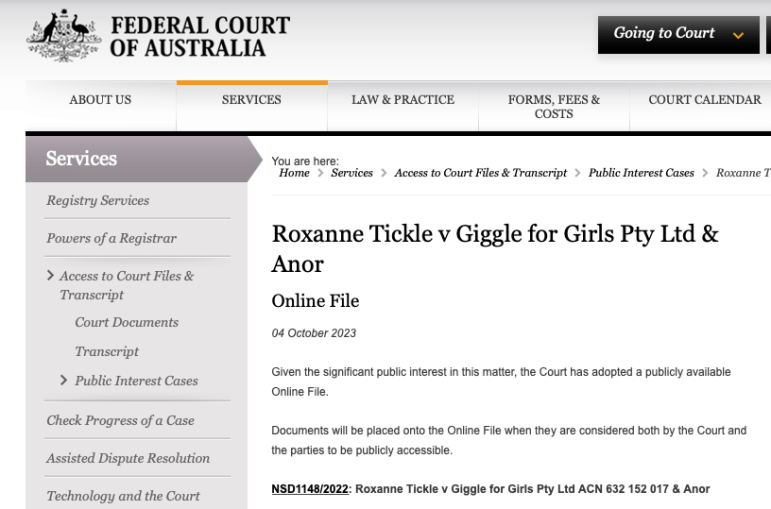
Two recent Australian cases raise important questions about sex and gender identity as legal categories. One, a decision of the highest appellate court in NSW, held that a change in sex under the law of a State does not require a change to be made in a marriage certificate issued under Commonwealth law. The other is a decision still awaiting a final hearing in the Federal Court, where the operator of a females-only only social networking site is being sued for her decision to exclude an applicant who was born biologically male but has since undergone “gender affirming surgery”. Though neither case explicitly involves anyone whose views are based on religious beliefs, both raise important issues which connect with “law and religion” interests, and are worthy of noting.

Continue reading

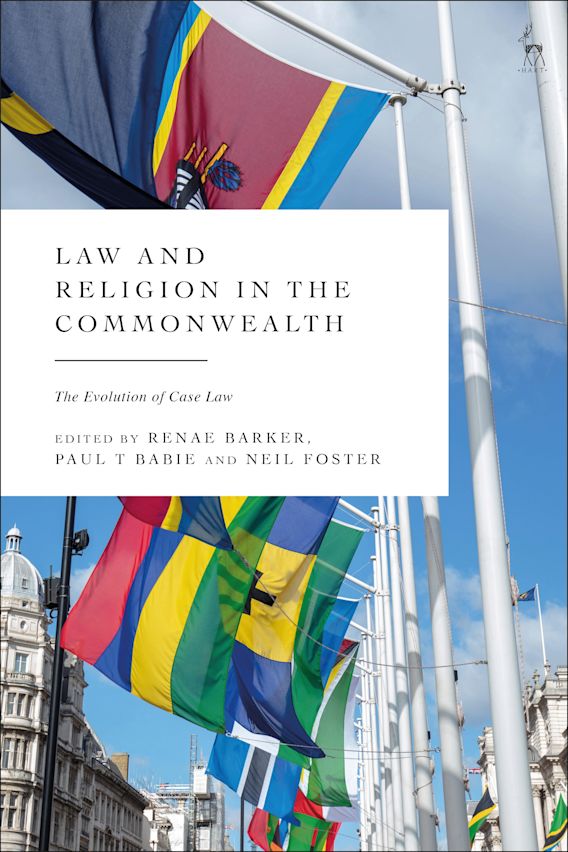
Law and Religion in the Commonwealth- paperback version

I previously posted about the publication of an edited collection of papers on Law and Religion issues around the Commonwealth, of which I am one of the editors. The book was available in hardcover and in an ebook version, but is now about to be released as a paperback in December. (The only difference is the reduced price!)

The publication date in Australia and New Zealand is 28 December 2023 and the webpage can be found here: https://www.bloomsbury.com/au/law-and-religion-in-the-commonwealth-9781509950188/

Readers of this blog can use the discount code GLR AQ7 , which entitles you to a 20% discount off a purchase of the book made on the Bloomsbury website

Just as a reminder:

Each chapter focuses on a specific case from a Commonwealth jurisdiction, examining the history and impact of the case, both within the originating jurisdiction and its wider global context.  

The book contains chapters from leading and emerging scholars from across the Commonwealth, including from the United Kingdom, Canada, Australia, Pakistan, Malaysia, India and Nigeria. 

The cases are divided into four sections covering:
– Foundational Questions in Law and Religion
– Freedom of Religion around the Commonwealth
– Religion and state relations around the Commonwealth
– Rights, Relationships and Religion around the Commonwealth.

Like religion itself, the case law covers a wide spectrum of life. This diversity is reflected in the cases covered in this book, which include: 
– Titular Roman Catholic Archbishop of Kuala Lumpur v Home Minister on the use of the Muslim name for God by non-Muslims in Malaysia
– The Church of the New Faith v Commissioner of Pay-roll Tax (Vic) which determined the meaning of religion in Australia 
– Eweida v UK which clarified the application of Article 9 of the European Convention on Human Rights 
– R v Big M Drug Mart on the individual protections of religious freedom under the Canadian Charter of Rights.  

The book examines how legal disputes involving religion are among the most contested in the courts and shows that in these cases, passions run high and the outcomes can have significant consequences for all involved.

My chapter is an analysis of the key Australian case, Christian Youth Camps Limited v Cobaw Community Health Services Limited and is sub-titled “Balancing Discrimination Rights with Religious Freedom of Organisations”.

Freedom for Faith conference- Nov 6, 2023

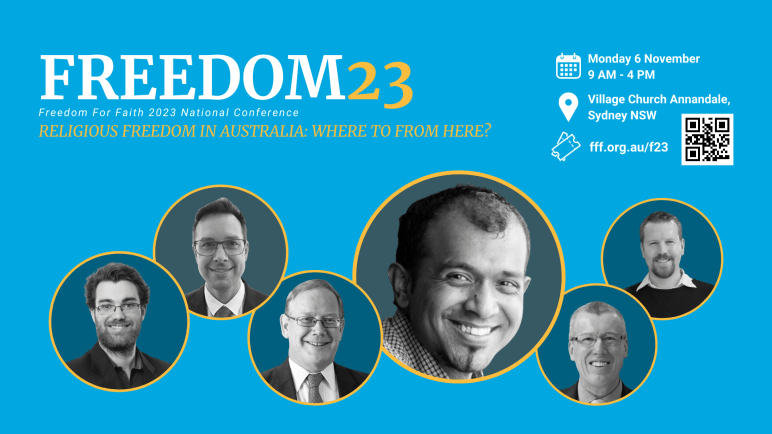
I am pleased to share details of the Freedom for Faith annual conference- this should be a great day to consider religious freedom issues in Australia. (I am on the board of Freedom for Faith, and would encourage anyone interested in this area to support the organisation as it seeks to advocate for religious freedom for all!)

Freedom for Faith invites you to its annual conference, FREEDOM23, on November 6th at Village Church Annandale (Sydney) and live streamed.

FREEDOM23 will inform you about the current threats to religious freedom and their effects on families, churches and faith organisations, equip you to be ready for what lies ahead, and to advocate for religious freedom now, and encourage you in the knowledge that together, our voices can be heard.

The day will be particularly helpful for church and other religious leaders, those working in faith organisations, and anyone concerned about threats to religious freedom.

FREEDOM23 speakers include:

  • Max Jeganathan – Senior Research Fellow at the Centre for Public Christianity (CPX), former lawyer and policy advisor.
  • Mike Southon – Executive Director of Freedom for Faith
  • Dr Alex Deagon – Associate Professor of Law, QUT
  • Nick Jensen – Political liaison for the Australian Christian Higher Education Alliance (ACHEA)
  • Peter Fowler – CEO of The Anglican Schools Corporation

For in-person and streaming tickets: https://fff.org.au/f23.

Religion and Private Law

I am presenting some brief comments on the background of private law, especially the law of torts, in the doctrines of Christianity, for a seminar organised by the law student association at my University. The paper can be downloaded here.

The Ethics of Freedom: Religious Freedom in the Workplace

I am presenting a paper at the annual City Legal conference on August 25 on The Ethics of Freedom: Religious Freedom in the Workplace. It considers issues around religious freedom of employees and also touches on issues arising for Christian lawyers in particular. It can be downloaded here.

Vilification claims based on critique of drag queens event dismissed

The Queensland Civil and Administrative Tribunal, in its decision yesterday in Valkyrie and Hill v Shelton [2023] QCAT 302 (18 August 2023), has dismissed claims of vilification based on sexual orientation or gender identity, made against conservative commentator Lyle Shelton. The careful decision of Member Gordon reveals a number of uncertainties still surround the interpretation of this and other similar laws around Australia, but finds in the end that comments critical of the participation of the complainants in a “drag queen library event for children”, did not amount to the incitement of hatred towards, serious contempt for, or severe ridicule of the complainants on the ground of their sexuality or gender identity in contravention of section 124A of the Anti-Discrimination Act 1991 (Qld). There are a number of points in the decision worth noting.

Continue reading