Academic conference on Theology and Jurisprudence, 2025- call for papers

On behalf of the organisers, I am happy to post (for academic, and academically inclined, readers!) a call for papers for a symposium to be held in Queensland in February 2025.

5th Annual Theology and Jurisprudence Symposium

School of Law,  Queensland University of Technology, Gardens Point Campus

Friday 14 February 2025

THEME:

This annual symposium focuses on the relationship between theology and jurisprudence. Jurisprudence typically purports to provide a non-theistic account of ‘law’. However, foundational to many theories of law is some kind of theology. Natural law, of course, is deeply influenced by its theological articulation through Thomas Aquinas and even modern ‘secular’ theories of natural law retain vestiges of this influence. The main proponents of legal positivism (such as Thomas Hobbes and John Austin) often engaged with different aspects of Christian theology. Moreover, theological influences on legal theory are not limited to Christianity; jurisprudential viewpoints around the world have been shaped by a broad range of theological traditions. The tendency of jurisprudence to ground itself in some kind of theology is not surprising given its need for an ontological foundation for legal authority. This symposium aims to consider jurisprudence from a variety of theological standpoints and critically examine the reliance of diverse theories of law on theological perspectives. 

CALL FOR PAPERS: 

We invite papers that consider the prevailing theological assumptions of legal theories; unpack the different streams of jurisprudence from a theological perspective; explore how theology tends to define and undergird theories of law; or consider any other issues which engage both theology and jurisprudence. Presenters are required to submit written papers (which can be works-in-progress) for distribution to the other symposium participants by 1 February 2025. Presenters will be allocated to panels, and each panellist will be asked to introduce and comment on another panellist’s paper to start the discussion. The finalised papers may be considered for publication in a special journal issue or edited book.

SUBMISSIONS:Abstracts of 100-200 words should be submitted by email to Associate Professor Alex Deagon (alex.deagon@qut.edu.au) no later than 1 November 2024. Successful applicants will be notified by the end of November. There is no conference fee for the symposium, but participants will need to fund their own transport and accommodation.

More details are to be found here:

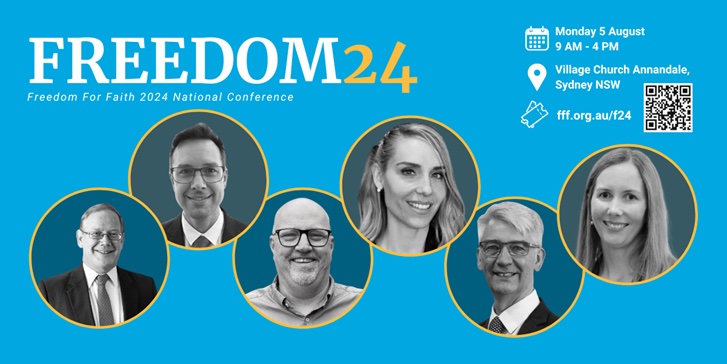
FREEDOM24 conference August 5

Freedom for Faith is hosting the FREEDOM24 Conference 9am-4pm on Monday August 5th at Village Church Annandale in Sydney. I highly recommend this conference!

Livestream tickets are free, to maximise access for those who cannot attend in person.

FREEDOM24 conference will develop your understanding of threats to religious freedom in Australia from historical, theological and policy perspectives.

Historian Sarah Irving-Stonebraker will examine the history of religious freedom, while John McClean of Christ College will share a theological perspective on how the church is to respond to legal threats to ministry. We will also have a number of experts unpack the major religious freedom concerns in Australia, as well as implications and paths forward for advocacy.

Issues examined will include:

  • Federal Religious Discrimination Bill
  • Faith-based schools and the Sex Discrimination Act
  • NSW Conversion Practices Act
  • NSW “Equality” Bill
  • Queensland Anti-Discrimination and “Respect at Work” Bill

Get tickets at fff.org.au/f24.

Hate Speech – Vilification Laws and Threats to Religious Speech

I have presented a paper today surveying Australia laws on “hate speech” and “vilification”, as they have an impact on religious free speech. The paper can be downloaded here:

Australian Journal of Law and Religion vol 4- Theology and Jurisprudence

It is good to see the online publication of Volume 4 of the Australian Journal of Law and Religion. This is a special issue on “Theology and Jurisprudence”.  The table of contents:

Volume 4, 2024  

The Catholic Modernity of Pope Benedict XVI: Healthy Secularity and Christian Jurisprudence Zachary R. Calo

Natural Law with and without God Jonathan Crowe 17 

Christian Natural Law and a Foundation for Religious Freedom: Love, the True, and the Good Alex Deagon 34 

The Secularisation of Conscience: A Natural Law Critique  Constance Youngwon Lee 57 

Kierkegaard’s Works of Love: From Benedict’s Rule to More’s Utopia  Joshua Neoh 75 

Corporations, Compelled Speech, and the Common Good  Lukas Opacic 84 

Christianity and Law in the Enlightenment  John Witte Jr. with Harold J. Berman 101 

All articles can be downloaded for free from: https://ausjlr.com/issue-archive/  

Church liability for clergy abuse

The High Court of Australia recently heard an appeal in a case involving an allegation that a Bishop in the Roman Catholic church can be held vicariously liable for an act of child abuse committed by a member of the clergy. The case is Bird v DP (a pseudonym) and I have previously mentioned the earlier stages of the proceedings here and here.

I have written a note outlining the arguments being made and offering my view on what I think should be the outcome of the appeal, which can be downloaded here. Here is the summary of the note:

In Bird v DP (A Pseudonym) the High Court will address two important questions about the civil liability of institutions for child sexual abuse perpetrated by representatives of the institution. The case involves a claim against the Roman Catholic Bishop of Ballarat as liable for child abuse committed in 1971 by Father Coffey, a priest working for the diocese. The trial judge and the Victorian Court of Appeal have ruled that while Coffey was not an employee, the diocese is nevertheless vicariously liable for the abuse. This involves an extension of the ‘stage 1’ issue of vicarious liability (the question as to which legal relationships allow attribution ofliability) which is being challenged in the appeal. The High Court has also been asked in a notice of contention to consider whether, if the Court of Appeal was wrong on the vicarious liability issue, liability might alternatively be sheeted home to the diocese under the principle of non-delegable duty (NDD). This would require the High Court to overturn its previous decision in NSW v Lepore on the point that the NDD doctrine cannot be applied to intentional torts. This article argues that the appeal should be allowed, the notice of contention upheld, and Lepore be overruled on this issue.

Religious Freedom and the NSW Conversion Practices Ban Act 2024

I have prepared a paper exploring the operation of the NSW Conversion Practices Ban Act 2024 in relation to the freedom of churches and other religious groups to continue to provide teaching and guidance based on the tenets of their faith. The Act has received assent but will not commence operation until 3 April 2025.

Overall, the Act contains much better protections for religious freedom and the welfare of vulnerable children and young people than similar legislation elsewhere. But there are some areas where it is not clear, and it will require careful consideration by religious groups, as well those interested in so-called “gender transition” issues even from a non-religious background.

The paper can be downloaded here:

Challenges to Religious Freedom: Conversion Practices law passed, ALRC report released

A brief update on two significant challenges to religious freedom which have emerged over the last few days.

First, in NSW, the Conversion Practices Ban Bill 2024 has been rushed through both Houses of Parliament, receiving final approval on Friday March 22 after an all-night debate in the Legislative Council, and is now awaiting the Royal Assent. I posted about this Bill recently. There I said:

Legislation of this sort has been introduced in other jurisdictions around Australia and elsewhere. The aim of banning oppressive and violent practices designed to “convert” someone’s sexual orientation from homosexual to heterosexual is good, of course. But those practices, while they may have existed some time ago, are really no longer around. The problem with these laws now is that their drafting can be so broad that they interfere with the ordinary teaching of religious doctrines and life within families. These laws are also often premised on the assumption that “gender transition” is a good thing which should be freely available to children, whether or not with parental permission. They raise important issues of concern to all those interested in the welfare of children, whether or not from a religious perspective.

In that more detailed post I outlined the problems with the Bill. I noted that it is at least better than some others which have passed, especially the bad Victorian law. But none of the suggested amendments put forward by faith groups and the Opposition and other members were accepted by the government, which had the numbers with the Greens to push it through unchanged.

So churches and other religious groups will need to consider carefully where the line can be drawn between counselling which urges someone to live in accordance with God’s will (by not engaging in sex outside a man/woman marriage, or by living in line with one’s biological reality), and counselling which “suppresses” a person’s “sexual orientation” or “gender identity”. The Bill (soon to be an Act) will also put a thumb on the scales of advice to those wrestling with gender confusion, in favour of “affirming” treatment, when the scientific evidence is becoming increasingly clear that for young people, puberty blockers and other such treatments are not shown to be of help, and lead to massive bodily change which can usually not be reversed.

The Act, once given assent, is due to come into operation in one year.

The second concerning development is that on Wednesday 21 March the Australian Law Reform Commission released its report Maximising the Realisation of Human Rights: Religious Educational Institutions and Anti-Discrimination Laws (ALRC Report 142). Far from “maximising” human rights, the report (as expected by those who spoke to some of its researchers) would have the effect, if adopted, of seriously impairing the operation of faith-based schools around Australia. In brief, it recommends removal of all of “balancing clauses” in the federal Sex Discrimination Act 1984 which currently recognise the need to balance the religious freedom of faith-based schools with rights of teachers and students not to be detrimentally treated on the basis of sexual activity or “gender identity”. In particular, this would remove (among other provisions) section 38 of that Act, which allows faith schools to operate in accordance with their religious ethos when making staffing and educational decisions.

The Prime Minister has noted that the government has not made a decision to formally accept these recommendations. He has indicated, however, that since the report was made available to the government in December, two draft pieces of legislation have been prepared (though not made publicly available). He has indicated he would like bi-partisan support from the federal Opposition. It has to be said that views on these issues seem so strongly held that this seems unlikely. But it will all depend on the wording of any proposed laws.

Australia needs to decide if it wants to offer parents the option of having their children educated in faith-based schools, or not. Many parents have signalled they want this option, by sending their children to such schools. But if those schools find that their very reason for existence, operating in accordance with a religious world-view, is taken away, it seems likely that many will decide it is not worth continuing operations. The federal government needs to listen very carefully to all sides of this debate.

More issues with the Queensland Anti-Discrimination Bill 2024

I am happy to present a guest post today from Associate Professor Mark Fowler, raising more issues of concern from a religious freedom perspective with the recently released proposed Anti-Discrimination Bill 2024 . Dr Mark Fowler is Principal, Fowler Charity Law, Adjunct Associate Professor, University of Notre Dame, School of Law, Sydney and an External Fellow at the Centre for Public, International and Comparative Law, University of Queensland.

The concerns can be broadly grouped as follows:

  1. The Bill’s exception for employment by religious institutions would enact the most restrictive regime in Australia;
  2. The Bill will require religious institutions to provide services against their religious beliefs;
  3. The imposed ‘duty to eliminate discrimination’ will require religious institutions to proactively engage in activities that do not conform to their religious beliefs; and
  4. The Bill fails to protect religious individuals from discrimination when they engage in collaborative effort with fellow believers. 

Continue reading

NSW Conversion Practices Bill- risks to religious freedom

The NSW government has introduced a Conversion Practices Ban Bill 2024 into the Parliament, with the apparent aim of moving it through very quickly. Legislation of this sort has been introduced in other jurisdictions around Australia and elsewhere. The aim of banning oppressive and violent practices designed to “convert” someone’s sexual orientation from homosexual to heterosexual is good, of course. But those practices, while they may have existed some time ago, are really no longer around. The problem with these laws now is that their drafting can be so broad that they interfere with the ordinary teaching of religious doctrines and life within families. These laws are also often premised on the assumption that “gender transition” is a good thing which should be freely available to children, whether or not with parental permission. They raise important issues of concern to all those interested in the welfare of children, whether or not from a religious perspective.

But laws of this sort can in particular have significant implications for religious freedom. I have previously provided a detailed analysis of the Victorian legislation on this topic, noting the serious problems that law has created. The good news in NSW is that the government does seem to have listened to some of the concerns about the law raised by religious leaders and other concerned citizens. The Bill is certainly an improvement on the Victorian model. But there are a number of areas where it could be clearer in protecting important rights of all members of the community, to speak and act freely in accordance with their convictions and biological reality.

Continue reading

Queensland – new proposed discrimination law

The Queensland government has released a draft of a proposed new discrimination law for public comment. The proposed Anti-Discrimination Bill 2024 will make some radical changes to Queensland law, and of interest here is that it will seriously impact religious freedom in that State. One of the ways that religious freedom is protected in Australia is through the inclusion in discrimination laws of “balancing clauses” (provisions that balance the right not to be discriminated against, with the important right of religious freedom). But the new Bill will dramatically narrow those clauses.

I am pleased to present a guest blog post commenting on some religious freedom impacts of the draft Bill, from Dr Alex Deagon, an Associate Professor in the School of Law at QUT, and an internationally recognised researcher in religious freedom.

Continue reading