“Hate speech” and religious freedom- recent developments in Australia

Recently there have been a number of legislative moves or proposals attempting to deal with issues around the area of “hate speech”. The term of course is problematic- we will try to unpack it shortly. But the context, in Australia at least, is the shocking rise in the number of anti-semitic slogans and actual violence being seen in the last few months. Insults have been daubed on buildings and cars, fires lit at buildings associated with the Jewish community. And more recently, we have the shocking spectacle of two nurses from Bankstown Hospital saying on a video which has gone all over the world, that they would either like to kill their Israeli patients, or have already done so!

Part of the response of governments, at the Federal and State level, has been to either enact or propose laws punishing “hate speech”. The term itself is ambiguous. Does it mean speech “motivated” by hate? Or speech expressing hate? Or speech encouraging others to hate? I think we can all agree that, at one end of a spectrum, speech urging commission of violence against others should be unlawful. But what about expressing disagreement with moral choices made about sexual activity? Such speech might not be motivated by hate, but by concern for the bad effects of the behaviour, including contravening of divine law. Yet it might be perceived to be “hateful” by some who hear it.

It is regularly asserted that religiously based violence is somehow connected to speech insulting people on the basis of their religion. Yet some scholars note that there is little evidence produced that this is actually the case- that there is in truth no clear causal connection between speech of this sort and the issuing of threats or perpetration of violence.

Still, let’s concede that such is possible. It may be that regular assertions about how terrible people from a certain religious background are, will “normalise” the idea that threats and violence are appropriate responses. But will laws against such speech actually reduce the threats and violence? Or will they simply result in the speech being hidden from the community before it erupts in the actual acts?

The other problem with hate speech laws, of course, is that there is a serious danger that punishing speech on religious topics will unduly impair free speech on such topics generally. In the rest of this post I want to mention three recent Australian legislative initiatives on “hate speech” and note their possible impact on religious freedom. One is a new provision of Federal law which has already commenced. Second, I will be noting some changes that have been enacted and may commence soon under NSW law. Finally, I will briefly note some concerning legislation currently before the Victorian Parliament.

Before I do so, though, let me be very clear. The right to religious freedom cannot include the right to advocate for physical violence against other members of the community, nor of course a right to actual commit such violence or issue threats of such violence. Note that I have added the word “physical” here to be clear about the sort of “violence” I am referring to. The word “violence” should not be extended in metaphorical directions to refer to “criticising someone’s moral choices” or “upsetting someone”. These matters are not appropriately dealt with by the law. But no community can tolerate physical violence or threats against other members of the community justified by religious beliefs. As we will see, some recent laws are generally in the appropriate area of preventing actual violence; others are more problematic.

Continue reading

Religious faith, medical procedures and minors- H v AC

One of the most difficult areas to navigate in the intersection between law and religion is the dilemma that is faced by a court when asked to adjudicate on differing opinions about medical treatment of young people, when objections to medical treatment are based on religious views. This is an area where a court, when asked to adjudicate, will have to weigh up different interests of the minor- bodily health, and being able to make decisions in accordance wth their faith.

Many such cases have arisen in based on objections to blood transfusions by Jehovah’s Witnesses. But in this post I want to note a careful decision on the issues which was handed down early last year, where the young person involved was from a “mainstream” Protestant church, and was strongly of the view that they had been healed miraculously and that no further treatment was needed. The decision was that of Meek J in the NSW Supreme Court in H v AC [2024] NSWSC 40 (2 February 2024). An important part of the case is that his Honour clearly understood and explained the religious views of the young person, “AC”, in coming to his decision.

Continue reading

Latest Issue of Australian Journal of Law and Religion; my “surrejoinder” on s 109

I’m very pleased to note that the latest online issue of the Australian Journal of Law and Religion (2024, vol 5) has just become available (free to download) here. The issue contains a number of really interesting articles I am looking forward to reading- I will list the Table of Contents below. (Of course it goes without saying that I might not agree with everything said by the other authors, nor they with my views- but that is what a robust academic debate is about!)

But I hope I will be forgiven for highlighting two articles of particular interest to me. One is a book review by Jacob Carson, who is a current undergraduate law student at the University where I have the privilege to work. The other is an article that I have written, which is labelled a “surrejoinder” : “Religious Freedom, the Sex Discrimination Act, and Section 109: A Surrejoinder to Butler“. This somewhat unusual word is used when something is published as part of an ongoing academic debate.

I published an article in volume 1 of the AJLR arguing that, where Commonwealth laws provide a more generous regime for religious bodies accused of sex discrimination, than that provided by States and Territories, that the effect of s 109 of the Constitution is that the Commonwealth law will prevail over the other laws.

 In volume 2 of the journal, Nicholas Butler provided a rejoinder to my article, arguing that I was wrong to suggest that the effect of s 109 of the Constitution would be that such State laws would be inoperative. In this volume I continue the debate with my “surrejoinder”, and maintain that my earlier arguments were correct. This issue continues to be significant, as increasingly laws enacted by States and Territories make it harder for faith-based organisations and educational institutions to operate in accordance with their faith commitments. In those circumstances, while the Commonwealth laws provide a reasonable balance between rights of religious freedom and rights not to be discriminated against, such bodies should, I argue, be able to rely on the protections provided by Commonwealth law.

I commend the debate to those interested. The other articles in this volume are noted below; it is good to see in particular articles published as part of a co-operative venture with a key US website which comments on religious freedom issues, “Canopy Forum”. All of the articles are available here, either as a single download of the whole issue or separately.

Alex Deagon and Jeremy Patrick, Editorial (pp. i-ii)

Articles

Brady Earley, Religious Exemptions in Ancient China (pp. 1-13)

Rosemary Teele Langford and Malcolm Anderson, Religious Charities in Australia: Implications for Governance Under Traditional Values and Outlooks (pp. 24-39) 

Joseph Lee, Religious Institutions and Personal Injury Compensation Claims for Abuse: The Noteworthy Significance of Insurance (pp. 40-61) 

Interviews

Hon. Michael Kirby, AC CMG, An Interview on Faith and Sexuality with Michael Kirby (pp. 62-70) 

Book Reviews

Michael F Bird, Religious Freedom in a Secular Age: A Christian Case for Liberty, Equality, and Secular Government (Review by Jacob Carson) (pp. 71-73) 

John Witte, Jr. and Rafael Domingo (eds.), The Oxford Handbook of Christianity and Law(Review by Alex Deagon) (pp. 74-75) 

Robert F. Cochran Jr., The Servant Lawyer: Facing the Challenges of Everyday Faith in Christian Law Practice (Review by Benjamin B Saunders) (pp. 76-78) 

Special Topic Forum: The Rise of the Nones (co-published with Canopy Forum)

Rhys Gower and Adam Possamai, The 2021 Australian “Mark ‘No Religion’” Campaign (pp. 79-82) 

Anna Halafoff, Andrew Singleton, and Elenie Poulos, Querying “No Religion”: State, Society, and Spirituality in Australia (pp. 83-88) 

Jeremy Patrick, A Brief Rejoinder to Movsesian on ‘The New Thoreaus’ (pp. 89-91)

Jesse M. Smith and Ryan T. Cragun, The Push Away from Religion and the Pull Toward Secularity: The Rise of the Nones in the United States (pp. 92-96)

The new Federal privacy tort and religious freedom

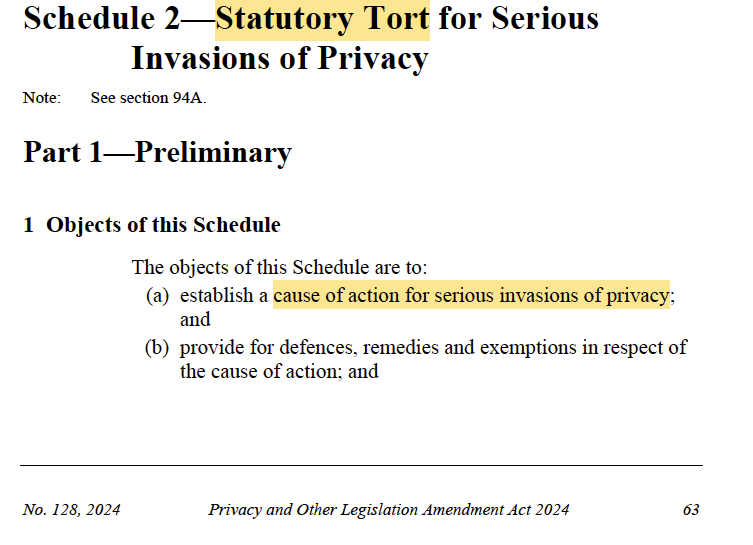
In the closing Parliamentary days of 2024, the Australian Federal Parliament created a new statutory privacy tort action, which may have a significant impact on churches and other religious groups. In the context of a possible disciplinary action against someone who has behaved contrary to the principles of a religious group to which they belong, it may be necessary to inform other members of the group about the person’s behaviour. In doing so the group will be in danger of breaching a right of privacy set up by the new law. The tort action (which will probably come into operation on 11 June 2025) seems to cut across important rights of religious freedom, and the exemptions under the law do not take this into account.

In this post I aim to outline some aspects of the operation of the new law, and recommend that before it commences Parliament provide specific recognition of religious freedom as an exemption to the availability of the action. In this discussion I will specifically refer to the impact on Christian churches, but my comments will in most cases be also applicable to other religious traditions and to other organisations operating with a religious ethos.

Continue reading

Law and Religion essay competition

The University of Southern Queensland has established an essay competition in law and religion open to students in any Australian law program (see here for more details).  There are cash prizes and the winner’s essay will be published in the Australian Journal of Law and Religion. This is a great opportunity and I encourage anyone who is studying law, and interested in this area, to have a go! (Deadline is 1 June 2025.) Do pass this on if you know law students who might be interested. 

Bishop not vicariously liable for abuse by clergy

The High Court of Australia has handed down a significant decision on the law of “vicarious liability”, ruling that a church body is not automatically liable for sexual assault carried out by priests or ministers, where those persons are not employed by the church. In Bird v DP (a pseudonym) [2024] HCA 41 (13 November 2024) the court ruled (by 6-1 majority) that the doctrine of vicarious liability should not be extended to apply to relationships “akin to employment”. In doing so it upheld an appeal against the decision of the Victorian Court of Appeal that the Roman Catholic Bishop of Ballarat (and the diocese) should be held to be vicariously liable for historic acts of child abuse committed by one Coffey, who at the time was an assistant priest in the diocese. It was accepted at all times that a priest is not an employee of the bishop or diocese. (For reasons why this is correct, see my previous post on employment status of clergy).

While I think this decision on vicarious liability is the correct application of the law of Australia, I want to stress that this does not mean I think churches should not be able to be held civilly liable for abuse committed by clergy. I have argued that an alternative doctrine, known as “non-delegable duty” (NDD), should apply even in cases of intentional sexual abuse, where a church has accepted the care of children and young people into its activities. However, NDD was not argued at the initial stages of this litigation, and the High Court held in Bird that they would defer until another day a ruling on whether NDD can apply in cases of intentional wrongdoing.

Continue reading

The Calculus of Christianity

Applying the “calculus” of negligence spelled out in Wyong Shire Council v Shirt (1980) 146 CLR 40, this paper aims to show that the reasonable person will carefully investigate the claims of Jesus Christ:

The Calculus of Christianity- breakfast seminar Oct 30

For those who are in or can make it to Newcastle, I am speaking at a breakfast seminar on Wednesday Oct 30 (7:30-8:30 am) in the Newcastle CBD (Nuspace, the Uni city campus) x703. The topic is “The Calculus of Christianity”! Here is what it is about:

Both professionally and personally, we are constantly making calculations around risk. What would happen if we were to extend those calculations to the claims of Jesus Christ? Join us at our next Newcastle City Legal as Torts Lecturer Assoc. Prof. Neil Foster uses Wyong Shire Council v Shirt to do just that.

What would a “reasonable person” (for local purposes, the user of the Newcastle Light Rail!) make of the claims of Jesus, and how should they respond?

Registrations here. All welcome, but would be especially good to see local lawyers and anyone else interested in the law!

Christian sexual ethics and the abuse of adolescents: Lessons from the Anglican Diocese of Newcastle

I encourage everyone interested in law and religion issues to read this challenging piece published on the Australian Broadcasting Commission website from Emeritus Professor Patrick Parkinson: “Christian sexual ethics and the abuse of adolescents: Lessons from the Anglican Diocese of Newcastle” (24 September 2024). Professor Parkinson provides some comments on the excellent recent review of the horrific child abuse perpetrated by some clerics in Newcastle published by Anne Manne, Crimes of the Cross (Black Inc, 2024). Both the article and the book itself are crucial reading for church leaders, who need to be aware of the terrible things done under cover of the Christian faith.

An important insight that Professor Parkinson brings is that the gradual departure of some in the church from Biblical standards of sexual morality has been one of the factors contributing both to the abuse of children but also to the unwillingness of those in the church to take action to prevent it. He comments:

I suspect that the abandonment of traditional Christian sexual ethics without a theologically informed replacement created an environment where the sexual abuse of adolescents became more likely in Newcastle; and this remains a continuing vulnerability for churches that depart from traditional Christian sexual ethics or that allow this to occur in a subterranean way. 

I commend the article, and Ms Manne’s book, as important reading.

Tickle v Giggle: Sex and Gender Identity

In his decision in Tickle v Giggle for Girls Pty Ltd (No 2) [2024] FCA 960 (23 August 2024) Bromwich J in the Federal Court of Australia found that the company Giggle had been guilty of indirect gender identity discrimination when its director, Sall Grover (who was also sued), had removed Roxy Tickle from her women-only social media app. Roxanne Tickle (“the applicant”), as Bromwich J noted:

was of the male sex at the time of birth, but is now recognised by an official updated Queensland birth certificate, issued under the Births, Deaths and Marriages Registration Act 2003 (Qld) (Qld BDM Registration Act), as being of the female sex.  This followed from, and was predicated on, sexual reassignment surgery, being the term used in the Qld BDM Registration Act.. (at [3])

I commented on earlier stages of this litigation in a previous post. The question as to whether sex as a legal category is changeable, and the implications of this for discrimination law, are of great concern to many concerned with protection of traditional female-only spaces. It is a question which raises concerns for religious folk, many of whom see sex as a biological category determined at conception and ordained by God. Hence a review of the decision seems justified on this blog concerned with law and religion, although I note that none of the participants in the case professed any religious reasons for their views. The view that sex is determined by fundamental biological facts is shared by many, on both religious and scientific grounds.

In short, I think this decision is incorrect as a matter of law, and the implications of the decision are bad for society as a whole, and women in particular. I hope it will be overturned on appeal.

Continue reading